
Alea Is the Great Equalizer: How Chance Makes a Table Feel Just
Pure skill quietly enforces the room's real hierarchy. Chance suspends it, and that suspension is why a card table can feel fair across age, status, and ability.
Watch a family play a game of pure skill long enough and you'll see who was always going to win. The strongest player wins, then wins again, and the seven-year-old learns that the table is just the living room with a scoreboard. The adult who reads situations fastest at work reads the board fastest here too. Skill games are honest, but at a family table their honesty is a problem: they reproduce, in miniature, the exact pecking order everyone came to the table to step out of for an hour.
Chance does something different. It opens a gap between deserving and getting, and into that gap walks the grandparent, the kid, and the ringer, each with a live shot at the same hand. That gap is not a flaw in the game. For a mixed table, it may be the whole point.
Caillois named it: alea is its own kind of play
The French sociologist Roger Caillois, in Man, Play and Games (1958), argued that play isn't one thing. He sorted it into four drives. Agôn is competition, the contest of matched skill, like chess or tennis. Alea is its opposite: games of chance, where the player surrenders to fate rather than imposing will on it. (Mimicry, make-believe, and ilinx, the pursuit of vertigo, round out the four.)
What makes Caillois useful here is that he saw agôn and alea as mirror images answering the same human need from opposite directions. Agôn says: let the better player prove it under fair conditions. Alea says: strip away every advantage, mine and yours alike, and let the verdict come from somewhere neither of us controls. In a contest of skill, you want to be unequal, because you want your training to count. In a game of chance, Caillois noted, the player deliberately gives up that leverage. Everyone at the table is reduced to the same posture, waiting on the deal.
That reduction is the equalizing act. The expert can't out-prepare a shuffle. The child isn't behind on reps. For the length of a hand, the usual ledger of who-is-better-at-what is set aside, and the only thing that moves is luck, which has no memory of your résumé.
Most real card games, of course, blend the two. Poker, gin, and hearts hand you a random deal and then ask you to play it well. That blend is exactly why they travel so well across a mixed table. The deal gives everyone a fresh, uncorrelated starting point; the skill layer gives the stronger player something to do with it. Nobody is locked out, and nobody is bored. Caillois' two drives aren't fighting. They're sharing the table.
Why fairness has to feel impartial as well as be impartial
Chance only equalizes if it is chance. A deal that secretly favors someone, through a clumped, unrandomized deck or a sloppy shuffle that leaves last hand's tricks sitting together, smuggles the hierarchy back in. The form looks fair. The substance isn't. And people feel the difference even when they can't name it.
This is where the sociologist Georg Simmel is clarifying. Simmel wrote about sociability as a distinct social form, where people interact as equals for the sake of the interaction itself rather than for any outside gain. Its defining move, he observed, is that participants set aside their real-world weight, their wealth and rank and reputation, and meet on terms the situation invents. The rules of a sociable gathering, in his account, work precisely by enforcing an artificial equality among people who are unequal outside it. A good game is one of those forms. Simmel never wrote about a card shuffle; that step is ours. Its rules, including the rule that the deal is blind to who you are, are what let an attorney and a third-grader sit down as genuine opponents. Break the impartiality of the deal and you haven't just bent a rule. You've punctured the equality the whole gathering was built on.
So the shuffle is not a throat-clearing ritual before the real game. It is the mechanism that makes the equality real instead of merely declared. Whether anyone could reasonably suspect the deal is the difference between a table that feels just and one that feels rigged.
How much shuffling is enough
Here intuition fails most of us, which is why the math is worth knowing. The mathematicians Dave Bayer and Persi Diaconis studied ordinary riffle shuffling, the interleaving of two halves, and asked how many it takes to mix a 52-card deck. Their 1992 result is famous for a reason: the deck doesn't get gradually more random with each shuffle. It stays clearly ordered, then crosses a threshold and becomes well-mixed suddenly. They put that cutoff at about seven riffles. Below it, real structure from the previous hand survives, the kind a sharp player can read or simply benefit from. Around seven, the deck is near-random and the memory of the last deal is gone.
They put that cutoff at about seven riffles.
The practical lesson is humbling: the careful two or three shuffles most of us do by hand fall short of the cutoff. We think we've randomized. We've mostly rearranged. And the residual order is, by definition, an advantage that doesn't belong to anyone by merit.
Craft matters here, in the shuffle itself. A shuffle that reliably crosses the randomness threshold is doing the justice work the table can't do for itself by feel. The Lotus does one true riffle per touch. Run it three times for a game night, about seven when you want the deck near-random, and nobody at the table starts a half-step ahead. Speed was never the point. A clean, blind deal is a small act of fairness, repeated, and fairness is what lets people stop competing for status and start enjoying each other.
Luck doesn't ruin a game. Handled honestly, it's the thing that makes the game fair enough to be worth playing together.
Sources
- Roger Caillois, Man, Play and Games (Les Jeux et les Hommes), 1958.
- Georg Simmel, "The Sociology of Sociability," 1910 (collected in his work on social forms).
- Dave Bayer and Persi Diaconis, "Trailing the Dovetail Shuffle to Its Lair," Annals of Applied Probability, 1992.
A deal that's blind to who you are is the whole equalizer, and the Lotus exists to keep it that way: one true riffle per touch, about seven to near-random, favoring no one.
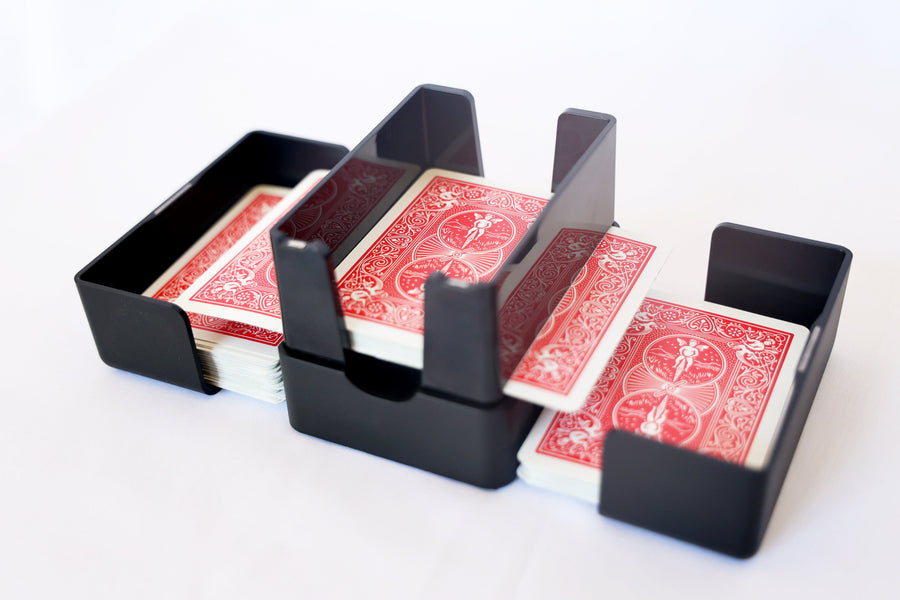
Product photo shows the original Lotus V1.
The one these guides keep pointing to
Lotus Card Shuffler V2
The Tabletop Family rated the Lotus V2 24/25, their Best Overall among the 8 distinct models they bench-tested from 13 shufflers. Lotus supplied its review units.
$89.00 Free US shipping
Order Now