
Design the Table, Not the Evening: A Friction Audit for Connection
The threat to a good game night isn't a bad game. It's the small interruptions that keep everyone looking down instead of looking up.
You can't design a good evening. You can't script the moment your brother-in-law finally tells the story he's been holding back, or the second your kid notices you're paying attention. Those moments arrive on their own schedule, or not at all. What you can design is the table they happen at, and the single biggest variable is how often attention gets pulled away from the people and back onto the logistics.
John Gottman, who spent decades watching couples in his research lab, found that connection isn't built in big gestures. It's built in what he calls "bids," small attempts to turn toward another person. A glance, a comment, a question tossed across the table. The other person can turn toward the bid, turn away, or turn against it. In his research, couples who stayed together turned toward each other's bids most of the time; the ones who later divorced turned toward them far less often. The bids themselves are tiny. They're also constant, and easy to miss.
In his research, couples who stayed together turned toward each other's bids most of the time; the ones who later divorced turned toward them far less often.
The problem for a host is that a bid only lands if someone is available to catch it. And availability is exactly what friction destroys. Every time the table stalls to relearn a rule, reshuffle a clumped deck, or argue about who deals, attention leaves the people and goes to the machinery of the game. The bid sails past unanswered. Nobody decided to ignore anyone. The room was just busy.
So the real craft of hosting isn't planning the evening. It's auditing the table for the friction points that keep everyone's eyes down, and removing them one at a time.
What friction costs
Mihaly Csikszentmihalyi, who studied optimal experience for most of his career, described flow as the state where attention is fully absorbed and self-consciousness drops away. Flow depends on a few conditions, and one of them is unbroken concentration. The moment the activity stalls, with a missing piece, a forgotten rule, a fumbled setup, attention snaps back to the self and the spell breaks. A group can find a shared version of this absorption, but it's fragile. It builds slowly and collapses fast.
Game-night friction is a collection of these collapses. None is large on its own. Stacked across two hours, they're the difference between a table that hums and a table that keeps having to restart itself.
The friction is also unevenly distributed, which is the part hosts miss. The person setting up the next round, hunting for the rule, or shuffling a stubborn deck is doing cognitive work while the conversation moves on without them. They're the least available to catch a bid precisely when the lull invites one. Fix the friction and you don't just smooth the evening. You give the busiest person at the table their attention back.
The audit: name every interruption
Walk through a typical night and mark each point where the table stops being together and starts being busy. Most fall into a handful of buckets.
- Setup and teardown. Boxes that need sorting, pieces that need counting, a board that takes ten minutes to lay out. Choose games that open fast, or do the heavy setup before guests arrive so the first round starts the moment people sit down.
- Rules disputes. The single most reliable flow-killer. Keep a reference within reach, appoint one person as rules-arbiter for the night, and agree in advance to play a contested call quickly and settle it after. The goal is to keep moving, not to be right.
- The deal and the shuffle. Whose turn is it to deal? Did anyone shuffle well, or is the deck still clumped from last hand? This is the most repeated interruption in a card game. It happens every single round, and a poor shuffle compounds, leaving cards in runs that make the game less fair and more contested. Standardize the deal, and make the shuffle a non-event.
- Phones. The friction you import. A basket by the door, or simply a shared agreement, does more for presence than any game choice. Gottman's bids can't land on someone who's looking at a screen.
- Snacks and refills. Set them out before you start. A host who keeps popping up to the kitchen is a host who keeps leaving the table.
You won't remove every interruption, and you shouldn't try. Some friction is the game: the tension of a close hand, the negotiation of a trade. That kind pulls people in. The friction worth auditing out is the administrative kind, the stalls that serve nothing and ask nothing of anyone except patience.
The table as a third place
Ray Oldenburg, in The Great Good Place, argued that people need a "third place" beyond home and work, somewhere informal and welcoming where the regulars gather and conversation is the main event. He was writing about cafés, pubs, and barbershops, but his criteria translate cleanly to a well-run game table: a low barrier to entry, a leveling effect where status falls away, and conversation as the point. A game night designed for presence is a third place you build at home.
Oldenburg's third places work because nothing about them is effortful. You don't prepare to go; you just go, and the ease is the invitation. A table that demands constant administrative labor never becomes that kind of place. A table where the friction has been quietly designed out can.
The shuffle is the one interruption a tool can take off the list. An automatic shuffler like the Lotus does a true riffle at a touch; three passes suit a game night, about seven bring the deck near-random, and nobody has to re-sort a clump. The deck is ready while the table keeps looking up. That's the whole point of a friction audit: to clear the small stalls so the bids can land, not to collect gear.
Design the table, and the evening designs itself.
Sources
- John Gottman, The Relationship Cure (2001)
- Ray Oldenburg, The Great Good Place (1989)
- Mihaly Csikszentmihalyi, Flow: The Psychology of Optimal Experience (1990)
If the audit leaves one stall standing, it will be the shuffle; the Lotus makes it a non-event, so the bids keep landing and the table keeps looking up.
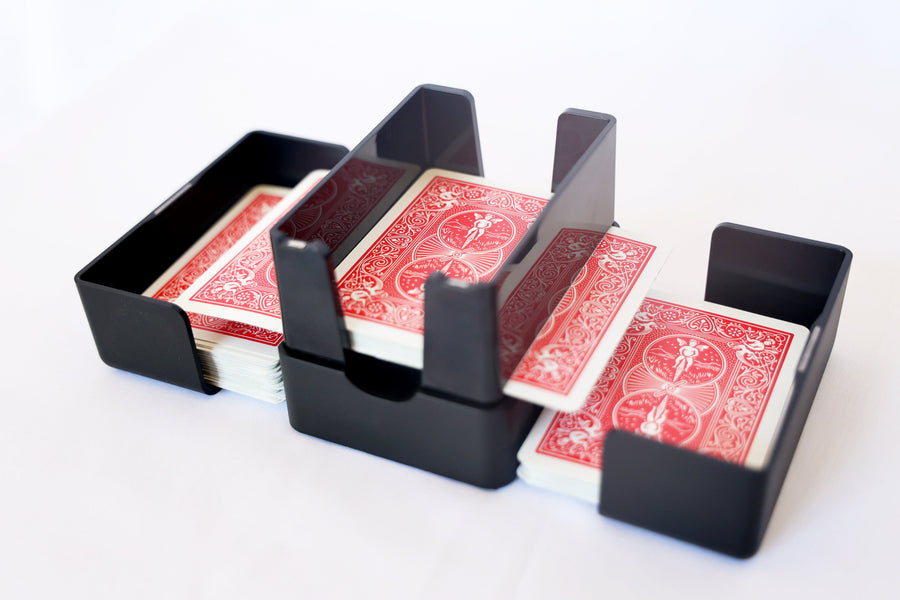
Product photo shows the original Lotus V1.
The one these guides keep pointing to
Lotus Card Shuffler V2
The Tabletop Family rated the Lotus V2 24/25, their Best Overall among the 8 distinct models they bench-tested from 13 shufflers. Lotus supplied its review units.
$89.00 Free US shipping
Order Now