
Flow Has a Sweet Spot: The Goldilocks Difficulty Behind a Great Game
Why the best family games can hold a 7-year-old and a grandparent in the zone at the same table, and how to set yours up to do it.
Flow lives in a narrow band. Too easy and you drift into boredom; too hard and you tip into anxiety. The psychologist Mihaly Csikszentmihalyi mapped this in Flow (1990): the absorbed, time-disappears state arrives when the challenge in front of you is matched to your skill. Push the challenge above your skill and you get nervous. Let it fall below and you get bored. The zone is the diagonal between them.
Here is the part that makes game night interesting. That band is personal. Your sweet spot is not your kid's sweet spot, and neither is your father's. Yet a good family game can hold all three of you in the zone at the same table, at the same time. It does this not by being one difficulty, but by running several at once. Csikszentmihalyi drew his channel for one person at a time. The mixed-age table is our reading of it, not his.
Why one game can have many difficulties
Csikszentmihalyi's channel is drawn for a single person. A seven-year-old and an adult sit at very different points on it. A game of pure skill, chess for instance, collapses this immediately. For the adult it might be a fair fight; for the child it is a wall, and the child leaves the table anxious or bored within minutes. One difficulty cannot serve two skill levels.
What the best family games do is decouple the challenge each player faces from the single board everyone shares. Roger Caillois, in Man, Play and Games (1958), gave us the vocabulary for how. He sorted play into four families: agôn (competition, skill against skill), alea (chance, the roll and the draw), mimicry (make-believe), and ilinx (the pleasant vertigo of being briefly off-balance). Most household games are blends, and the blend is the mechanism. The more a game leans on alea, the more it flattens the skill gap between a child and an adult, because nobody controls the dice. The more it leans on agôn, the more raw skill decides everything, and the wider the gap yawns.
This is why a game built only on skill rarely survives a mixed-age table, and why a game built only on chance gets boring fast for the grown-ups. The ones that work hold both: enough agôn to reward attention and choice, enough alea to keep any single player from running away with it. Chance is not a flaw in a family game. It is the load-bearing wall that keeps everyone inside the channel.
How to tune the table for mixed ages
You do not need to buy the perfect game. You can tune almost any game toward the flow band with a few deliberate moves.
Add a handicap, openly. Give the younger or newer player a head start, extra resources, or a shorter path to the goal. This is not charity; it is recalibration. You are nudging each person's challenge down toward their own skill so they sit in the zone rather than against the wall. Charles Walker's study 'Experiencing Flow' (2010) found that flow felt in company, and especially in highly interactive group activities, tended to be more enjoyable than flow experienced alone. A handicap that keeps everyone genuinely in the game protects exactly that shared version.
Charles Walker's study 'Experiencing Flow' (2010) found that flow felt in company, and especially in highly interactive group activities, tended to be more enjoyable than flow experienced alone.
Lean toward games with real chance in them. When you are choosing what to play with a wide age range, favor the ones where a draw, a roll, or a shuffle resets the odds each round. The randomness is what lets a child legitimately beat an adult, and legitimacy is the point. A win that everyone at the table knows was earnable holds attention in a way a thrown game never can. Legitimacy depends on the chance being real. A shuffle that leaves clumps from the last hand is no longer resetting the odds, and the child's win stops being one anybody can trust.
Let roles differ. Make-believe and cooperative games let a five-year-old be the storyteller while an adult tracks the rules. Same table, different challenges, both engaged. Caillois's mimicry is not a lesser form of play; it is another lever for matching challenge to the person.
Watch faces, not scores. Boredom and anxiety are visible. A child slumping is under-challenged or overwhelmed; an adult checking their phone has dropped out of the band. Adjust the next round rather than finishing the current one out of obligation. Flow is felt, so use the felt signal.
The friction that isn't worth it
There is one kind of difficulty that helps no one: the mechanical friction of running the game itself. The fumbled shuffle that takes a full minute. The reshuffle after every hand while four people wait and the seven-year-old wanders off. This friction sits outside Caillois's four families entirely. It is not agôn, not alea, not challenge of any worthwhile kind. It is the tax that pulls people out of the band between rounds, right when the table had finally settled into it.
That difficulty is worth engineering away. What an automatic shuffler owes a mixed-age table, in Caillois's terms, is real alea with no new tax attached: a deck properly mixed every round, three passes between hands, so no clumps carry over and the draw resets the odds. The Lotus runs an inverse riffle: the deck drops into one tray, soft rollers deal it card by card into two piles, you restack, about five seconds a pass. Three passes suit a game night, and the table keeps talking through them. The only difficulty left, then, is the good kind, the kind that holds a child and a grandparent in the same zone, in the same game, at the same time.
Sources
- Mihaly Csikszentmihalyi, Flow: The Psychology of Optimal Experience (1990)
- Roger Caillois, Man, Play and Games (1958)
- Charles J. Walker, 'Experiencing Flow: Is Doing It Together Better Than Doing It Alone?', The Journal of Positive Psychology (2010)
If the only difficulty left at your table is going to be the good kind, let the Lotus clear away the other kind: three passes between hands and the deck is mixed, no tax attached.
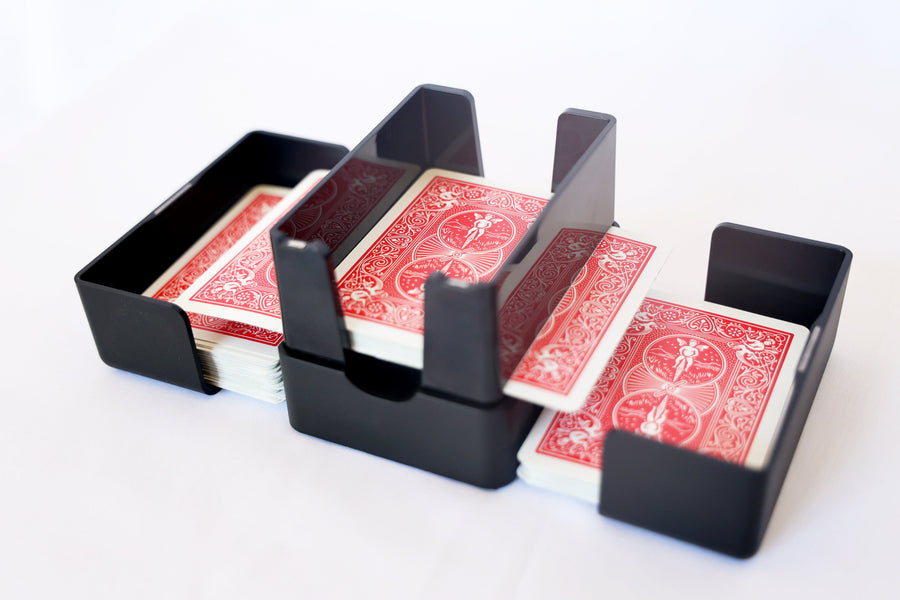
Product photo shows the original Lotus V1.
The one these guides keep pointing to
Lotus Card Shuffler V2
The Tabletop Family rated the Lotus V2 24/25, their Best Overall among the 8 distinct models they bench-tested from 13 shufflers. Lotus supplied its review units.
$89.00 Free US shipping
Order Now