
How to Build a Third Place at Your Own Kitchen Table
The café, the bar, the corner barbershop are vanishing. The most radical thing you can do about it might be to turn your own dining room into the neighborhood's regular hangout.
Sociologist Ray Oldenburg gave a name to the places that aren't home and aren't work: the "third place." In The Great Good Place (1989), he meant the café, the tavern, the beauty parlor, the bookstore where regulars gather: the informal public life that, in his telling, holds a community together. His worry was that American design had been quietly erasing them. Postwar suburbs were built around the house and the commute and almost nothing in between, leaving people with two settings and no third.
A decade later, Robert Putnam measured the cost. Bowling Alone (2000) documented a long slide in the everyday associations that once stitched neighborhoods together: club membership, dinner parties, card games, the casual face-to-face hours that don't show up on a calendar but do show up in how known you feel. People were, famously, still bowling, just no longer in leagues. Together but separately.
Bowling Alone (2000) documented a long slide in the everyday associations that once stitched neighborhoods together: club membership, dinner parties, card games, the casual face-to-face hours that don't show up on a calendar but do show up in how known you feel.
You can read that as a loss to mourn. Or you can read it as an opening. If the public third places have thinned out, the function they served hasn't gone anywhere. Oldenburg would not call a kitchen table a third place; home is his first place by definition. What you can rebuild is the function, and that is the claim here. And Oldenburg was specific enough about what made them work that you can rebuild the conditions deliberately, at a smaller scale, in a room you already own.
What made a third place work
Strip away the espresso machine and the bar stools and Oldenburg's third places share a short list of traits. They run on a regular cast of characters, not a guest list that resets each time. They put everyone on the same footing. Your job title doesn't follow you through the door. The mood is playful and the stakes are low; nobody is being evaluated. And the point of being there is the being there. Conversation is the main event, not the thing you do while waiting for the real activity to start.
Notice what's not on the list: a commercial venue, a liquor license, a neighborhood that still has a main street. None of those are load-bearing. The load-bearing parts are a recurring group, a leveling activity, low stakes, and conversation as the purpose. All four can live at a kitchen table.
A regular game night turns out to be an unusually good vessel for all four. Build one on purpose.
Build the four conditions on purpose
Fix the cast, then fix the time. Oldenburg's third place depended on regulars, the same faces often enough that showing up stopped requiring a decision. That's the part most home gatherings get backwards. A one-off dinner party is a production; a standing Thursday is a habit. Pick a small core of four to six people and a recurring slot (first Friday, every other Sunday, whatever survives real life) and protect it before you worry about who else to invite. The recurrence is doing the heavy lifting. It's what lets people relax into being known instead of performing arrival each time.
Choose a leveling activity. The third place worked because rank dissolved at the door. A game does this mechanically. Around a table, the rules apply to everyone equally, the lawyer and the line cook draw from the same deck, and a good night doesn't depend on anyone's credentials. Pick games that seat your whole group and lean social rather than cutthroat, the kind where talk flows around the play rather than stopping it. The game is scaffolding for the conversation, not a competitor to it.
Keep the stakes low and the friction lower. Oldenburg's regulars came back because nothing was being demanded of them. You want the same easy gravity, which means removing the small frictions that make hosting feel like work and attending feel like an obligation. Keep the food simple and repeatable so you're not cooking a performance. Let people arrive imperfectly. And tend the literal friction at the table: the long stall while someone shuffles a worn deck by hand, the misdeals, the dead air between rounds. These are tiny, but they're where the energy leaks out. An automatic shuffler like Lotus closes that gap. A pass takes about five seconds and three passes mix the deck for a game night, so the table stays in conversation instead of pausing for the mechanics. The point isn't speed for its own sake. It's that presence is fragile, and the fewer interruptions between hands, the longer the talk holds.
Make conversation the point. This is the one that's easy to lose. The game is the occasion, not the objective. The win condition for the night isn't the scorecard. It's that people left more known to each other than they arrived. Choose games that let talk breathe, resist the urge to fill every silence with a new round, and let the night wander. If a hand ends and nobody reaches to deal because the table is mid-story, that's not a lull. That's the whole thing working.
The radical part
What Oldenburg understood, and what Putnam counted, is that a community isn't held together by its big institutions so much as by its small recurring ones. The standing night where the same people show up and nothing important happens is exactly the kind of thing that's been disappearing, and exactly the kind of thing you can put back.
You don't need a storefront or a main street. You need a table, a regular cast, a reason to gather that levels everyone, and enough ease that people keep coming back. Do that for a year and you've built the thing the neighborhood lost, not as nostalgia, but as a place. Yours happens to have a kitchen attached.
Sources
- Ray Oldenburg, The Great Good Place: Cafés, Coffee Shops, Bookstores, Bars, Hair Salons, and Other Hangouts at the Heart of a Community (Marlowe, 1999; first published 1989)
- Robert D. Putnam, Bowling Alone: The Collapse and Revival of American Community (2000)
If the third place runs on ease, the Lotus is a small piece of it: the deck riffles itself between hands, and the talk never has to pause for the mechanics.
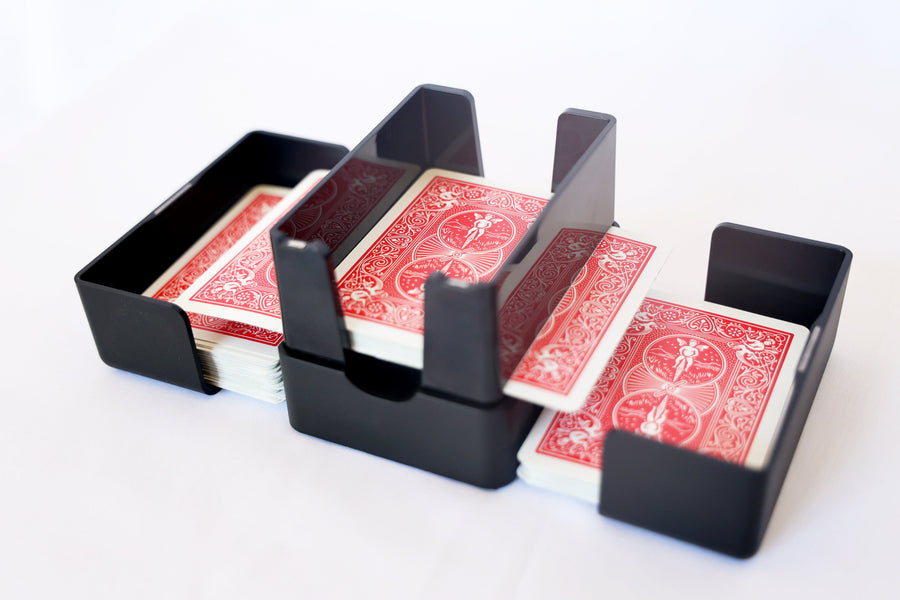
Product photo shows the original Lotus V1.
The one these guides keep pointing to
Lotus Card Shuffler V2
The Tabletop Family rated the Lotus V2 24/25, their Best Overall among the 8 distinct models they bench-tested from 13 shufflers. Lotus supplied its review units.
$89.00 Free US shipping
Order Now