
How to Start a Game Night That Survives Past March: A Ritual-Design Spec
Most recurring game nights die for the same reason, and it has nothing to do with whether people had fun. It's a missing spec.
The first night is always great. Everyone shows up, the snacks are good, somebody stays late. Then the second one is harder to schedule, the third gets a rain check, and by March the group text has gone quiet. People blame busy lives. The real cause is structural: the night was held together by enthusiasm, and enthusiasm is not a load-bearing material.
There's a more useful way to think about this. The conditions that make a group click are not mysterious. They're listable. Keith Sawyer, who studies how groups enter collective flow, found that group flow has specific, designable preconditions, including a shared goal, the right level of challenge, close listening, and a container that lets people stay focused together. It doesn't arrive by luck. It gets set up.
Keith Sawyer, who studies how groups enter collective flow, found that group flow has specific, designable preconditions, including a shared goal, the right level of challenge, close listening, and a container that lets people stay focused together.
Dorothy and Jerome Singer found something parallel studying how children sustain imaginative play. In The House of Make-Believe, the play that lasts depends on a small set of supports: a reliable adult who values it, plus a consistent time, place, and set of props. Remove the reliable person or the consistency, and the play thins out and stops. Adults are not so different. We also need a someone, a when, a where, and the stuff laid out.
Put those together and you get a spec. Five conditions. Most game nights skip three of them and then wonder why the thing fell apart.
The five conditions
Fixed time. "We'll find a date that works" is how a game night dies in committee. A standing slot removes the recurring negotiation that quietly kills the group. Second Tuesdays. Every other Thursday. The specific cadence matters less than that it never has to be decided again. When the time is fixed, attendance becomes a default people opt out of, not a plan they have to opt into each round. The decision happens once.
Fixed place. Rotating houses sounds fair and is a slow poison. Each new venue resets the logistics, and "whose turn is it" becomes one more thing to resolve. A reliable place lets the night build muscle memory. People learn where the glasses are, where to sit, how the room works. The Singers found that a consistent setting was part of what let play deepen rather than restart from zero each time, and the same holds for a room full of adults.
Low setup friction. This is the condition hosts underrate most. Every minute between "we're here" and "we're playing" is a minute the energy leaks out. Sawyer's flow conditions include deep, focused attention, and you cannot focus together while half the table is reading rulebooks or hunting for a missing component. Pick games people already know, or one new one taught quickly. Keep the gear in one box. Anything that turns the threshold of play into a chore is friction worth engineering away.
A reliable host. The Singers are blunt about this one: imaginative play needed a reliable person who valued it and kept showing up. A game night needs the same. Not the most fun person in the group. The most consistent one. The host's real job is not entertaining. It's holding the frame: sending the reminder, keeping the time and place stable, making sure the night happens whether or not everyone's in the mood that week. Reliability is the load-bearing trait. Charisma is optional.
A protected boundary. A ritual is defined partly by what it keeps out. Anthropologist Roy Rappaport argued that ritual works precisely because it sets apart a frame with its own rules, marked off from ordinary time. A game night needs that edge. Phones in a basket. Work talk parked at the door. A clear start so the night isn't just people drifting in and out of a kitchen. The boundary is what turns "hanging out" into something with shape, and shape is what people come back for.
Why three of five isn't enough
The trap is that game nights usually nail the easy two. The food is good and the company is good, so it feels like it's working. But the easy conditions are the ones enthusiasm already supplies. The hard three, fixed time, a reliable host, and a protected boundary, are exactly the ones that require deliberate design and a little unglamorous discipline. They don't feel urgent on night one. They're the difference between night one and night fifteen.
This is also why "we should do this more often" almost never becomes doing it more often. It's an expression of enthusiasm, not a spec. The fix isn't more enthusiasm. It's converting the warm feeling into structure while the warmth is still there: name the day, name the place, name the host, name the rule about phones. Do it before everyone leaves the first night, when saying yes is easy.
Engineer the threshold
Of the five, low setup friction is the one most within a host's direct control, and the one a product can actually help with. The goal is to make the gap between arriving and playing as close to zero as possible, because that gap is where presence drains away.
Some of this is just preparation: the box stays packed, the table stays clear, the snacks are simple enough that nobody's still cooking when people arrive. Some of it is tools. A shuffler is a small example of the principle done right. Hand-shuffling between every hand is a steady tax on attention, the kind of friction that fragments a table mid-conversation. An automatic shuffler turns the shuffle into a condition you install once, like the standing slot: the deck comes back near-random, and nobody at the table has to vouch for the mix (that's the chore we built Lotus to take). The rhythm of the night never has to break for the mechanics of the night.
None of the five conditions is hard on its own. The discipline is installing all five before March, while the first night's glow is still doing the work for you. Build the spec, and the ritual holds itself up. The small tools worth adding are the ones with a condition's name on them: a packed box that keeps setup friction near zero, a phone basket that holds the boundary, a shuffler that returns the deck thoroughly mixed so dealing joins the list of things decided once. Each one removes a decision or a chore the night would otherwise have to keep paying for. That's the test for anything you add: not whether it's clever, but whether it takes one more thing off the table so the people around it can stay.
Sources
- Keith Sawyer, Group Genius: The Creative Power of Collaboration (2007)
- Dorothy G. Singer and Jerome L. Singer, The House of Make-Believe: Children's Play and the Developing Imagination (1990)
- Roy A. Rappaport, Ritual and Religion in the Making of Humanity (1999)
Install the five conditions once and they hold; the Lotus is the shuffle installed the same way: one touch, and the deck comes back near-random, a decision the night never has to make again.
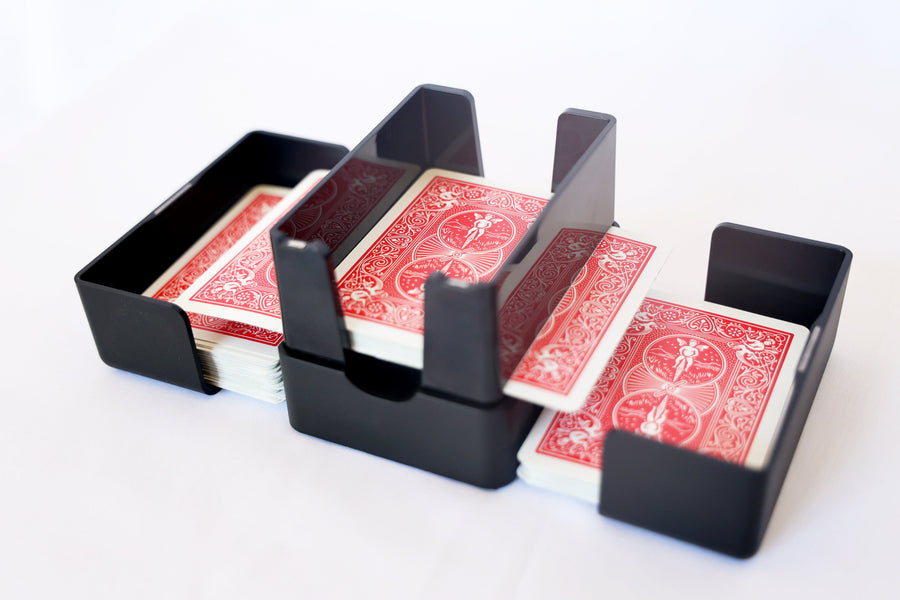
The one these guides keep pointing to
Lotus Card Shuffler V2
TheTabletopFamily’s Best Overall pick. V2 scored 24/25, first of the 8 distinct models they bench-tested from 13 shufflers bought. Two decks, no buttons. Pre-order ships October.
$89.00 Free US shipping
Pre-order V2