
It Was Never the Bowling
Putnam's famous alarm wasn't that Americans stopped bowling. It's that they stopped bowling in leagues, and the league was the part that mattered.
By the late 1990s, more Americans were bowling than ever before. Robert Putnam noted this plainly in Bowling Alone. The lanes were busy. What had collapsed was league bowling: the standing Tuesday-night team, the same faces week after week, the season that ran on a schedule whether or not anyone felt like showing up. People kept bowling. They just stopped bowling together in any structured, recurring way.
That distinction is the whole argument, and it's the part most people miss when they remember the book by its title. The problem was never the activity. It was the disappearance of the container the activity used to live inside.
What the league actually did
A league isn't a game. It's a structure that makes the game happen again. Putnam's concern in Bowling Alone was the broad erosion of these structures across American life: the bowling leagues, but also the union halls, the bridge clubs, the PTA, the standing card games. He documented declining membership and participation across a wide range of associations through the second half of the twentieth century. The thread running through all of it: fewer settings where the same people gathered, on a schedule, by default.
This matters because the recurring part is doing work that a one-off gathering can't. A league produces what Putnam called social capital: the trust, reciprocity, and dense web of small obligations that build up between people who keep showing up to the same thing. You learn who's reliable. You cover for someone, and later they cover for you. You hear about a sick parent, a new job, a kid's recital. None of that comes from a single excellent evening. It accumulates, slowly, across many ordinary ones.
A league produces what Putnam called social capital: the trust, reciprocity, and dense web of small obligations that build up between people who keep showing up to the same thing.
The casual bowler who shows up alone or with a rotating cast of friends gets the activity but not the accumulation. Same lanes, same pins, same score sheet. What's missing is the part that compounds.
Why recurrence beats the great party
Randall Collins gives us the mechanism underneath Putnam's pattern. In Interaction Ritual Chains, Collins argues that connection isn't built in single encounters but in chains of them. Each successful interaction, with people physically together, attention focused on a shared thing, a common mood building between them, generates what he calls emotional energy. That energy is what makes you want to come back. And coming back is what builds the next link in the chain.
The word chain is the point. A ritual that happens once is an event. A ritual that happens again, and then again, links into something that carries its own momentum. The shared focus and the rhythm of regular gathering are, in Collins's account, what turn a group of people in a room into a group that actually feels bound to one another.
This reframes a question a lot of hosts get wrong. The instinct is to plan the big night: the dinner party with the perfect menu, the milestone celebration, the once-a-year reunion that everyone talks about for weeks. Those evenings are real and worth having. But by both Putnam's and Collins's logic, a single peak event, however excellent, can't do what a modest, recurring one does. The dinner party is a link. The standing weekly night is the chain.
A great party asks a lot and delivers a spike. A standing night asks little each time and delivers a slope. Over a year, the slope wins, because the slope is where the trust and the inside jokes and the casual depth actually live.
The standing night, made easy to keep
If recurrence is what does the work, then the practical task for a host isn't to plan something spectacular. It's to lower the cost of doing the ordinary thing again. The enemy of a weekly night isn't a bad evening. It's friction: the small frustrations that make "let's skip this week" the path of least resistance until the week becomes a month and the chain quietly breaks.
Collins never wrote about hosting; the practical corollary is ours: the ritual has to be easy enough to repeat. Shared attention has to land on each other, not on the logistics. Anything that pulls focus back to fumbling and setup is working against the very thing the gathering is for.
A card night is one of the most durable versions of the standing ritual: cheap, low-prep, endlessly variable, and as good for two people as for six. The friction tends to hide in small places. The reshuffle between hands, the deck that comes back half-sorted from the last trick. A good automatic shuffler erases that particular gap. The cards come out well mixed every hand, the dealing stays fair without anyone thinking about it, and the table's attention stays where it belongs. That is the whole job of a tool at a card table. It keeps the friction low so the night is easy to keep.
Because the night you keep is the one that matters. Not the perfect party you throw once. The good-enough one you throw fifty times. Putnam's alarm, read correctly, was never nostalgia for bowling. It was a warning about what we lose when the standing thing stops standing.
Sources
- Robert D. Putnam, Bowling Alone: The Collapse and Revival of American Community (2000)
- Randall Collins, Interaction Ritual Chains (2004)
The lanes were the container, not the point; the Lotus lowers the cost of doing the ordinary thing again, so the standing thing keeps standing.
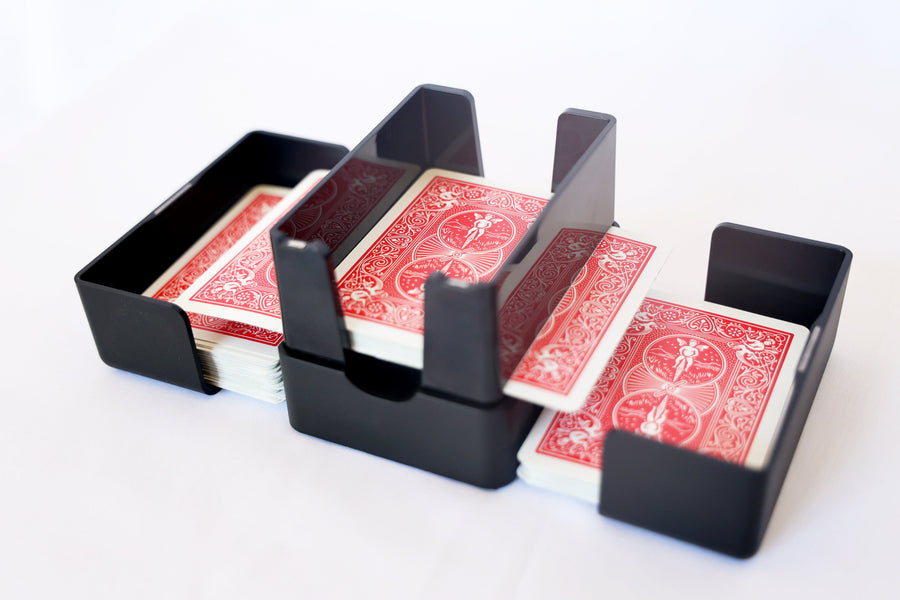
Product photo shows the original Lotus V1.
The one these guides keep pointing to
Lotus Card Shuffler V2
The Tabletop Family rated the Lotus V2 24/25, their Best Overall among the 8 distinct models they bench-tested from 13 shufflers. Lotus supplied its review units.
$89.00 Free US shipping
Order Now