
Loneliness Is a Preventable Condition, and the Card Table Is a Dose
The mortality data on isolation is real and unsettling. Read honestly, it points to something you can actually build: structure.
Loneliness carries a measurable health cost, and a standing weekly game night is one of the few responses that is both grounded in the evidence and within an ordinary person's reach. The reason is not the game. It's the structure underneath it: regular contact, with the same people, in a setting where being together is the point.
The research behind that claim is worth reading carefully, because the careful version is the useful one. In 2015, Julianne Holt-Lunstad published a meta-analysis covering more than three million people and found that social isolation and loneliness carried a mortality risk in the same range as well-known killers, comparable to the effect of smoking and larger than that of physical inactivity. In 2023, the U.S. Surgeon General, Vivek Murthy, made it official with an advisory titled Our Epidemic of Loneliness and Isolation. Two decades earlier, in 2003, Joe Verghese and colleagues reported in the New England Journal of Medicine that older adults who regularly played board games and cards had a measurably lower risk of dementia.
In 2015, Julianne Holt-Lunstad published a meta-analysis covering more than three million people and found that social isolation and loneliness carried a mortality risk in the same range as well-known killers, comparable to the effect of smoking and larger than that of physical inactivity.
Put those together and the temptation is to say something neat: that game night saves your life. It doesn't, and the honest version is more useful. A shuffle is not medicine. The recurring social structure around the table is the likely active ingredient, and structure is exactly the kind of thing you can decide to build into a week.
What the data actually says
Start with the strongest claim and its limits. Holt-Lunstad's finding is about association across enormous populations. People who are more connected tend to live longer; people who are isolated tend to die sooner, and the size of that gap is large enough to sit beside smoking on the chart. What the meta-analysis cannot do, by design, is prove that connection causes the longer life. The arrows could run both ways, since healthier people may find it easier to stay social. That caveat is not a reason to dismiss the result. It's a reason to read it as a serious signal rather than a guarantee.
Murthy's advisory takes that body of evidence and treats it as a public health matter rather than a private feeling. The framing is the contribution: loneliness moves from "something some people suffer" to "a condition with population-level consequences worth addressing deliberately." Conditions you address deliberately are conditions you can prevent. That word, preventable, is doing real work here, and it's earned.
Verghese is where the picture gets specific and where the honesty has to get sharper. His team followed older adults and found that frequent participation in cognitively engaging leisure, board games and cards among them, was associated with lower dementia risk. Again, association, not proof. And the reverse-causation question is live: early, undiagnosed cognitive decline might cause someone to stop playing games, which would make the games look more protective than they are. The researchers were aware of this and the finding held up under scrutiny, but the careful reader holds it loosely. The game may be exercising the mind. It may also simply be a reliable reason to sit down with other people every week. Those two explanations are hard to separate, and for a game night, you don't need to.
Why structure is the part you can control
Here's the hinge. Across all three sources, the thing that keeps appearing is not a specific activity but a recurring social structure: regular contact, with the same people, in a setting where being together is the point.
You cannot will yourself to be less lonely. You can, however, build a container that makes connection the default rather than the exception. A standing night does most of the work that good intentions fail to do. It removes the weekly negotiation, the "we should really get together sometime" that never resolves. It gives the people in your life a reliable place to land. For an adult child watching a parent's world quietly shrink, a recurring table is one of the few interventions that's both grounded in the evidence and actually within reach. You can't prescribe connection. You can host it on a schedule.
This is what "dose-able" means, and why the medical metaphor holds even after you've stripped out the overclaims. A dose is regular, repeatable, and roughly the right size. A game night that happens once is a nice evening. A game night that happens every week, with the same faces, is a structure. The literature gives you permission to treat the second one as worth defending against everything that wants to crowd it out.
What this asks of a single evening
If the structure is the medicine, then the job of any given night is simply to remove whatever gets in its way. Friction is the enemy of recurrence. The night that involves a hunt for the cards, a long stretch of fumbled shuffling, a lull where attention drifts to phones is the night that quietly gets harder to repeat. Smooth the path and the habit survives contact with a busy life.
This is the small, earned place where a good tool fits. A shuffler that does one thing genuinely well, producing an excellent, near-random deal at a single touch, isn't the point of the evening. It's the thing that keeps the evening moving so the people stay in it. The riffle is handled, the deal is fair, and the table's attention stays where the evidence says it matters: on each other. That's not a cure. It's a way to make the dose easy enough to keep taking.
Sources
- Julianne Holt-Lunstad et al., "Loneliness and Social Isolation as Risk Factors for Mortality: A Meta-Analytic Review," Perspectives on Psychological Science, 2015.
- Joe Verghese et al., "Leisure Activities and the Risk of Dementia in the Elderly," New England Journal of Medicine, 2003.
- Vivek H. Murthy, Our Epidemic of Loneliness and Isolation: The U.S. Surgeon General's Advisory on the Healing Effects of Social Connection and Community, U.S. Department of Health and Human Services, 2023.
The dose was never the cards; it's the structure around them, and the Lotus is just one way to make it easy enough to keep taking.
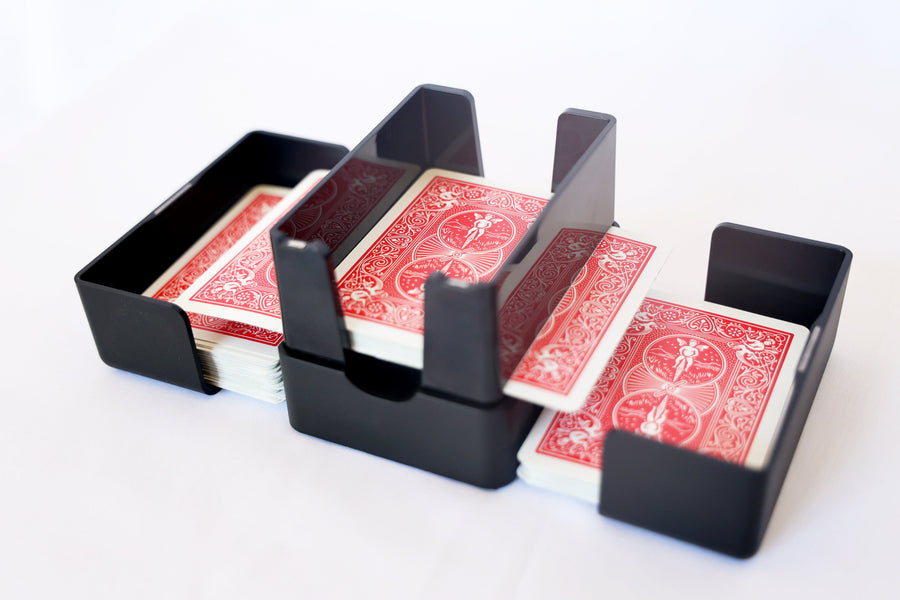
The one these guides keep pointing to
Lotus Card Shuffler V2
TheTabletopFamily’s Best Overall pick. V2 scored 24/25, first of the 8 distinct models they bench-tested from 13 shufflers bought. Two decks, no buttons. Pre-order ships October.
$89.00 Free US shipping
Pre-order V2