
The 85-Year Harvard Answer: It Was Never the Money
Harvard tracked the same lives for eight decades to learn what makes a good old age. The winner wasn't wealth or achievement. It was warmth, delivered in small, ordinary doses.
In 1938, researchers at Harvard began following a group of young men with a simple, ambitious question: what makes a life go well? They tracked these men through war, careers, marriages, illness, and old age. They later added a second group from Boston's poorest neighborhoods, and eventually the wives and children. The Harvard Study of Adult Development is now the longest study of adult life ever conducted. It has run for more than 85 years.
After all of it, the answer was not what most of us would have guessed at twenty, or even forty. Robert Waldinger, the study's fourth director, put it plainly: the people who stayed healthiest and happiest into their eighties were the ones with the warmest relationships. Not the richest. Not the most accomplished. Not the ones who had planned hardest for retirement. The clearest signal across a lifetime of data was the quality of a person's connections to other people.
Good relationships, not grand gestures
It's tempting to hear "relationships matter" and file it next to every other thing we already know and ignore. But the study's finding is more specific, and more useful, than the bumper sticker.
The strongest predictor wasn't how many friends someone had, or whether they were married. It was the felt quality of connection: whether a person had relationships in which they could relax, be themselves, and count on someone. Waldinger has described it as having at least one relationship where you feel you could call in the middle of the night. Satisfaction with relationships at age 50, the study found, predicted physical health at 80 better than cholesterol levels did. Loneliness, by contrast, tracked with earlier decline in health and brain function. The body seems to keep a record of whether we feel held.
Satisfaction with relationships at age 50, the study found, predicted physical health at 80 better than cholesterol levels did.
What's striking is how unglamorous the mechanism turns out to be. The study doesn't reward dramatic devotion or once-a-year reunions. It rewards steadiness. The relationships that protected people were the ones that got tended, regularly, over years. Waldinger sometimes frames it as a kind of fitness: social connection is something you keep up, the way you keep up your body, through repeated small acts rather than one heroic effort.
The case for the recurring table
If warmth is built from repetition, then the question for anyone planning a good old age isn't "who matters to me?" It's "when do I actually see them?"
This is where most well-meaning intentions quietly fail. We love people in the abstract and let months pass. We mean to call. The relationships erode not through conflict but through absence, the slow way a path disappears when no one walks it. The fix isn't more love. It's more contact, and contact is easiest to sustain when it's scheduled and low-stakes, when showing up doesn't require an occasion.
A weekly table is exactly this. Game night, dinner, a standing Sunday afternoon. The form barely matters. What matters is that it recurs, that it asks little, and that it puts the same people in the same room often enough for the easy, unforced version of intimacy to accumulate. You don't have to perform closeness at a recurring table. You just have to keep coming. The closeness is a byproduct of the attendance.
There's also something the research implies about presence. Connection that protects health is the kind where people feel seen, where attention is mutual and unhurried. That's hard to manufacture when everyone is half-distracted, and it's the part of game night that small friction quietly erodes. The minutes someone spends fumbling a shuffle, re-dealing, sorting a dropped deck are minutes the table spends managing the game instead of being with each other.
The table is the infrastructure
This is the practical reading of an 85-year finding. A good old age is built, in part, from thousands of unremarkable evenings spent in good company. The vehicle is recurring, low-stakes, in-person contact with people you trust, and the enemy is everything that makes that contact feel like work.
A card shuffler is a small thing against a large truth. But it earns its place by removing one specific friction so the table can do what tables are for. Lotus shuffles fast and well, near-random with the riffle done right, so the deck is handled and the hands stay free. The point was never the cards. The point is the people across from you, the standing invitation, the ease of showing up again next week. Harvard spent 85 years finding out what holds a life together. It turned out to be each other, in small regular doses. Set the table accordingly.
Sources
- Robert Waldinger and Marc Schulz, The Good Life: Lessons from the World's Longest Scientific Study of Happiness (Simon & Schuster, 2023).
- Robert Waldinger, "What Makes a Good Life? Lessons from the Longest Study on Happiness," TED Talk, 2015.
- Harvard Study of Adult Development (Grant Study and Glueck Study), Harvard Medical School / Massachusetts General Hospital, ongoing since 1938.
Harvard's answer was other people, in small regular doses; the Lotus just makes the table easier to set again next week.
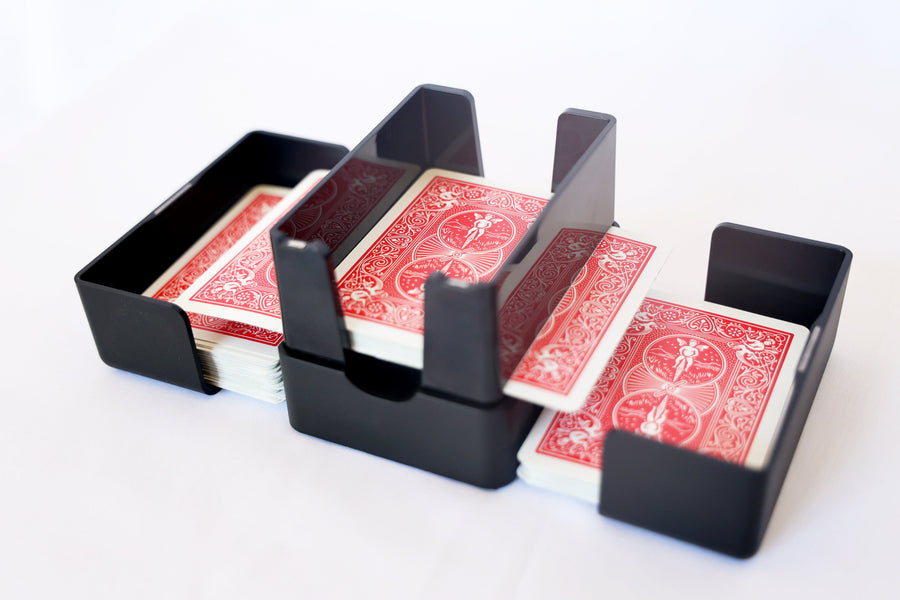
The one these guides keep pointing to
Lotus Card Shuffler V2
TheTabletopFamily’s Best Overall pick. V2 scored 24/25, first of the 8 distinct models they bench-tested from 13 shufflers bought. Two decks, no buttons. Pre-order ships October.
$89.00 Free US shipping
Pre-order V2