
The Acquaintance at Your Table Is Doing More Than You Think
The friend-of-a-friend you invite to fill the fourth seat may matter more to your life than your closest friend does, and the research is unusually specific about why.
When you're short a player and someone says "I'll bring my coworker, you'll like her," that coworker is easy to treat as filler. She's there to make the numbers work. But the people we know loosely turn out to do a kind of heavy lifting that our closest relationships, for all their warmth, structurally cannot. Two pieces of research, fifty years apart, point at the same surprising thing: the open chair at your table is one of the highest-leverage social assets you have.
Why the loose connection carries more new information
In 1973, sociologist Mark Granovetter published a paper called "The Strength of Weak Ties." He had been studying how people actually found jobs, and the answer ran against intuition. People rarely got their best leads from close friends. They got them from acquaintances, the contacts they saw only occasionally.
His explanation is the part worth keeping. Your close friends mostly know each other, and mostly know what you know. You move through the same rooms and hear the same news. Information circulates inside that tight group quickly and then has nowhere new to go. A weak tie sits in a different cluster. The acquaintance lives in a social world you don't otherwise touch, so what reaches you through her hasn't already bounced around your circle. Granovetter called these connections bridges: the spans that link one dense group of people to another. New information, the kind that turns into a job or an introduction or an idea you couldn't have generated on your own, tends to arrive across a bridge rather than within a cluster.
The counterintuitive line follows directly. The relationships that feel least important by the warmth test are often the ones doing the most by the opportunity test. Not because the acquaintance is better than your friend, but because she's positioned differently. She reaches into a part of the world your inner circle can't see.
The acquaintance is also good for an ordinary day
For decades that finding lived in the world of careers and networks. Then psychologists Gillian Sandstrom and Elizabeth Dunn asked a smaller, more human question: what do weak ties do for how a day actually feels?
In their 2014 research, published as a pair of studies on social interactions and well-being, they had people track their daily encounters and distinguish between strong ties (close friends and family) and weak ties (acquaintances, the barista, a classmate they barely knew). The pattern was consistent. On days when people had more interactions with their weak ties, they reported greater happiness and a stronger sense of belonging. People who interacted with more acquaintances across the board tended to be happier overall. The 85-year Harvard study lands in the same place from the closest ties: relationships, not money, predict how life feels.
On days when people had more interactions with their weak ties, they reported greater happiness and a stronger sense of belonging.
This isn't a claim that acquaintances beat close friends. Strong ties remain the deep structure of a life. What the research adds is that the loose ones are not negligible. The light, low-stakes exchanges, the easy conversation with someone you don't know well, contribute something real to how connected a person feels, and we routinely underestimate it.
Put the two findings together and the acquaintance comes into focus. Through Granovetter, she's your bridge to opportunity and novelty. Through Sandstrom and Dunn, she's a measurable lift to an ordinary evening. The same loose connection is working on both registers at once.
What this means for who you invite
If you host, you make casting decisions whether you think of them that way or not. The instinct is to protect the table, to fill it with the people you're already closest to, because that feels safest and warmest. The research gently argues for leaving a chair open to the bridge.
Invite the friend-of-a-friend. Say yes when someone wants to bring a coworker. Pull in the neighbor you've nodded at for two years but never really talked to. You're not diluting the night. You're routing a bridge through your living room, and that bridge carries both things the research describes: the lead you couldn't have reached on your own, and a quieter, immediate gain in how the evening feels for everyone at the table.
A card game does something useful here that a dinner party doesn't quite manage. It gives the loose connection a job. Nobody has to perform conversation or find a topic; the game supplies the structure, the turns, the small talk that isn't really small. The acquaintance has a reason to be there and an easy way to belong, and by the third hand she isn't filler anymore.
That's also where friction matters. The stretches that pull people out of the moment, the fumbled riffle, the cards spilling, the one person hunched over a clumsy shuffle while everyone else waits, are exactly the gaps where a newcomer drifts to the edge. A shuffler that handles the deck cleanly, the way seven good riffles leave it near-random, keeps the rhythm going so the table stays a table. That is the whole reason Lotus exists: to take the friction out so the people in the chairs, the close ones and the bridges alike, can simply be present with each other. Set the open chair. The research says it's the best seat in the house.
Sources
- Mark S. Granovetter, "The Strength of Weak Ties," American Journal of Sociology (1973)
- Gillian M. Sandstrom & Elizabeth W. Dunn, "Social Interactions and Well-Being: The Surprising Power of Weak Ties," Personality and Social Psychology Bulletin (2014)
The bridge does the real work at your table; the Lotus just keeps the cards moving so the fourth chair never feels like filler.
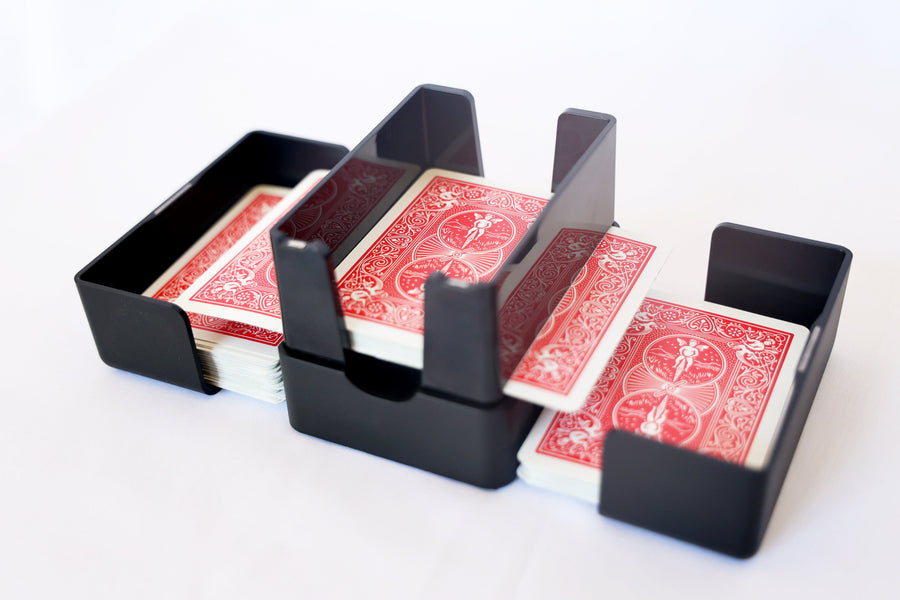
The one these guides keep pointing to
Lotus Card Shuffler V2
TheTabletopFamily’s Best Overall pick. V2 scored 24/25, first of the 8 distinct models they bench-tested from 13 shufflers bought. Two decks, no buttons. Pre-order ships October.
$89.00 Free US shipping
Pre-order V2