
The Deal as Ritual Instrument: What the Shuffle Does That Has Nothing to Do With Randomness
The cards mix to make the game fair. But the reason the room goes quiet when they start moving is something else entirely.
The religious studies scholar Catherine Bell made a claim that sounds backward at first: ritual is not defined by what it accomplishes, but by how an act is performed. In Ritual Theory, Ritual Practice (1992), she argued there is no fixed category of "rituals" floating apart from ordinary life. There is only "ritualization": the way certain actions are set apart, made formal, repeated in a particular way, marked as different from the gestures around them. The thing that makes an act ritual isn't its content. It's the manner of its doing.
The religious studies scholar Catherine Bell made a claim that sounds backward at first: ritual is not defined by what it accomplishes, but by how an act is performed.
Hold that up against a card table and something clicks. We tend to explain the shuffle in functional terms: the cards must be mixed so no one knows what's coming, so the game is fair. True, and necessary. But fairness doesn't explain the shift, the way conversation drops half a register, hands settle, and eyes move to the table the moment the deck starts moving. That shift has nothing to do with randomness. It's ritualization, doing exactly what Bell said it does: telling everyone present that the ordinary frame has been suspended and a different one has opened.
The shuffle is a threshold, not a function
Bell's insight is that ritualized acts work by differentiation. They distinguish themselves from the flow of regular activity through formality, repetition, and a specific bodily choreography. You don't have to believe anything for this to work. The body reads the formality directly. A handshake, a toast, the lighting of a candle: none of them accomplish much in practical terms, and all of them reorganize the people around them.
The deal is one of the cleanest examples you'll find at a kitchen table. It is formal: there's a right way to do it, and everyone knows when it's done wrong. It is repeated: the same gesture, hand after hand, night after night. And it is bodily: the riffle, the bridge, the squaring of the deck, the cards going out one at a time in a fixed order. None of that is required to randomize a deck. You could shake the cards in a bag. The choreography exists because the choreography is the point. It is the gesture that says: we are playing now.
This is why the moment lands even with people who've never thought about ritual in their lives. The shuffle is a threshold. You cross it and the register changes.
Crossing into the magic circle
Johan Huizinga gave this crossing a name in Homo Ludens (1938). He argued that play happens inside a "magic circle," a space marked off from ordinary life, with its own rules, its own time, its own seriousness. Step inside the circle and different laws apply. The chessboard, the playing field, the card table: each is a temporary world, set apart, where what happens matters intensely and stops mattering the instant you step back out.
But a circle needs an edge, and the edge needs to be drawn. Huizinga noted that play is bounded in time and place. It begins and it ends, and those boundaries are felt. The shuffle is one of the most common ways human beings draw that edge. It is the gesture that opens the circle. Before the cards move, you're a few people at a table with snacks and half-finished sentences. After they move, you're players, inside the game, bound by its rules and its stakes. Nothing material changed. The frame did.
That's also why a clumsy or interrupted shuffle can deflate a table: cards spraying, a re-deal, someone fumbling the count. The break isn't just inconvenient. It punctures the threshold. The circle won't quite close, and everyone feels the game struggle to start.
Why the formality has to be performed, not faked
Roy Rappaport, in Ritual and Religion in the Making of Humanity (1999), pushed on a related point: the form of a ritual carries its meaning, and the act of performing it is itself a kind of commitment. By doing the formal gesture, participants accept the order the gesture establishes. You can't get the effect by intending it privately. It has to be done, in the open, in the agreed-upon way, where everyone can see.
This is the honest reason the deal matters more than its mechanics suggest. When the cards go around the table in their fixed order, every player is, in Rappaport's sense, accepting the frame, agreeing, without saying so, to be inside the game together. The performance is the agreement. That's a real thing happening between people, not a metaphor, and it's most of what we mean when we say a game "begins."
So the design question for anyone who hosts isn't how do I randomize cards efficiently. It's how do I make the opening gesture clean enough to do its work. A threshold only works if it feels like one.
This is where an excellent shuffler earns its place at the table, and only here. A Lotus shuffle is near-random, clean mixing every hand, so the fairness is simply handled, no one watching the dealer, no one re-counting. The quieter gift is that the gesture stays intact. The cards move, cleanly and the same way every time, and the threshold gets drawn without a fumble. The host is freed from managing the mechanics and can do the thing the night was for: be present with the people who showed up. The circle opens, and you're already inside it with them.
Sources
- Catherine Bell, Ritual Theory, Ritual Practice (1992)
- Johan Huizinga, Homo Ludens: A Study of the Play-Element in Culture (1938)
- Roy A. Rappaport, Ritual and Religion in the Making of Humanity (1999)
The threshold still has to be drawn every time the cards come out; the Lotus just keeps the gesture clean enough to do its work.
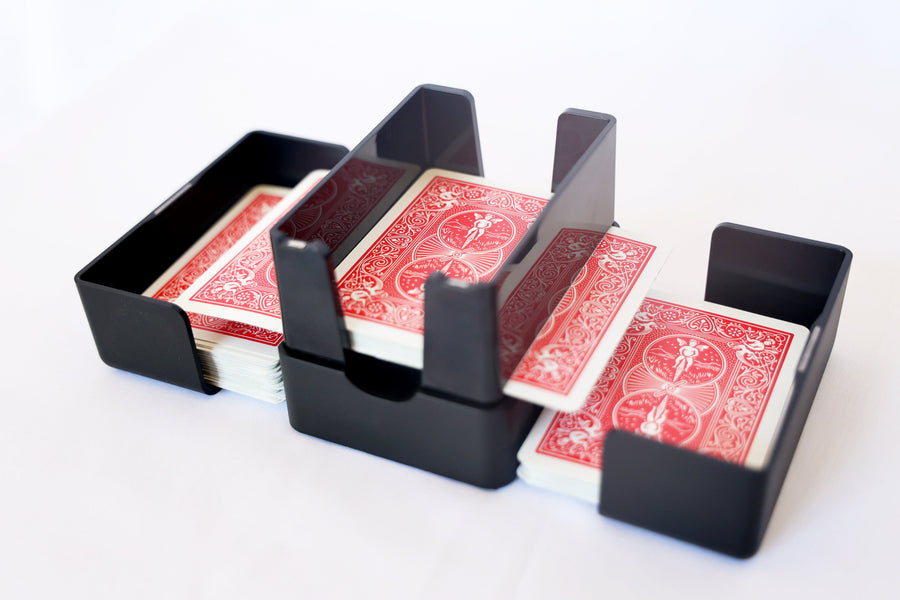
The one these guides keep pointing to
Lotus Card Shuffler V2
TheTabletopFamily’s Best Overall pick. V2 scored 24/25, first of the 8 distinct models they bench-tested from 13 shufflers bought. Two decks, no buttons. Pre-order ships October.
$89.00 Free US shipping
Pre-order V2