
The Etiquette of the Deal: Why Cutting the Deck Is a Centuries-Old Trust Protocol
Every time you offer the deck to the player on your right to cut, you are performing a piece of security engineering as old as the card table: a verifiable fairness handshake.
Watch a card game closely and you will notice it is full of small, fussy gestures nobody questions. The dealer shuffles. The deck is set down and pushed toward the player on the right. That player lifts off a portion and sets it aside, and the dealer completes the cut. Then cards go out one at a time, around the circle, never two to the same person in a row. We treat these as habits, the way you treat saying "bless you." But they are not habits. They are a protocol, and it was designed to solve a specific problem: how do you play a game of chance and skill with people you cannot fully vouch for, and trust that nobody cheated?
The deal is a security procedure wearing the costume of manners
David Parlett, in The Oxford Guide to Card Games, traces playing cards across centuries of European life, and one thing becomes clear reading him: the conventions that surround dealing did not appear all at once or by decree. They accreted. Different games, regions, and eras layered their own rules onto the basic act of distributing cards. What survived and spread were the procedures that worked, in the way that durable institutions work, because they kept the game honest enough that strangers would keep sitting down to play.
The cut is a second party introducing entropy you did not choose. It does not trust the dealer; it removes the need to.
Consider what each piece of the ritual does.
The shuffle randomizes the order, so no one can know what is coming. But a shuffle alone is not enough, because the person doing the shuffling is also the person who could rig it. So the shuffle is followed by the cut, and the cut is performed by someone other than the dealer. This is the load-bearing move. By handing the deck to your neighbor and letting them slice it at a point you cannot predict, you surrender your last say over where the deal starts. The cut is a second party introducing entropy you did not choose. It does not trust the dealer; it removes the need to.
Then the cards go out one at a time, in a fixed direction, one to each player in turn. Dealing singly rather than in clumps makes it far harder for a dealer to route a known run of cards to a confederate, or to themselves. The mechanics are visible and rhythmic, easy for everyone at the table to follow. Anyone can audit the deal by watching it.
None of this requires you to believe your fellow players are honest. That is the elegance of it. A good protocol does not run on goodwill. It runs on structure that makes cheating hard and detection easy, so that goodwill becomes unnecessary. You can play cards with a stranger in a tavern, a relative you suspect, or a rival you actively dislike, and the deal still holds, because the deal was built for exactly those conditions.
Why a game needs more rules than real life
There is a deeper puzzle underneath all of this. Why would anyone accept so many constraints, voluntarily, just to play?
The philosopher Bernard Suits gives the cleanest answer in The Grasshopper: Games, Life and Utopia. His definition of game-playing is "the voluntary attempt to overcome unnecessary obstacles." Suits points out that a game always involves accepting rules that forbid the most efficient means to the goal. You could just take the cards you want. You could deal yourself the winning hand. The rules exist precisely to rule those shortcuts out, and players adopt the rules, in Suits's phrase, to make the activity possible at all. He calls this the "lusory attitude," the willingness to accept inefficient means for the sake of the play. Suits was writing about games in general; reading the cut through his definition is our move.
The etiquette of the deal is the lusory attitude made physical. The cut is an unnecessary obstacle in the literal sense. Nothing forces you to offer the deck to your right. You do it because everyone at the table has agreed, tacitly, to be bound by a procedure that protects the game from each of them, including from yourself. That mutual agreement to be constrained is the trust. It is not that players trust each other and therefore play. It is that they consent to a shared rule that makes trust beside the point, and in doing so, they build something more reliable than trust: a fair frame that holds even when feelings don't.
This is why the deal feels almost ceremonial. It is performing a small social contract every single hand. The handshake on a contract says "I am a person of my word." The cut says something more modest and more durable: "Neither of us has to be a person of our word, because the procedure protects us both." For people who might not fully trust each other, that is a better promise.
What the ritual is protecting at your table
Most of us are not playing in taverns against rivals. We are playing on a Tuesday with people we love. The adversarial origins of the deal have faded into something gentler, but the ritual did not lose its function when it moved into the living room. It changed jobs.
At a friendly table, the cut and the orderly deal are no longer guarding against your uncle the card sharp. They are guarding against the thing that spoils home games: the small friction of doubt, the "wait, did you shuffle that right?", the suspicion of an uneven start that can sour a night before it begins. The protocol clears all of that away with a few seconds of shared ceremony, so the table can stop thinking about fairness and start paying attention to each other. A fair start is what lets the evening be about the people, not the procedure.
There is a quiet lesson here for anyone who hosts. The little rituals are not in the way of connection. They are what make connection safe. When the frame is trustworthy, nobody has to manage it, and the attention freed up by that trust is exactly what a good night together runs on. This is also the logic behind taking the shuffle off the human entirely. An automatic shuffler run a few times delivers a near-random order every hand, the same procedural fairness the cut exists to protect, without anyone at the table having to perform or police it. The protocol gets honored, the friction disappears, and what's left is the part that was always the point: the people, the game, and the time you get to spend looking at each other.
Sources
- David Parlett, The Oxford Guide to Card Games (1990)
- Bernard Suits, The Grasshopper: Games, Life and Utopia (1978)
Centuries of cut-the-deck etiquette solved trust between players; the math of a thorough shuffle solved the rest.
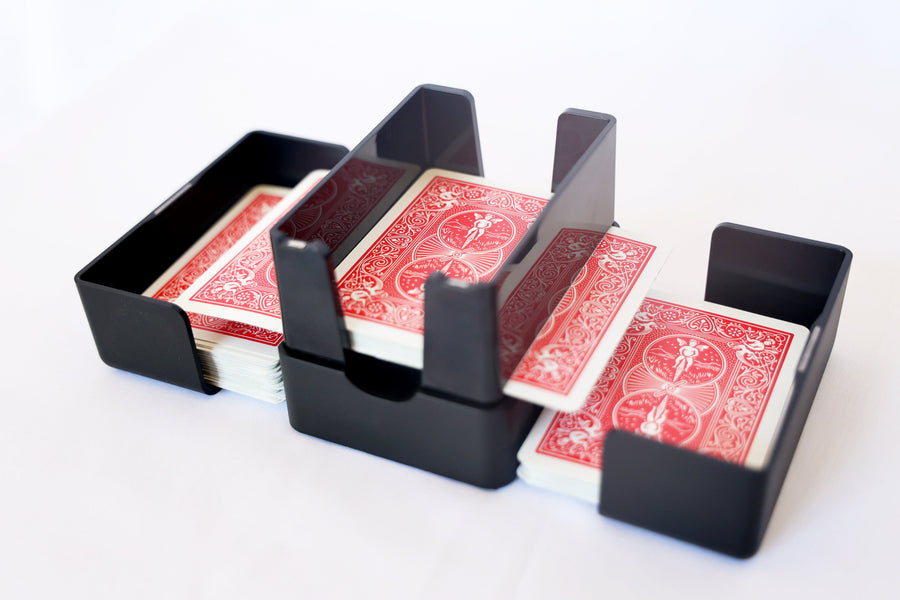
Product photo shows the original Lotus V1.
The one these guides keep pointing to
Lotus Card Shuffler V2
The Tabletop Family rated the Lotus V2 24/25, their Best Overall among the 8 distinct models they bench-tested from 13 shufflers. Lotus supplied its review units.
$89.00 Free US shipping
Order Now