
The Four Ingredients of a Ritual That Sticks: Collins's Recipe for Game Night
A sociologist reverse-engineered why some gatherings bind people and others fall flat. A card game checks every box on his list. Dinner in front of the TV misses the one that matters most.
The sociologist Randall Collins spent a career on a deceptively simple question: why do some times together leave you charged and bonded, while others leave you sitting in a room with people you love, feeling oddly alone? In Interaction Ritual Chains (2004), he argued that the difference is not warmth, history, or good intentions. It's a set of mechanics. When the mechanics are present, an ordinary gathering becomes what he called a successful interaction ritual, and it produces something you can feel: a lift of shared energy, a stronger bond, the sense of being a we. When they're missing, you get people physically near each other and emotionally nowhere.
When the mechanics are present, an ordinary gathering becomes what he called a successful interaction ritual, and it produces something you can feel: a lift of shared energy, a stronger bond, the sense of being a we.
Collins built on Émile Durkheim, who studied how communal gatherings generate what he termed collective effervescence, and on Erving Goffman, who showed that everyday interactions run on tiny rituals of attention and deference. Collins's contribution was to name the ingredients precisely. There are four. A card game at the kitchen table delivers all four. Collins never wrote about card games; the checklist is his and the table is our reading of it.
The Four Ingredients
Collins identified four conditions that have to be present for the ritual to catch:
1. Bodily co-presence. People in the same physical space, able to affect each other through posture, gesture, and the small unconscious signals bodies send. Co-presence matters because the rhythm a group falls into is something bodies do together, below the level of talk. A phone call or a group chat can't reach it.
2. A barrier to outsiders. A sense of who is in and who is out, so the people present know the moment is theirs. The boundary doesn't need to be unfriendly. It needs to exist, so attention has an edge to gather inside.
3. A shared focus of attention. Everyone looking at the same thing, and, the part Collins stressed, everyone aware that everyone else is looking at it too. Mutual focus, rather than parallel focus. Two people watching the same screen in silence each have a focus; they don't have a shared one.
4. A shared mood. A common emotional tone that the group feels together and feeds back to each other, building as it circulates.
When all four lock in, Collins says they amplify one another. Bodies entrain to a shared rhythm, the rhythm intensifies the shared mood, the mood deepens the focus, and the loop tightens. The output is what he called emotional energy, the warm, confident, connected feeling you carry out the door. Membership feels real. The night stuck.
Why a Card Game Hits All Four
Run a typical activity against the checklist and most fall short on at least one count. A card game clears all four almost by accident.
Co-presence is built in. A card game requires a table, chairs pulled close, hands and faces in view. You read the player across from you: the pause, the tell, the grin held back. Bodies are doing the work Collins described whether you notice it or not.
The barrier is the table itself. The people in the hand are in; everyone else is out. A round has a beginning and an end. It draws a line around the group, which is exactly what a boundary is for.
Shared focus is the heart of it, and where most home activities fail. A card game forces mutual attention by design. The cards on the table are the one thing everyone must watch, and everyone knows everyone is watching. You can't drift without falling behind. Compare this to dinner in front of the television, where each person's attention runs to the screen in private. That's parallel focus, not shared. Collins's model predicts it generates almost no bond.
Shared mood rides on top of the other three. The turns and reversals of a game move the whole table at once: the groan, the laugh, the held breath before a reveal. Because everyone is watching the same thing in the same room, the feeling circulates and builds. That is collective effervescence at the scale of a kitchen table.
This is why we should hang out more so often disappoints, and why a regular game night so often works. Good company in a room is not the ritual. The ritual needs an object to gather around.
Designing the Night
If Collins is right, hosting well is not about charm. It's about engineering the four ingredients on purpose.
Put people at a table, close, facing each other, and you protect co-presence. Set a start time and let the deal mark a clear beginning, and you give the night a boundary. Choose a game that demands real mutual attention rather than turn-taking in isolation, and that becomes your shared focus. Pick something with enough swing to move the table emotionally, and that seeds the shared mood. Then get out of the way and let the loop tighten.
The one thing that undoes all of it is friction. Anything that pulls a person out of the shared focus breaks the loop Collins is describing: a fumbled shuffle, a re-deal, a deck that comes back half-sorted from a kid's card trick. The focus drops, the mood deflates, the bond stops building, and the table has to climb back up from the bottom.
A shuffler belongs in this essay only if it protects the four. The Lotus takes the deck whole into one tray, deals it card by card into two piles, and gives it back; three passes between hands, and nobody has left the table or the focus. That is all it claims here. It does not make the ritual. It stays out of the ritual's way.
Read Collins's four conditions once more. He puts the object in only one of them; at a card table it turns up in all four. Bodies gather around something. A boundary encloses something. Attention needs a thing to land on, and a mood needs an event to ride. That is why company alone so rarely does it, and why the same people around a deck of cards so often do.
Sources
- Randall Collins, Interaction Ritual Chains (2004)
- Erving Goffman, Interaction Ritual: Essays on Face-to-Face Behavior (1967)
- Émile Durkheim, The Elementary Forms of Religious Life (1912)
A ritual this delicate deserves machinery that respects it: a quiet shuffle that never steals the focus it exists to protect.
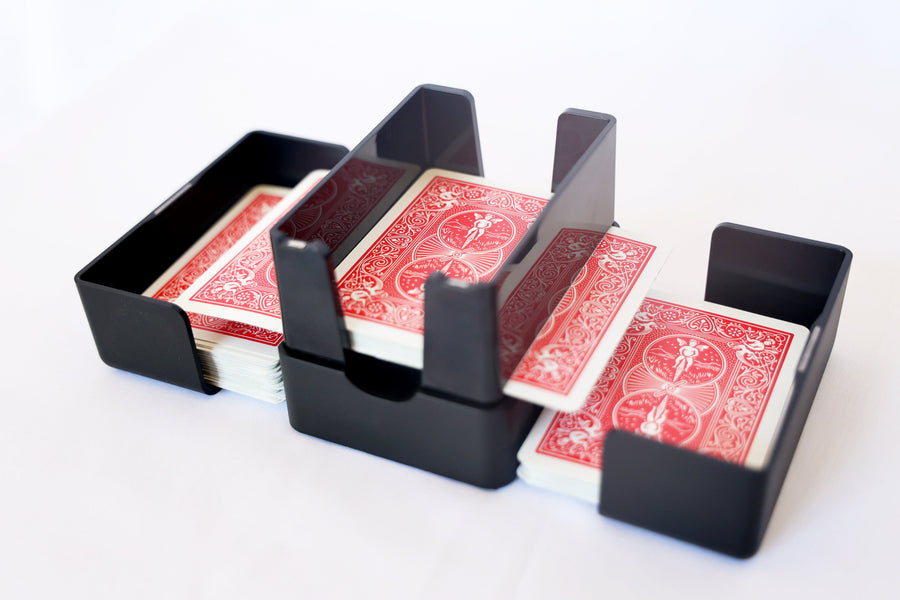
Product photo shows the original Lotus V1.
The one these guides keep pointing to
Lotus Card Shuffler V2
The Tabletop Family rated the Lotus V2 24/25, their Best Overall among the 8 distinct models they bench-tested from 13 shufflers. Lotus supplied its review units.
$89.00 Free US shipping
Order Now