
The Freedom to Quit Is What Makes It Play
Peter Gray's definition of play has a counterintuitive core: it only counts if you're free to leave. Which means the surest way to kill a recurring game night is to make it mandatory.
The psychologist Peter Gray, who has spent his career studying how children learn, lists several features that distinguish play from everything else people do. One sits at the center: play is freely chosen, and players can quit at any time. The freedom to leave isn't a loophole in play. It's the thing that makes it play at all.
One sits at the center: play is freely chosen, and players can quit at any time.
This lands strangely on anyone who hosts a recurring game night and finds themselves nudging, reminding, and gently guilting people into showing up. The instinct makes sense. You want the ritual to hold. But Gray's definition points the other way. The moment attendance becomes an obligation, the activity changes category. It stops being play and becomes a duty that happens to involve dice.
Why the exit makes the room
Consider what the freedom to quit actually does in a room full of people. If everyone present could leave and chose not to, then their presence carries information. They are here because they want to be. That fact works all evening. It means the laughter is real, the attention is genuine, and nobody is running an internal clock waiting for the polite moment to go.
This is the inversion worth sitting with. The most binding game nights are the ones nobody is forced to attend. Voluntariness isn't a weakness in the structure that you shore up with reminders and obligation. It is the glue. A standing invitation that people keep accepting tells you something a mandatory event never can: this is worth choosing, again and again.
Bernard Suits, in his 1978 book The Grasshopper, gave one of philosophy's cleanest definitions of game-playing. To play a game, he wrote, is "the voluntary attempt to overcome unnecessary obstacles." Every word in that sentence is doing work, but notice the first one. Voluntary. You agree to use only the cards you're dealt, to take turns, to follow rules that exist for no reason except that they make the game possible. You accept limits you could refuse, because accepting them is the whole point. Suits called this the "lusory attitude," the willing embrace of inefficient rules for the sake of the activity they create. Compulsion poisons it. An obstacle you're forced to face isn't a game. It's just an obstacle.
The circle you step into, not the one you're pushed into
Johan Huizinga saw the same thing from a wider angle. In Homo Ludens (1938), his study of play as a foundation of culture, he described play as something set apart from ordinary life inside a bounded ground. His own list of those grounds runs from the arena to the temple to the stage and includes the card-table; the phrase "magic circle" sits in that list, and later game scholars made it the name for the whole idea. Step into it and different rules apply. The score matters intensely for an hour and then matters not at all. The ground has a strange property, though. It only works if you step onto it willingly. Huizinga held that play is free, "is in fact freedom." A ground someone shoves you onto is a smaller cage.
What these three thinkers share, across very different projects, is the recognition that the voluntary frame is not decoration around the real activity. It is the activity's precondition. Take it away and the thing collapses into something that wears the same clothes but has a different heart.
So the practical move for a host is almost the opposite of the obvious one. Stop optimizing for attendance. Optimize for the kind of evening people would choose. Make the room warm. Make the food good. Make the games fun and the company present. Then leave the door open and trust that an evening worth choosing will get chosen. The people who come because they want to are the ones who make it a night anyone wants to come back to.
This reframes the empty chair, too. When someone skips, the right read isn't betrayal. It's information. Either tonight wasn't their night, which is fine and human, or the evening isn't yet worth choosing, which is something you can actually work on. Guilt obscures that signal. Freedom clarifies it.
What this asks of the host
If the work isn't getting people through the door, it's making the inside of the door worth crossing. A lot of that is presence and warmth, which no tool can manufacture. But some of it is friction, and friction is worth attacking, because friction is the small tax that turns a freely chosen evening into a slightly tedious one.
The shuffle is a clean example. Hand-shuffling between rounds is the dead air where attention leaks out, where someone checks a phone and the evening sags. It's a stretch of obligation inside an evening that's supposed to be chosen. An automatic shuffler takes that recurring chore off the table. The Lotus runs a true riffle, one pass per touch and near-random after about seven, so the next hand starts before the energy drops. That's what removing friction buys you: not a faster game, but a longer stretch of the thing people came for. An open door gets people into the room. Removing the small frictions is part of how you make the room worth choosing once they're in it.
You can't force play into existence. Gray, Suits, and Huizinga all say so, in their own vocabularies, and none of them wrote about a Tuesday card night; the step from their definitions to your table is ours. What you can do is make the evening so worth choosing that people keep walking through an open door. The freedom to quit is what makes it play. The fact that nobody does is what makes it yours.
Sources
- Peter Gray, Free to Learn (Basic Books, 2013)
- Bernard Suits, The Grasshopper: Games, Life and Utopia (1978)
- Johan Huizinga, Homo Ludens: A Study of the Play-Element in Culture (1938)
Play only counts when everyone at the table could leave; a game night people keep choosing is the proof that nobody wanted to.
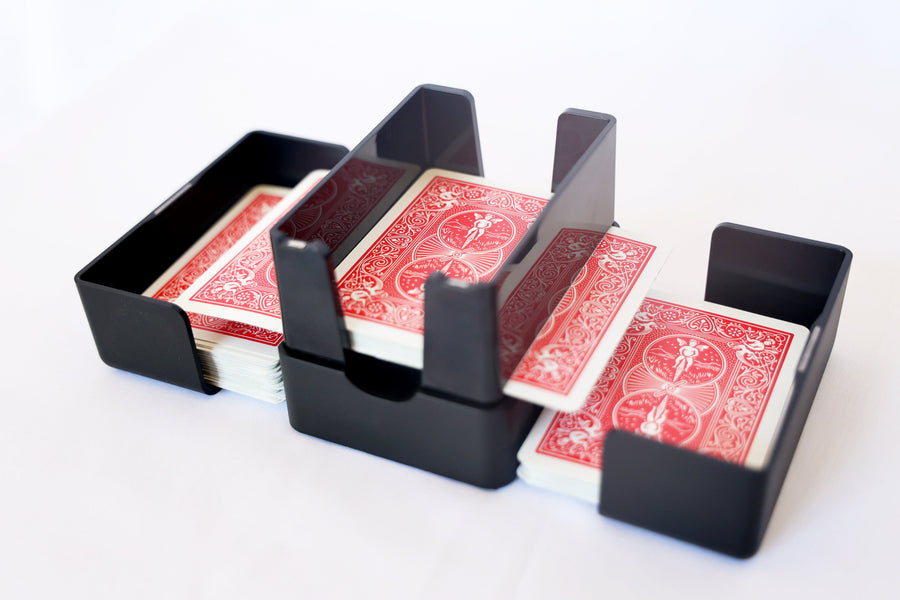
Product photo shows the original Lotus V1.
The one these guides keep pointing to
Lotus Card Shuffler V2
The Tabletop Family rated the Lotus V2 24/25, their Best Overall among the 8 distinct models they bench-tested from 13 shufflers. Lotus supplied its review units.
$89.00 Free US shipping
Order Now