
The League, Not the Outing: Why a Standing Tuesday Beats the Perfect Party
The night you remember is doing less relational work than the boring one you keep. Recurrence, not magnitude, is the active ingredient.
You have probably hosted a game night you were proud of. The good lighting, the snacks that took an afternoon, the friends who said on the way out that you should really do this more often. And then you didn't, or you did it again eight months later, with the same effort and the same warm dispersal afterward.
Here is the uncomfortable reading we take from the research: the elaborate annual gathering does less for your relationships than a modest one you repeat every week. Nobody ran that comparison in a lab; the argument below is ours, built from three people who studied the pieces. What builds connection is not the size of any single event. It's the return.
What Putnam actually found
Robert Putnam's Bowling Alone is remembered for its title image, but the argument is more specific than the metaphor. Putnam tracked the decline of American "social capital" across the second half of the twentieth century, and what he found mattered was not whether people occasionally gathered. It was whether they belonged to recurring structures.
The league is doing the work in his title, not the bowling. More Americans were bowling than before; what collapsed was league membership, the standing slot with the same people week after week. League play builds the dense, repeated ties that produce trust, reciprocity, and the small favors that make a community function. Solo bowling, or one big outing a year, does not. The recurrence is what converts time spent together into a relationship you can draw on later.
More Americans were bowling than before; what collapsed was league membership, the standing slot with the same people week after week.
This reframes the host's instinct. The energy you spend making one night spectacular is, in social-capital terms, partly spent on the wrong thing. The same energy spread thin across a repeating slot compounds.
Why repetition is the mechanism
The sociologist Randall Collins explains the mechanism underneath Putnam's pattern. In Interaction Ritual Chains, Collins argues that connection is built by a specific kind of encounter: people physically present together, attention focused on a shared object, a mood building between them. When that happens, it produces what he calls emotional energy and a sense of group membership, a small charge of belonging that people carry away.
The word doing the heavy lifting in his title is chains. A single successful gathering gives you one good night. It is the chain of them, each encounter feeding into the next, that builds a durable bond and a shared identity. Collins's whole model is sequential. The ritual that happened last week is part of what makes this week's land. One peak event, however well produced, is a link with nothing to attach to.
This is why the perfect party can feel oddly hollow afterward, and why a scrappy weekly night feels like more even when each installment is forgettable. Co-presence has to repeat for the chain to form. A game night gives you Collins's ingredients almost for free: bodies in a room, attention on the shared board, a mood that rises and falls together. The only ingredient you control is whether it happens again.
The difference between a routine and a ritual
You might object that "weekly" sounds like one more obligation, another recurring thing to manage. The research on family life draws a useful line here. Barbara Fiese, who has spent decades studying family routines and rituals, distinguishes the two: a routine is instrumental, something you do and then forget, while a ritual carries meaning and a sense of "this is who we are." Her work associates family rituals with better outcomes for children and a stronger sense of belonging, where bare routines do not carry the same weight.
The encouraging part is that the line between them is thin. A routine becomes a ritual mostly through repetition and a little attention to what it means. The standing game night that starts as logistics ("it's the night that works for everyone") becomes, after enough returns, a thing the family is. The kids start guarding the slot. That transformation is not available to the annual blowout, no matter how lovingly produced, because it never repeats often enough to become identity.
So the practical advice inverts the usual hosting wisdom. Lower the bar for any single night so you can clear it every week. The goal is not the unforgettable evening. It's the forgettable evening you keep having, until the keeping is the point.
Removing the friction that kills the chain
If recurrence is the active ingredient, then the enemy is anything that adds drag to doing it again. The annual party survives a lot of friction because it only has to happen once. The weekly night does not. Every small chore that stands between sitting down and actually playing is a tax on repetition, and over enough weeks, taxes are what kill a habit.
Setup is one of those taxes. The hand-shuffling, the dropped cards, the deck that comes back half-sorted from the last round. None of it is hard; it's just enough friction to make "let's skip this week" a little easier to say. A Lotus shuffler removes that particular drag: a true riffle, about five seconds a pass and near-random after about seven, so the night starts on the first deal and the table stays in the conversation instead of the logistics. It does not make one night spectacular. It makes the next one easier to begin, and the next one is the whole point. The league was never the bowling. It was the Tuesday.
Sources
- Robert D. Putnam, Bowling Alone: The Collapse and Revival of American Community (2000)
- Randall Collins, Interaction Ritual Chains (2004)
- Barbara H. Fiese, Family Routines and Rituals (2006)
A standing Tuesday survives on being easy to repeat, which is why weekly beats annual at the card table just as it did in Putnam's leagues.
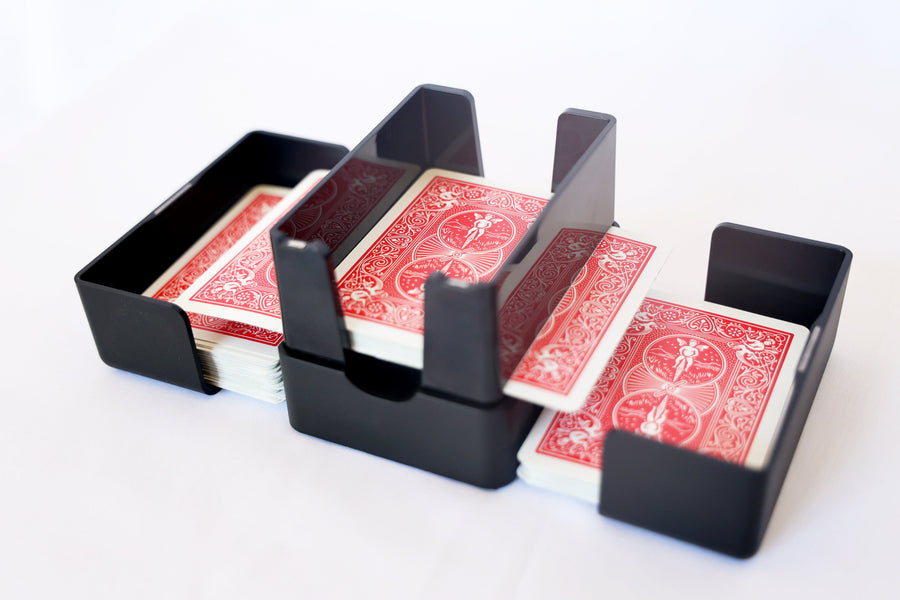
Product photo shows the original Lotus V1.
The one these guides keep pointing to
Lotus Card Shuffler V2
The Tabletop Family rated the Lotus V2 24/25, their Best Overall among the 8 distinct models they bench-tested from 13 shufflers. Lotus supplied its review units.
$89.00 Free US shipping
Order Now