
The Open Chair Strategy: Sociology's Case for Always Inviting One More
The healthiest thing you can do for your social life isn't tightening your inner circle. It's permanently reserving one chair for whoever's on the edge of it.
Most advice about adult friendship tells you to go deeper with the people you already love. Protect your inner circle. Cancel less. Text the close ones back. All good. But there's a quieter finding in sociology that points the other way, and it's the one that actually solves the problem people are usually trying to solve when they say they want to make new friends.
The finding is this: the relationships that change your life most are usually not your closest ones. They're the people one step out. The friend-of-a-friend. The neighbor you wave to. The person someone brought along who you'd never have met on your own. If you want more of that in your life, you don't need a new personality or a bigger network. You need one open chair, kept open on purpose.
Why the person on the edge matters more than you'd think
In 1973, sociologist Mark Granovetter published a paper with a title that sounds like a paradox: "The Strength of Weak Ties." Studying how people actually found jobs, he noticed that the useful lead rarely came from a close friend. It came from an acquaintance, someone they saw occasionally, knew loosely, weren't especially intimate with.
Studying how people actually found jobs, he noticed that the useful lead rarely came from a close friend.
His explanation is the part worth keeping. Your close friends mostly know what you know and who you know. You move through the same world, the same information, the same handful of rooms. A weak tie lives in a different cluster. They're connected to people, opportunities, and ideas you have no other path to. Granovetter called these connections "bridges." The value isn't in the strength of the relationship. It's in the reach. A weak tie is a door into a room you'd otherwise never enter.
This reframes what an acquaintance is for. The person on the edge of your circle isn't a lesser friend you haven't gotten around to upgrading. They're structurally positioned to bring you something your inner circle, by definition, cannot.
The hosting rule this produces
Stack Granovetter's insight against a simple truth about adult life, that we mostly stop being introduced to new people, and the host's move becomes obvious.
Bridging ties need a place to form. They don't appear because you wished for them. They appear because two clusters that wouldn't otherwise touch end up at the same table. As a host, you are the only person who can arrange that. You are the bridge-maker. And the cost of building one more bridge is a single chair.
So the rule: every time you gather people, deliberately reserve one seat for someone outside your core circle. The new coworker. Your friend's visiting sibling. The neighbor you keep meaning to ask. The person who just moved here and knows no one. Not the whole guest list. One chair, every time.
What makes this work is that it's a standing policy, not a one-time act of courage. "I'll invite someone new when I feel up to it" never survives contact with a busy week. "There's always one open chair" runs on its own. It turns the awkward, effortful project of making new friends as an adult into a structural feature of how you already spend your evenings.
A few things make the open chair land well:
- Anchor the new person to the regulars, not to the void. A quick, specific introduction ("Maya, this is Sam, the one who actually knows how to fix a sourdough starter") gives them a thread to grab.
- Pick activities that carry the conversation. A shared task does the social work so no one has to perform. Which is exactly what a good game night is built to do.
- Lower the stakes of the invite. "Come by, we play cards on Thursdays, no need to be good at anything" is a far easier yes than "let's get dinner sometime," the invitation everyone offers and no one schedules.
Why this needs a place, not just an intention
Granovetter tells you weak ties are valuable. Eric Klinenberg, in Palaces for the People (2018), tells you they don't form in midair. They form in places.
Klinenberg's term is "social infrastructure," the physical settings that shape how often, and how well, people interact. Libraries, parks, barbershops, courtyards, the corner café where the same faces show up. When that infrastructure is strong, casual connection happens almost by accident, just by people sharing space repeatedly. When it's thin or absent, people retreat into private life and weak ties quietly starve. His research after Chicago's 1995 heat wave found that neighborhoods with richer social infrastructure simply kept more people alive, because connection was woven into the daily geography rather than left to individual effort.
Most adults don't have much of this anymore. The third places have thinned out. Which means the gathering you host has quietly become social infrastructure, maybe the most reliable kind in your friends' lives. A recurring table is a small palace for the people who sit at it. When you keep one chair open, you turn your home into the bridge that the surrounding world has stopped providing.
That's the whole strategy, and it's almost embarrassingly small. You don't need to be more outgoing or build a network. You need a regular table and a habit of leaving room at it. The math is generous: most of those new faces stay acquaintances, and that's fine, because acquaintances are exactly the ties Granovetter showed carry the disproportionate value. Every so often, one becomes a real friend. You only get those rolls of the dice if the chair is there to be filled.
There's a small, practical reason the table is where this works. The whole point of the open chair is that the newcomer arrives as a person, not as a project, and the fastest way to undo that is the dead minute of fumbled dealing, where the new face has nothing to do but feel new while everyone waits on the cards. A shared game does the social work, but only when the mechanics stay out of the way; a Lotus shuffler at the center of the table closes that minute, handing back a properly mixed deck while the host does the one job only the host can do: anchoring the new person to the regulars. The hand keeps moving, the talk keeps going, and the stranger in the open chair gets the one thing a bridge needs: a reason to stay at the table long enough to become a tie. Keep the chair open. Someone good is usually closer to the edge of your circle than you think.
Sources
- Mark S. Granovetter, "The Strength of Weak Ties," American Journal of Sociology (1973)
- Eric Klinenberg, Palaces for the People: How Social Infrastructure Can Help Fight Inequality, Polarization, and the Decline of Civic Life (2018)
Keep the chair open long enough and the stranger becomes what Granovetter promised: the acquaintance at your table quietly doing more than anyone thinks.
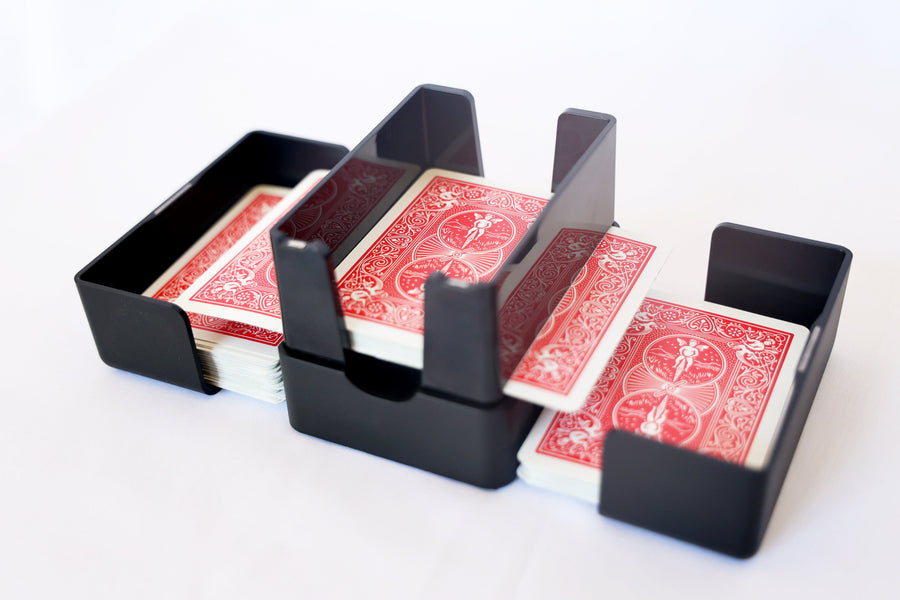
The one these guides keep pointing to
Lotus Card Shuffler V2
TheTabletopFamily’s Best Overall pick. V2 scored 24/25, first of the 8 distinct models they bench-tested from 13 shufflers bought. Two decks, no buttons. Pre-order ships October.
$89.00 Free US shipping
Pre-order V2