
The Opposite of Play Is Not Work. It's Depression.
The scholar who spent a lifetime studying play came to a conclusion that should change how you think about your free evenings.
Ask most adults what the opposite of play is and they answer instantly: work. Play is the indulgence, work is the obligation, and somewhere around the time the mortgage arrived, the second crowded out the first. That framing makes play optional. A reward for finishing the real things.
Brian Sutton-Smith spent more than forty years studying play across cultures, species, and ages: the rough-and-tumble of children, the rituals of festivals, the games adults invent and forget they need. At the end of all that research, in The Ambiguity of Play (1997), he landed on a line that dismantles the whole play-versus-work arrangement. The version everyone quotes, the opposite of play is not work, it is depression, is the short form. What he wrote is that the opposite of play "is not a present reality or work, it is vacillation, or worse, it is depression."
At the end of all that research, in The Ambiguity of Play (1997), he landed on a line that dismantles the whole play-versus-work arrangement. The version everyone quotes, the opposite of play is not work, it is depression, is the short form. What he wrote is that the opposite of play "is not a present reality or work, it is vacillation, or worse, it is depression."
Read that twice. He isn't saying play is fun, or relaxing, or good for you. He is saying that the absence of play and the presence of depression describe the same condition from two directions: a life drained of vitality, spontaneity, and the felt sense that being alive is worth the trouble. Which makes a deck of cards on the kitchen table something other than a toy. It makes it mood infrastructure.
Why a researcher would say something so strong
Sutton-Smith was not being poetic. He was pointing at what play does to a nervous system, and two other researchers spent their careers filling in the mechanics.
Jaak Panksepp, the neuroscientist who mapped the emotional systems we share with other mammals, identified PLAY as one of the brain's basic, hardwired circuits, sitting alongside the systems for fear, care, and seeking. In Affective Neuroscience (1998), he showed that play isn't a thin cultural veneer over otherwise serious creatures. It's deep, ancient equipment. Rats raised without the chance to play develop poorly. The drive to play, in his account, is a genuine appetite, like hunger. And like hunger, it doesn't disappear in adulthood. It just goes unfed, and we stop noticing the deficit because we've relabeled it as maturity.
Stuart Brown, a physician who began his research interviewing people whose lives had gone badly wrong, kept finding the same hole in their histories: a near-total absence of play. In Play: How It Shapes the Brain (2009), he came to argue that play is not the opposite of seriousness but a partner to it, and that play-deprived adults tend toward rigidity, brittleness, and a flatness of affect that looks a lot like the gray edge of depression. His prescription was not "work less." It was "play more," and he meant it literally, as a need rather than a lifestyle tip.
Put the three together and Sutton-Smith's line stops sounding like a provocation. Play is a built-in appetite (Panksepp), its long-term absence shows up in damaged, joyless lives (Brown), and the lived opposite of that vitality is depression (Sutton-Smith). Adults didn't outgrow the need. We just stopped scheduling it.
The delivery problem
The catch is delivery. Knowing play is good for you does roughly nothing, for the same reason knowing vegetables are good for you doesn't change dinner. Appetites need delivery systems. The reason adults stop playing isn't that they decided to. It's that play, for grown-ups, has no default container. Childhood had recess, the cul-de-sac, the long unstructured afternoon. Adulthood has a calendar, and play is the only thing on it that never gets an entry.
This is what a recurring game night solves. Not boredom. The delivery problem. A standing table, every other Friday, the kids included or the kids in bed, the same friends or whoever's around, turns "I should play more" into a thing that simply happens, the way a gym membership only works once it becomes a Tuesday habit rather than a good intention. The format is almost beside the point. Poker, rummy, a sprawling board game, a fast card game that ends in laughter and accusations. What matters is that the appetite gets fed on a schedule.
And it has to be easy, because the friction is where these rituals die. The night someone can't find a full deck, or the shuffle takes forever, or the cards stick and the deal gets argued over, is the night the whole thing starts to feel like effort. Play that costs effort to start is play that stops happening. Every removed annoyance is one less reason to skip next time.
A small piece of infrastructure
A tool like Lotus earns its spot here, not as the point of the evening, but as the thing that gets out of its way. An automatic shuffler does one job well: a clean riffle every hand, three passes between deals and the deck is mixed, so nobody's stuck doing the tedious part and the table stays in the conversation instead of the logistics. Run it three times and you have the kind of mixed deck that makes the game feel fair without anyone thinking about it. The cards keep moving, and so does the night.
That is a modest claim. The shuffler doesn't make the connection. The people do. But if Sutton-Smith was right, if play is where adults get back the vitality its absence drains away, then the small objects that keep a game night from falling apart are doing more than they appear to. They're keeping the appointment. And the appointment, kept often enough, is the point.
You don't need a reason to play. That was the point all along. But if you've been treating game night as the thing you'll get to once the serious work is done, consider that you may have had it backwards. The play might be the serious part.
Sources
- Brian Sutton-Smith, The Ambiguity of Play (Harvard University Press, 1997)
- Stuart Brown, Play: How It Shapes the Brain, Opens the Imagination, and Invigorates the Soul (Avery, 2009)
- Jaak Panksepp, Affective Neuroscience: The Foundations of Human and Animal Emotions (Oxford University Press, 1998)
If the appointment is what matters, a quiet clamshell shuffler is our way of making it easier to keep.
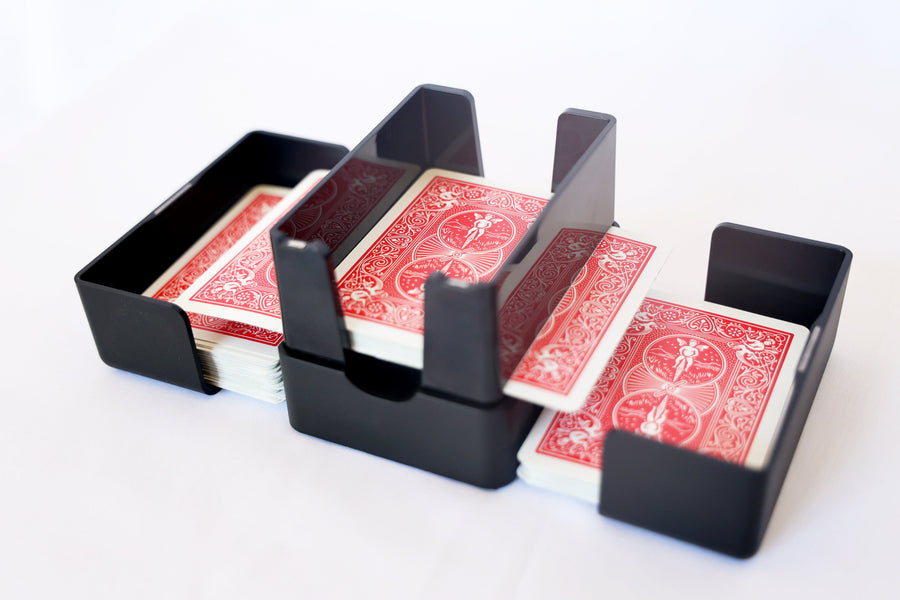
Product photo shows the original Lotus V1.
The one these guides keep pointing to
Lotus Card Shuffler V2
The Tabletop Family rated the Lotus V2 24/25, their Best Overall among the 8 distinct models they bench-tested from 13 shufflers. Lotus supplied its review units.
$89.00 Free US shipping
Order Now