
The Set Time and the Set Place: Why Game Night Needs a Spot, Not Just a Slot
Families remember to schedule game night and forget to locate it. The research says place does real work that a floating "wherever there's room" can never do.
Ask a parent how they protect game night and you'll hear about the calendar. Thursdays. Every other Sunday. The slot is sacred; the spot is wherever the table happens to be clear. That's the part most rituals get backward. When Dorothy and Jerome Singer studied how imaginative play takes hold in children, they found it flourished under two conditions, not one: a predictable time and a predictable place. The place wasn't decoration around the real thing. It was part of the real thing.
When Dorothy and Jerome Singer studied how imaginative play takes hold in children, they found it flourished under two conditions, not one: a predictable time and a predictable place.
This is a small change and an unusually durable one. You can make it this week, and it asks nothing except that you stop moving the game.
What the place is actually doing
In The House of Make-Believe, the Singers describe play not as something children do anywhere on impulse but as something that deepens inside a stable frame. A known corner, a particular rug, a table that means this is where we do this. The consistency itself becomes a signal. The child doesn't have to spend the first ten minutes figuring out whether this is a real occasion or a maybe. The setting has already answered that.
A meditator knows the feeling from the other side. Sit on the same cushion at the same time long enough and the body starts to settle before the mind decides to. The cushion becomes a cue. You're not summoning calm from scratch each time; the place is doing some of the carrying. A child's nervous system learns to trust a spot the same way. The reserved table says you can drop in here, and over weeks that message gets faster and more automatic until arriving at the table is itself part of the unwinding.
A floating game night can't send that signal. If it's the kitchen counter one week and the coffee table the next and the floor when cousins visit, every session reintroduces a small question, where are we, is this the good version or the rushed version, and the answer has to be rebuilt each time. The time tells everyone when. Only the place tells the body yes, this, the way we do it.
Ritual lives in the how and the where
The anthropologist Catherine Bell spent her career on a quietly radical point: what makes something a ritual isn't the content. It's the way it's set apart and performed. In her work on ritualization, the meaning rides on the how and the where: the marked-off space, the repeated form, the sense that this moment is distinguished from ordinary moments. Strip the framing and you don't have a smaller ritual. You have an ordinary activity that happens to involve dice.
That reframes what a fixed spot buys you. You're not decorating a hobby. You're doing the one thing that turns a recurring activity into a ritual: setting it apart, in space, on purpose. The table by the window with the good light. The corner where the rug is. The board that lives out, not packed away in a closet that takes a negotiation to reach. Each is a way of saying this is set apart, which is the whole engine of ritual according to Bell, and which a wandering location actively erodes.
It's worth being plain about the evidence here. The Singers studied imaginative play in children, and Bell theorized ritual across cultures. Neither ran a trial on family board games. The honest claim is narrower and still strong: the conditions that deepen children's play and the conditions that turn activity into ritual both point at the same overlooked variable. Place. The application to your Thursday night is reasonable inference, not a proven result, and it costs you almost nothing to test.
How to give game night a spot
A few concrete moves, in rough order of return:
- Pick the place once, then stop deciding. Choose the table or corner and let it be the default. The goal is to remove the weekly "where should we set up" question entirely. Same spot, every time, until it's invisible.
- Make the spot legible to a kid. It should be obvious to a five-year-old where game night happens, not because you announced it, but because it's always been there. That's the cue forming.
- Let it stay set up if you can. A board or shuffler that lives out on the table is a standing invitation. Packing everything away after each session quietly tells everyone the occasion was temporary.
- Protect the where as hard as the when. When the table is needed for something else, you've found the real test. Moving game night "just this once" is how the spot stops being a spot. Defend the location with the same seriousness you give the time.
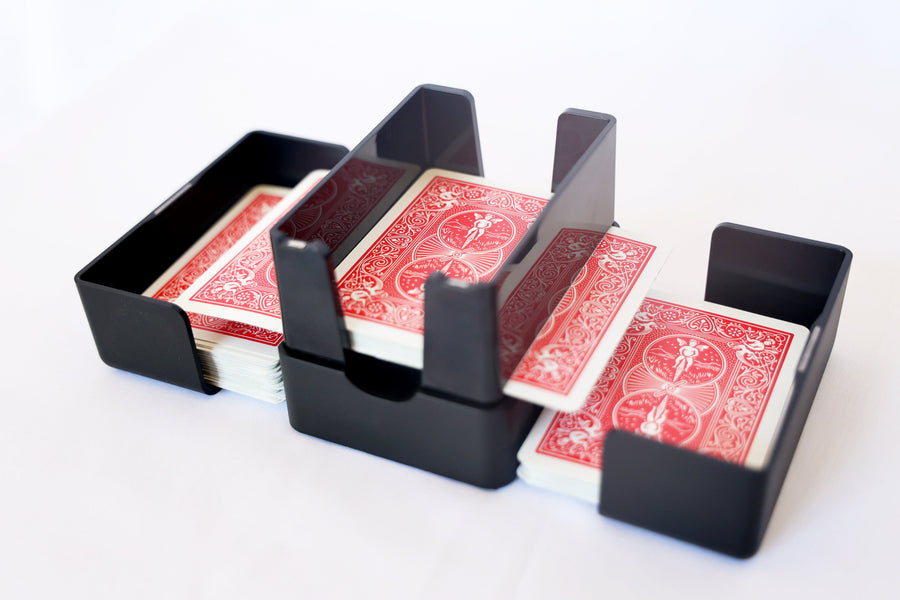
- Keep the friction out of the frame. The point of a set place is that arriving there is already the start of the ritual. Anything that turns the first few minutes into setup (hunting for pieces, an uneven hand-shuffle that stalls the deal) pushes against the cue you're building. This is the small, unglamorous case for a shuffler that lives on the fixed table: it keeps the spot meaning play, not prep. The shuffle is over before the chairs are all pulled in, so the table stays the table and the night starts the moment everyone sits down.
Give it a season. Same time, same spot, board left out: the same standing invitation we built the Lotus shuffler to be part of. The slot you already had. The spot is the part that makes it hold.
Sources
- Dorothy G. Singer and Jerome L. Singer, The House of Make-Believe: Children's Play and the Developing Imagination (Harvard University Press, 1990).
- Catherine Bell, Ritual Theory, Ritual Practice (Oxford University Press, 1992).
A set place deserves one object that never leaves it, which is why the shuffler we make folds shut and waits on the table for next week's game night.
The one these guides keep pointing to
Lotus Card Shuffler V2
TheTabletopFamily’s Best Overall pick. V2 scored 24/25, first of the 8 distinct models they bench-tested from 13 shufflers bought. Two decks, no buttons. Pre-order ships October.
$89.00 Free US shipping
Pre-order V2