
The Bid Across the Table: What Gottman's Divorce Lab Reveals About Game Night
A psychologist learned to predict divorce from how partners answered tiny requests for attention. A card table runs the same test, hundreds of times a night.
In the 1990s, John Gottman and his colleagues began watching couples in a small apartment-style lab rigged with cameras and sensors. They tracked the ordinary stuff: who spoke, who looked up, who answered. From that, Gottman reported he could predict which couples would divorce with accuracy around 90 percent. He did it not by listening for shouting matches or grand betrayals, but by counting something almost too small to see.
He called it a bid. A bid is any small gesture for connection: a comment, a question, a sigh, a hand resting near yours. "Look at that bird." "Ugh, my back." "Your turn." Each one is a tiny request, and it asks the other person to do one of three things: turn toward, turn away, or turn against.
The 86 and the 33
Working with Janice Driver, Gottman put numbers to it. Couples who were still together six years later had turned toward each other's bids about 86 percent of the time. Couples who had divorced had turned toward only 33 percent. The gap wasn't in the dramatic moments. It was in the thousands of unremarkable ones, the ones nobody would think to remember.
Couples who were still together six years later had turned toward each other's bids about 86 percent of the time.
This is the part that tends to land hard, because it inverts what most people assume keeps a relationship healthy. It isn't the romantic weekend or the deep conversation that does the load-bearing work. It's whether, when one person says something small and a little hopeful into the air, the other person answers. Turning toward can be almost nothing: a grunt, eye contact, "huh, really?" The size of the response barely matters. The direction does.
Gottman lays this out in The Seven Principles for Making Marriage Work. His phrase for what these small answered bids build over time is the "emotional bank account." Each turn toward is a deposit. The account is what you draw on later, when something actually goes wrong, when a real fight needs a way back. Couples who turn toward each other across years of trivial moments have the reserves. The ones who turned away, again and again, withdrawn one unanswered "look at that" at a time, find the account empty exactly when they need it.
A table that manufactures bids
Here is where it touches the kitchen table. Most evenings don't offer many bids. People scroll, half-watch a screen, drift into separate rooms. The opportunities to turn toward someone are thin, and easy to miss without noticing they were ever there.
A card game is the opposite. It densifies bids on purpose. "Your turn" is a bid. A groan at a terrible hand is a bid. Catching someone's eye after a ridiculous play is a bid. The triumphant slap of a winning card, the mock-outrage, the laugh at your own bad luck, a kid narrating their entire strategy out loud to no one in particular. An hour of play might hold a few hundred of these small openings, each one asking the same quiet question Gottman was measuring in his lab: are you with me right now?
And at a table, turning toward is easy. You're already facing each other. You're already paying a kind of attention the game requires. The bid lands, and the answer is right there: you laugh, you groan back, you meet the eye. You can't really turn away from "your turn" without it being noticed, which is part of why the table works. It makes the healthy move the natural one.
This isn't a claim that board games save marriages. Gottman's research is about turning toward, not about any particular activity. But the mechanism he found is exactly the kind of thing a game night runs by the hundred: small bids, met or missed, accumulating into either a reserve or a deficit. Practiced at a table on a Tuesday, the same micro-skill is available for the harder bids that come later, the ones made in a tense kitchen at the end of a long day.
What gets in the way
The threat to all of this is friction. The bids only count if people are present to make and catch them, and small frustrations pull attention away. Someone fumbling a clumsy shuffle, cards spraying across the floor, a long pause while one person sorts and bridges and re-sorts while everyone else waits and reaches for a phone. Each stall is a stretch of dead time where no bids are made and the ones that surface go unanswered. The friction doesn't just slow the game. It thins the field of connection the game was supposed to create.
This is the one chore at the table worth handing to a machine. Take the shuffle off human hands and the longest stall of the evening goes with it: no sorting and bridging and re-sorting, no pause where every eye drifts toward a phone. What that protects isn't the game. It's the unbroken stretch of facing each other, the field where the bids keep coming and the answers keep landing.
Gottman spent years in a lab learning to read a relationship from its smallest gestures. The encouraging part is that the same gestures are the ones you can practice tonight, sitting across a table from the people you'd most like to stay close to. So you keep the table clear of the things that pull attention sideways. You take the fumbled deal out of the loop, the dead time we built the Lotus shuffler to hand back to the bids. And then you do the only thing the research says actually matters: you stay turned toward each other, one answered bid at a time.
Sources
- John Gottman and Nan Silver, The Seven Principles for Making Marriage Work (1999): bids, turning toward/away/against, the emotional bank account, the ~90% divorce-prediction figure.
- Janice R. Driver and John M. Gottman, research on turning toward bids for connection and its association with relationship stability (the 86% vs. 33% finding).
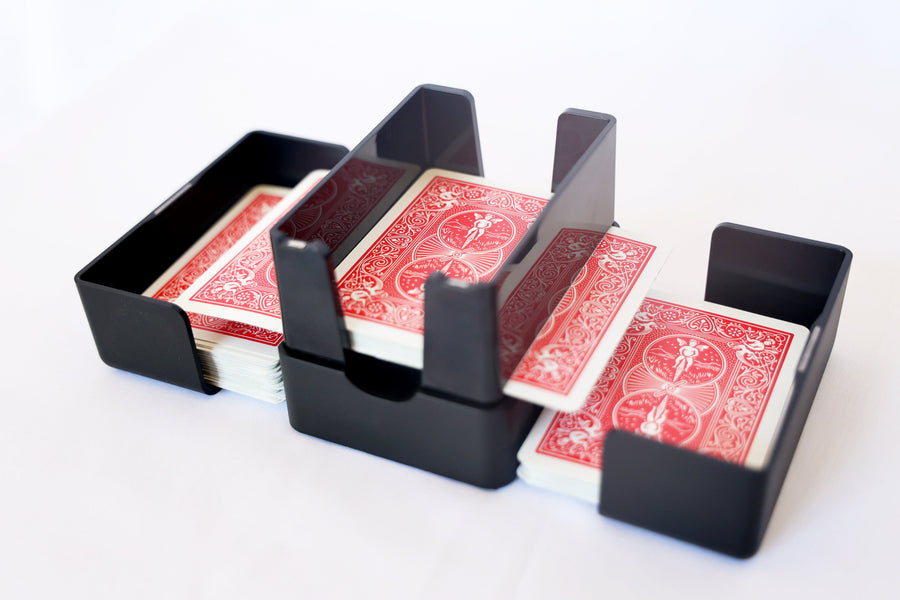
The shuffler we make has no buttons to fuss over: a touch starts the riffle, and the table stays turned toward its bids.
The one these guides keep pointing to
Lotus Card Shuffler V2
TheTabletopFamily’s Best Overall pick. V2 scored 24/25, first of the 8 distinct models they bench-tested from 13 shufflers bought. Two decks, no buttons. Pre-order ships October.
$89.00 Free US shipping
Pre-order V2