
Threshold, Not Transition: Why Clearing the Table Is the Most Important Move of the Night
Anthropologists studying rites of passage found that the ritual fails without a marked act of separation. If your game night sometimes never quite lands, the likely reason is that nobody crossed a threshold. Everyone just sat down.
There's a particular kind of game night that fizzles. Everyone showed up. The right people are around the table. But an hour in, three of them are half on their phones, the conversation keeps drifting back to work, and nobody can say why it never got going. You did everything right and it still felt like a continuation of the evening rather than a break from it.
The fix isn't a better game or a more interesting crowd. It's a move most home rituals skip: the deliberate act of leaving ordinary life before you try to enter the new thing.
What the anthropologists actually found
In 1909, Arnold van Gennep studied rituals across dozens of cultures (births, weddings, harvests, comings-of-age) looking for the shared structure underneath them. He found that every rite of passage moves through three phases. First separation: a marked departure from the ordinary world. Then a liminal phase: the in-between, where the usual rules are suspended. Then incorporation: the return, changed, to regular life.
The finding that matters for your Tuesday night is this: the separation phase is not optional. Van Gennep treated it as the precondition for everything that follows. Without a clear act of leaving the old state, the participant never enters the liminal space at all, and the liminal space is where transformation, or in your case connection, is supposed to happen.
The finding that matters for your Tuesday night is this: the separation phase is not optional.
Victor Turner, building on van Gennep decades later in The Ritual Process, gave that middle phase its sharpest description. The liminal is the "betwixt and between," a threshold where ordinary status and hierarchy fall away and a different kind of being-together becomes possible. Turner called the fellowship that forms there communitas: a flattened, unguarded closeness that doesn't survive the structured outside world. It's exactly the thing you're hoping for when you invite people over to play. But Turner is clear that communitas lives inside the liminal phase, and you only reach the liminal phase by first crossing out of the ordinary one.
Most home game nights skip the crossing. People drift to the table the way they'd drift to the couch. The cards come out, but no one has actually left anything behind. The phones are still live, the day is still running in everyone's head, and the table is just another surface in the same continuous evening. You moved chairs. You didn't cross a threshold.
Why naming the start changes the room
Catherine Bell, in Ritual: Perspectives and Dimensions, gives the practical reason this works. Bell shifted the question from "what is a ritual" to "what does ritualizing do," and her answer is that ritual is a way of acting that sets certain activities apart from everyday ones, marking them as more deliberate and significant. The setting-apart is the mechanism. A ritual doesn't work because of the specific gestures; it works because the gestures announce, to everyone present, that this is a different kind of time now.
That announcement is what your game night is missing. Not solemnity. You don't need a gong or a speech. You need a recognizable signal that ordinary time has paused and a bounded, shared time has begun. Bell's point is that this marking is something people do, together, in a patterned way. It's an action, not a mood you wait to descend.
This reframes the whole evening. Clearing the table isn't tidying. It's the separation rite. Putting phones in another room isn't a rule you're imposing. It's the act of leaving the ordinary world. The first shuffle isn't a chore before the fun. It's the threshold itself, the sound and motion that say, to the whole table at once, we're across now.
How to actually cross the threshold
You don't need to invent a ceremony. You need to make the start of the night a real, marked event instead of a slow slide. A few moves do most of the work.
Clear the surface completely. Not pushed-aside clutter, but a bare table. The empty surface does the same job a swept threshold or a changed garment does in van Gennep's rites: it signals that this space has been set apart for what comes next.
Make the phones leave the room, not just the hand. A phone face-down on the table is still a tether to the ordinary world. A phone in a basket by the door is a crossing. Do it visibly, do it together. The shared act is the point.
Mark the start with one clear, repeatable gesture. This is the heart of it. Pick a single moment everyone recognizes as the beginning. The cleanest one is the first shuffle: a sound and a motion the whole table registers at once. When the cards are riffled and laid down to start, there's a clean before-and-after. Ordinary time on one side, game time on the other. Repeated week after week, that gesture becomes the threshold you all step across without thinking about it.
A repeated gesture wants a repeatable sound, and this is the one place a tool helps. Hand shuffles vary, quick one night and halting the next, but the crossing lands cleanest when it sounds the same every week. That's the reason we built the Lotus shuffler: it draws the deck in, mixes it past the point where anyone at the table has to vouch for it, and sets it down ready for the first deal: the same opening note, struck the same way, every Tuesday. No one has to call the room to order. The shuffle does it. The threshold gets crossed, and the liminal space, the one Turner says connection actually lives in, finally has room to form.
The evening that "never gets going" almost always has people who came to the table without leaving anywhere. Give them a line to step over. Clear it, name it, shuffle, begin.
Sources
- Arnold van Gennep, The Rites of Passage (1909)
- Victor Turner, The Ritual Process: Structure and Anti-Structure (1969)
- Catherine Bell, Ritual: Perspectives and Dimensions (1997)
If the first shuffle is your threshold, it helps that ours is a quiet crossing: the same low note every week.
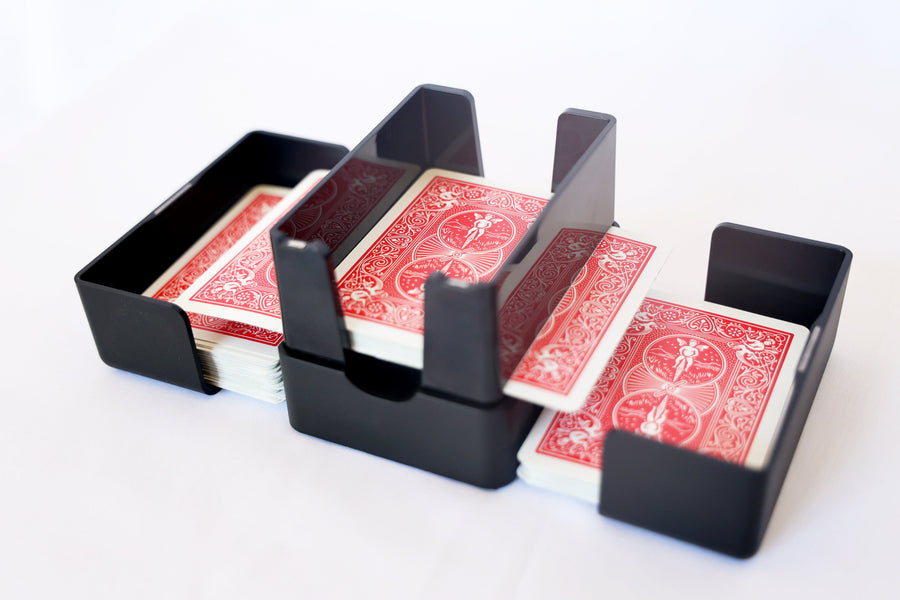
The one these guides keep pointing to
Lotus Card Shuffler V2
TheTabletopFamily’s Best Overall pick. V2 scored 24/25, first of the 8 distinct models they bench-tested from 13 shufflers bought. Two decks, no buttons. Pre-order ships October.
$89.00 Free US shipping
Pre-order V2