
Weekly Beats Annual: The Sociology of the Standing Game Night
The big reunion you plan for months is a weaker bond-builder than the unremarkable Tuesday card night you keep meaning to cancel. Three lines of social research explain why.
You can feel the pull of the grand event: the annual reunion, the destination weekend, the once-a-year gathering of everyone you love in one place. It costs months of planning and a small fortune in logistics, and afterward everyone agrees it was wonderful. Then a year passes before it happens again.
Meanwhile the standing Tuesday game night limps along. Two people text that they can't make it. Someone forgets whose turn it is to host. By any measure of spectacle, it is forgettable. And yet the people who keep that night are building something the reunion can't touch. The reason isn't effort or affection. It's structure, and specifically recurrence.
Putnam: the bond lives in the repetition, not the event
In Bowling Alone (2000), Robert Putnam spent hundreds of pages documenting the decline of American community life across the second half of the twentieth century. The title comes from his signature finding: Americans kept bowling, but they stopped bowling in leagues. The total number of bowlers rose while league membership fell. People were still doing the activity. They had stopped doing it together, on a schedule, with the same faces.
Putnam's point is that the league was not about bowling. The repeated, low-stakes contact was the thing: the standing night that put the same people in the same room week after week, where casual acquaintance slowly thickened into something you could lean on. He calls this social capital, and his core observation is that it accrues through frequency. The networks of trust and reciprocity that hold a community together are built in small, regular deposits, not large occasional ones.
He calls this social capital, and his core observation is that it accrues through frequency.
This is why the league mattered and the occasional tournament didn't. A bond is less like a monument you build once and more like a relationship you maintain. Skip a season and the connective tissue starts to thin. Putnam's data traced exactly this erosion as the standing commitments of American life, the clubs and leagues and regular dinners, dissolved into a calendar of one-off events.
Collins: emotional energy is rechargeable, and it fades
Randall Collins gives us the mechanism. In Interaction Ritual Chains (2004), he argues that human connection runs on what he calls interaction rituals: moments when people gather in person, focus their attention on the same thing, and share a mood. When those conditions line up, the gathering generates something Collins names emotional energy, a charge of confidence, warmth, and belonging that participants carry away with them.
The crucial word in his title is chains. A single interaction ritual produces a real charge, but the charge is not permanent. It decays. What sustains a relationship over time is not one intense encounter but a chain of them, each recharging the energy before it drains away. Collins describes people moving through their days seeking out the interactions that top them back up.
Set the annual reunion against this. As a single ritual it can be powerful: bodies in a room, shared focus, a common mood. The emotional energy spikes. But then twelve months pass with no recharge, and by the time the next reunion arrives the charge from the last one is long gone. The chain has only one link, repeated once a year, the connection draining flat in between.
The weekly game night runs the opposite pattern. Each night may be modest and the spike smaller. But the links sit close together. The charge never fully decays before the next gathering renews it. Over a year, the unremarkable night that recharges fifty times beats the spectacular one that fires once.
Why predictability does the work
There's a third strand worth naming, and it's about the room itself. Sociologist Ray Oldenburg described the "third place" in The Great Good Place (1989): the pub, the café, the barbershop that sits apart from home and work, a setting where community forms precisely because it's reliable. You don't schedule a third place. You know it's there, the same place with the same people, available on a rhythm you can count on. The connection grows out of the dependable backdrop, not out of any single visit.
That dependability is the part the grand event can't manufacture. A reunion is, by definition, an exception. It asks everyone to break from ordinary life, which is exactly what makes it rare and hard to sustain. The standing night asks for the opposite: that it become ordinary. Once a gathering is woven into the week, it stops requiring willpower. It runs on momentum. Nobody has to decide to attend, because attending is just what Tuesday is.
This is also why the night you "almost cancel" is doing more than you think. The temptation to skip it is the sign that it has become routine enough to take for granted, which is the same routine that makes it durable. The reunion never reaches that point. It's too special to be ordinary, and connection, it turns out, is built mostly in the ordinary.
The practical takeaway for tired hosts
If you're choosing between throwing one ambitious event and keeping one modest recurring one, the research points the same direction. None of these three authors set a reunion against a card night; that comparison is ours. Lower the stakes and raise the frequency. A small, repeatable night that you can sustain will, over a year, build deeper ties than the grand gathering you can only manage once.
What makes this achievable is keeping the recurring night light enough that it survives the weeks you're tired. The lower the friction, the more reliably the chain holds, which is why a shuffler belongs on a standing night more than on a special one. It removes one of the small jobs that stalls a table, so the deck is mixed and the people are talking before anyone loses momentum. The Lotus does one true riffle per touch, three passes for a game night, about seven to near-random, so the deck is ready before the talk has to stop. Fifty Tuesdays of that is the point.
The reunion will always be tempting. Keep it if you love it. But if you want to build the bonds, protect the Tuesday night first.
Sources
- Robert D. Putnam, Bowling Alone: The Collapse and Revival of American Community (2000)
- Randall Collins, Interaction Ritual Chains (2004)
- Ray Oldenburg, The Great Good Place (1989)
Protecting the Tuesday mostly means keeping it light, which is the whole design brief behind the clamshell shuffler we make.
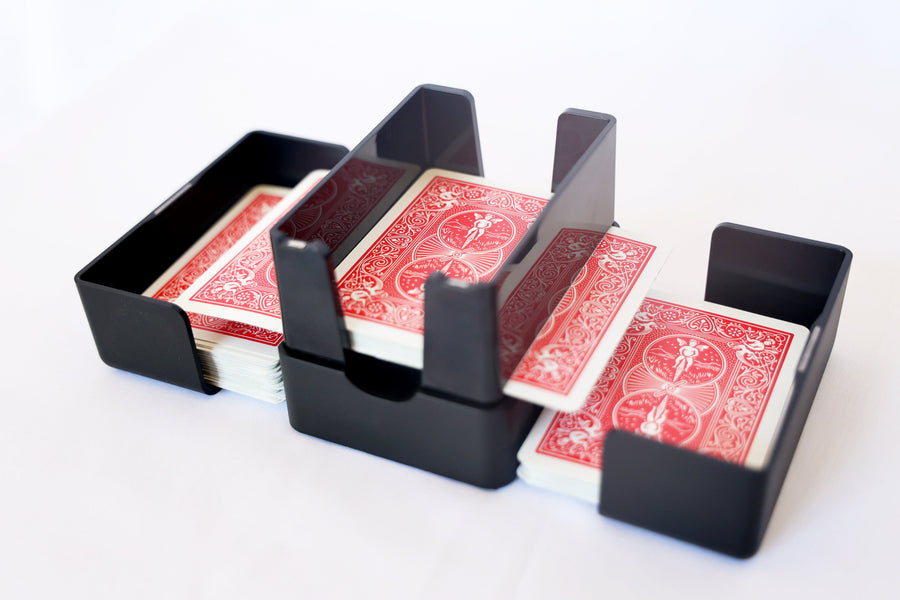
Product photo shows the original Lotus V1.
The one these guides keep pointing to
Lotus Card Shuffler V2
The Tabletop Family rated the Lotus V2 24/25, their Best Overall among the 8 distinct models they bench-tested from 13 shufflers. Lotus supplied its review units.
$89.00 Free US shipping
Order Now