
Why Hanging Out Falls Flat and a Card Game Doesn't
A casual hangout dies on the couch while a card game lights everyone up. The difference isn't the people. It's that connection needs structure the hangout doesn't supply.
You've hosted the evening that goes nowhere. Good friends and a free Saturday. And then somehow forty minutes in everyone is half-watching a screen, the conversation has thinned to logistics, and the room has gone quiet in the wrong way. You blame the energy, or the week everyone's had, or yourself for not planning more.
The energy was never the problem. The shape of the evening was.
What "let's just hang out" leaves out
The psychologist Mihaly Csikszentmihalyi spent decades studying the state he called flow: the deeply absorbing experience where attention narrows, self-consciousness falls away, and time seems to bend. In Flow (1990), he laid out the conditions that reliably bring it on. Two of them matter most here. An activity needs clear goals and immediate feedback. You have to know what you're trying to do, and you have to be able to tell, moment to moment, how it's going.
A card game hands you both for free. The goal is obvious. After every play you know instantly whether it worked, whose turn it is, who's ahead. The structure is working in the background, organizing attention so the people can stop managing the evening and start being in it.
An open-ended hangout supplies neither. There's no goal beyond the vague "have a nice time," and there's no feedback at all. Nobody can tell whether the evening is working, so everyone is privately monitoring it. Is this fun? Should I say something? Is she bored? That low-grade self-consciousness is the exact opposite of flow, and it's what the phone is so good at relieving. The drift to screens isn't a character flaw. It's what attention does when it's given nothing clear to hold.
The walls are what set you free
This is the part that sounds backwards. We tend to think structure is the enemy of a good time, that the best nights are spontaneous and the rules of a game are a constraint we tolerate for the sake of play.
Csikszentmihalyi's work points the other way. The rules are not a cage around the fun. They are the banks the river needs to flow. Goals and feedback give attention somewhere to go, and once attention has somewhere to go, the self-monitoring stops and the absorption begins. Constraint is the precondition for release, not the price of it. A game without rules is a hangout with cards on the table.
Our guess, not Csikszentmihalyi's, is that this is why "we should do this more often" gets said after the game and almost never after the aimless evening. The game had the same people. It had walls.
Flow with other people in the room
There's a further wrinkle, and it's the one that matters most for a game night. Most of what we know about flow comes from solitary pursuits: the climber, the surgeon, the writer. Charles Walker's study "Experiencing Flow: Is Doing It Together Better Than Doing It Alone?" (2010) asked whether flow felt different in company.
It did. Walker found that social flow, the kind that arises when people are absorbed in a shared activity together, was experienced as more enjoyable than solitary flow. And the more genuinely interdependent the activity, the stronger the effect. When what you're doing actually requires the other people, when their moves shape yours and yours shape theirs, the experience of flow deepens.
Walker found that social flow, the kind that arises when people are absorbed in a shared activity together, was experienced as more enjoyable than solitary flow.
A card game is interdependence by design. You're reading the table, reacting to what someone just did, setting up the person to your left or cutting off the one across from you. Everyone is pulled into the same current at the same time. That shared absorption is the thing we're actually after on a game night, and it's far closer than the conversation we imagined would carry the evening on its own.
Lower the friction, keep the flow
If the structure is what makes the night work, then anything that interrupts the structure is working against you. Few things break a table's flow more reliably than the shuffle. The current is running, everyone's in it, and then someone has to stop, gather the cards, fumble through a clumsy riffle, and hand them off, and the spell loosens a little each time. The feedback loop Csikszentmihalyi described stops for thirty seconds, and thirty seconds is long enough for the table to lose the thread.
A Lotus shuffler does one thing: a true riffle, one pass per touch, near-random after about seven, so the cards come back ready and the current barely pauses. Not to make the night fancier. To keep the walls intact so the flow between people doesn't leak out through the seams.
The good news in all of this is how little it takes. You don't need a better group or a more interesting life. You need an activity with a clear goal and quick feedback, the kind of structure a game supplies and a hangout never will. Put that on the table, and the connection you were hoping the evening would somehow produce shows up on its own.
Sources
- Mihaly Csikszentmihalyi, Flow: The Psychology of Optimal Experience (1990)
- Charles J. Walker, "Experiencing Flow: Is Doing It Together Better Than Doing It Alone?", The Journal of Positive Psychology (2010)
The banks are what let the river run; the Lotus keeps the current moving between hands.
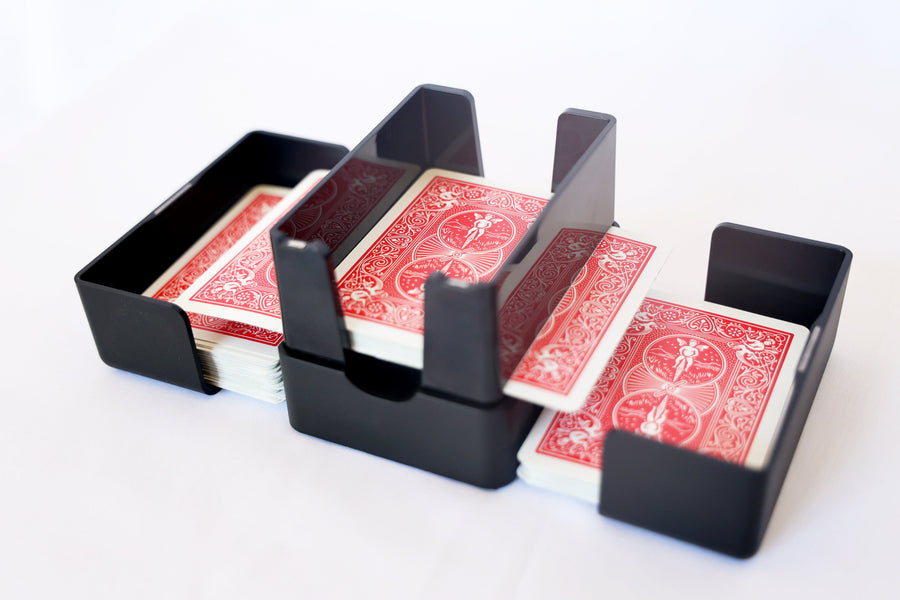
Product photo shows the original Lotus V1.
The one these guides keep pointing to
Lotus Card Shuffler V2
The Tabletop Family rated the Lotus V2 24/25, their Best Overall among the 8 distinct models they bench-tested from 13 shufflers. Lotus supplied its review units.
$89.00 Free US shipping
Order Now