
Why Most of the World Plays With French Suits: A Manufacturing Story
Hearts, diamonds, clubs, and spades won the deck not because they meant more, but because they cost less to print.
The reason your deck doesn't have acorns and bells has little to do with beauty. The French marks were the cheapest suits in Europe to reproduce. The four suits sitting in your hand right now (hearts, diamonds, clubs, spades) are a French invention from the late fifteenth century, and they spread across most of the world less by taste than by being trivial to manufacture. You could cut them from a stencil. You could print them in two colors. Once that was true, the older and arguably handsomer suit systems didn't stand a chance.
The decks that lost
For most of card history, Europe had no single set of suits. As David Parlett lays out in A History of Card Games, cards arrived in Europe in the late 1300s and quickly fractured into regional families. The Italians used cups, coins, swords, and batons. The Spanish ran a close variant of the same four. The Germans developed their own: hearts, bells, leaves, and acorns. Each system grew out of its local craft tradition, and each one was, by the standards of the eye, more pictorial than what replaced it. A coin is a little engraving. A sword is a small drawing. An acorn is a recognizable thing in the world.
That richness was exactly the problem. Pictorial suits had to be rendered. They carried fine internal detail, which meant they had to be drawn or printed from individually cut woodblocks, often hand-finished, sometimes hand-colored. Every pip on every card was a small act of reproduction, and small acts of reproduction add up fast when you are making a deck of fifty-two and then making thousands of decks.
What the French actually changed
The French suits, introduced around 1480, did something radical. They threw away the picture and kept the silhouette. A heart is a flat shape. A diamond is a flat shape. The spade and the club are stylized leftovers of the older leaf and acorn, flattened into outlines that read instantly at a glance and carry no interior detail at all.
Historians of the deck, Roger Tilley among them in A History of Playing Cards, point to the production consequence. Because the French marks were simple solid forms in only two colors, red and black, they could be applied with a stencil rather than cut as a full block for each card. You laid down a stencil, you brushed through it, you moved on. A workshop that adopted French suits could produce decks faster and far more cheaply than one still rendering Italian swords or German acorns block by block. The shapes were made, whether anyone framed it this way or not, for speed of printing.
Because the French marks were simple solid forms in only two colors, red and black, they could be applied with a stencil rather than cut as a full block for each card.
This is the hinge of the whole story. The French suits did not win a beauty contest. Plenty of people then and now find the older decks lovelier, and the surviving Italian and German cards are genuinely beautiful objects. The French marks won a cost contest. They were the deck a printer could make money on.
Production economics as an author of culture
Once cheap reproduction was on the table, the rest followed the way these things usually follow. Cheaper decks meant more decks. More decks meant wider distribution. Wider distribution meant the French marks became the assumed default in more places, which made them the safe thing for the next printer to produce, which made them cheaper still. The English picked up the French suits and carried them across an empire. The pattern compounded until "a deck of cards" simply meant these four shapes to most of the planet, and the cups and bells and acorns receded into regional play, where in places like Italy, Spain, and parts of Germany they survive to this day.
There's no villain and no grand design in this. No committee decided hearts and spades should rule. A manufacturing advantage got compounded by distribution until it looked like a cultural fact. We tend to read the artifacts around us as the products of taste or meaning, and sometimes they are. More often the deciding pressure was upstream and invisible: what was cheap to make and easy to copy. The standard outlasts the reason it became the standard, and by the time you hold it, the economics have dissolved into something that just feels like the natural order of things.
Hold both truths at once. The thing that wins on cost is not automatically worse. French suits are, in fact, beautifully legible, and that flat, two-color clarity is part of why a card reads from across a table in bad light. Constraint produced an object that works. But the next time someone tells you a design endured because it was the best, ask the more boring and more accurate question: best at what, and cheap for whom?
The deck that won is the one you could reproduce at scale without losing the thing that made it work. Centuries later the same instinct shows up in the tools we choose for the table. A Lotus riffle, one pass per touch and near-random after about seven, belongs to that family. The test that decided the deck still decides what stays on the table: the thing that disappears into the game is the thing that endures.
Sources
- David Parlett, A History of Card Games (Oxford University Press, 1991; first published 1990 as The Oxford Guide to Card Games)
- Roger Tilley, A History of Playing Cards (1973)
Hearts and spades won by being easy to make; the Lotus is built to the same test.
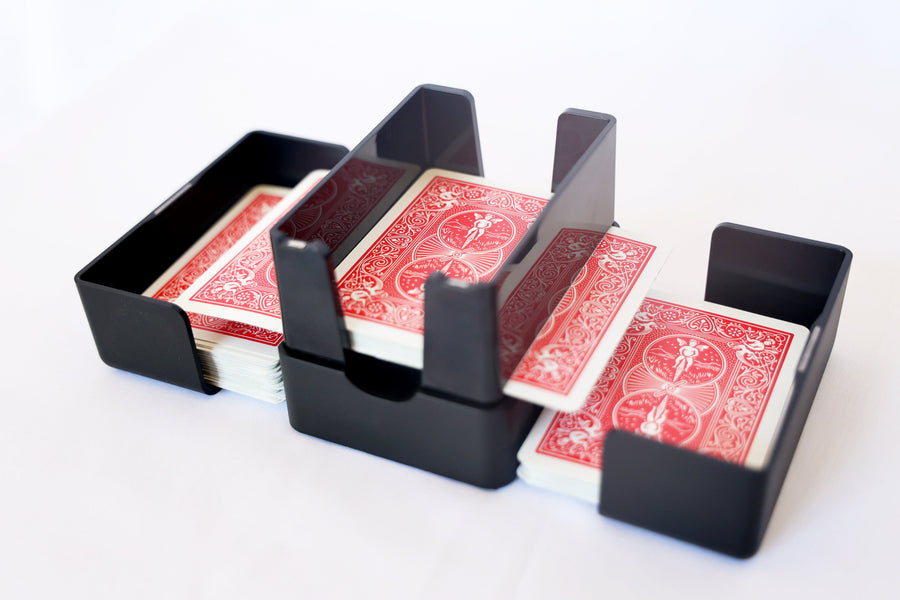
Product photo shows the original Lotus V1.
The one these guides keep pointing to
Lotus Card Shuffler V2
The Tabletop Family rated the Lotus V2 24/25, their Best Overall among the 8 distinct models they bench-tested from 13 shufflers. Lotus supplied its review units.
$89.00 Free US shipping
Order Now