
Why We Trust a Game's Fairness More Than Each Other's Word
When chance decides the outcome, the table can lose to luck without anyone losing face. That's not a flaw in games. It's the whole point.
Watch what happens when one person at a family table is the one who decides things. Who goes first, what counts, whether that move was legal. Even when they rule fairly, a small tax gets charged: someone has to be trusted, and trust is the thing that frays fastest among people who know each other well enough to keep score. Now watch what happens when chance decides instead. The dice fall, the deck is dealt, and a bad outcome lands on no one's character. You can lose to luck. You cannot resent it the way you resent a person.
That swap, from a human enforcer to an impartial mechanism, is one of the quietest and most useful things a game does. The philosophers who think hardest about games can tell us why.
A game is a voluntary agreement to do things the hard way
Bernard Suits, in The Grasshopper (1978), gave the cleanest definition of a game anyone has managed. To play a game, he wrote, is to attempt to reach a specific outcome using only the means the rules permit, where the rules forbid the more efficient means in favor of the less efficient ones, and you accept those rules because they make the activity possible. His example is golf. The goal is getting a ball into a hole. The efficient method is to walk over and drop it in. The game exists only because everyone agrees not to do that, and to use a stick from a hundred yards out instead.
Suits called the willingness to take on these unnecessary obstacles for their own sake the "lusory attitude." It's the agreement underneath every game: I will accept constraints I could easily break, because breaking them would dissolve the thing we're doing together. The rules have no force outside our shared decision to honor them. That shared decision is the game.
C. Thi Nguyen, in Games: Agency as Art (2020), takes this further. Games, he argues, are a medium for shaping agency itself. A game hands you a temporary self, a set of goals and abilities and obstacles you step into, like trying on a different way of wanting things for an hour. We don't usually choose our motivations. In a game, the designer hands us a clean one and we agree to inhabit it. The fairness of the whole thing depends on everyone inhabiting the same one, under the same constraints, at the same time.
Chance externalizes the fairness so no one has to embody it
This is where the deck earns its place at the table. Suits and Nguyen do not write about shuffling; the step from their definitions to the deck is ours.
If everyone has agreed to the same artificial constraints, the next question is who guarantees them. Someone has to ensure the cards are mixed, the order is unknown, the start is even. The elegant move, the one games have been making for centuries, is to hand that job to a mechanism rather than a person. A shuffle doesn't have a cousin it favors. It doesn't remember who won last week. It can't be lobbied, and it has nothing to gain. When chance distributes the starting conditions, fairness stops being something a person has to embody and becomes something the table can observe.
That changes the emotional texture of losing. A loss handed down by a person carries an implication about the people involved. A loss handed down by the deck carries none. The lusory attitude holds because no one had to be the authority, and so no one becomes the suspect. You can play hard against people you love and stand up from the table still loving them, because the thing that beat you was the draw.
This only works if the chance is real. A shuffle that leaves the deck half-ordered is worse than no shuffle, because it pretends to be fair while favoring whoever knows the deck's prior state. Here the math is unusually crisp. Dave Bayer and Persi Diaconis showed in 1992 that randomness in a shuffled deck arrives as a sharp cutoff, not a gradual fade. For a standard 52-card deck, riffle shuffles leave the order detectably structured for the first several passes, and then, right around the seventh, the deck tips into a state that is near-random, well-mixed for any practical purpose. Before the cutoff, fairness is a story you're telling. After it, it's a fact. The threshold is abrupt enough that "close enough" is a real category, with a real line.
Dave Bayer and Persi Diaconis showed in 1992 that randomness in a shuffled deck arrives as a sharp cutoff, not a gradual fade.
Why this matters most at the family table
The groups that need externalized fairness the most are the ones who know each other best. Strangers can afford to assume good faith because they have no history to weaponize. Families and old friends carry a ledger, and "who shuffled" can become a thing in a way it never does among people who'll never see each other again. The relationships with the most to lose from a disputed deal are exactly the ones playing for keeps.
Handing fairness to a mechanism is how those tables protect what matters. The game stays a game instead of curdling into an argument about character, because the one decision that could have started the argument was never anyone's to make. The deck dealt. Nobody chose. Everyone can keep playing, and keep liking each other, which was the actual reason you sat down.
A shuffle you don't have to think about earns its place here. Not because shuffling is hard, but because the honest deal is the load-bearing wall of the whole evening, and it deserves to be excellent. A Lotus does one thing: one touch is one riffle, and the count is yours. Three passes suit a game night; about seven reach the near-random the math describes. Either way the fairness is real and no one at the table has to be the one vouching for it. The cards become the impartial party. The people get to stay friends.
Sources
- Bernard Suits, The Grasshopper: Games, Life and Utopia (1978)
- C. Thi Nguyen, Games: Agency as Art (2020)
- Dave Bayer and Persi Diaconis, "Trailing the Dovetail Shuffle to its Lair," The Annals of Applied Probability (1992)
The most trustworthy authority at the table is the one with nothing to gain, and ours has no buttons to press and no favorites to play.
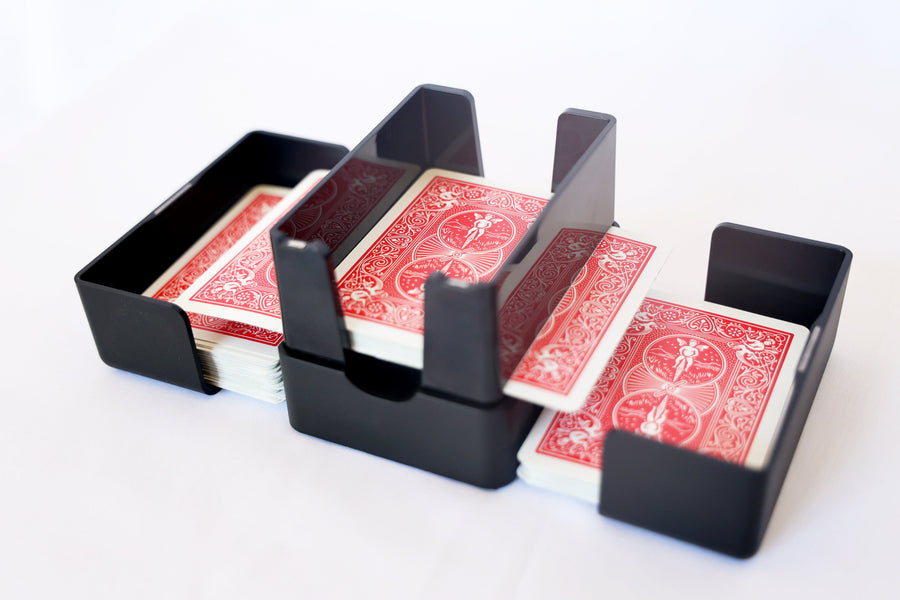
Product photo shows the original Lotus V1.
The one these guides keep pointing to
Lotus Card Shuffler V2
The Tabletop Family rated the Lotus V2 24/25, their Best Overall among the 8 distinct models they bench-tested from 13 shufflers. Lotus supplied its review units.
$89.00 Free US shipping
Order Now