
Why We Voluntarily Make Things Harder at the Card Table
A philosopher's definition of "game" explains why removing the friction of dealing and shuffling makes play better, not softer.
Bernard Suits defined a game as the voluntary attempt to overcome unnecessary obstacles. You could walk to the hole and drop the ball in with your hand. Instead you stand far away, pick up a stick, and agree to a long list of rules that make the task absurdly harder. That self-imposed difficulty isn't a flaw in golf. It is golf. Suits called the willingness to take on those pointless obstacles for the sake of the play itself the "lusory attitude," and it's the cleanest answer we have to the question of what makes something a game at all.
Bernard Suits defined a game as the voluntary attempt to overcome unnecessary obstacles.
The reason this matters at your kitchen table is that not every obstacle in a game night is the game. Some of it is just friction. And Suits gives you a precise way to tell the two apart.
The obstacle you chose vs. the obstacle you didn't
Suits' insight cuts a sharp line. The obstacle you want is the one the rules invented on purpose: you may only play a card of the led suit, you can't look at your opponent's hand, you have to bid before you see the flop. These constraints are unnecessary in the plain sense, nothing forces them on you, and that's exactly why they're fun. You accept them so the contest has shape. Strip them out and there's no game left to play.
Then there's the other kind of obstacle, the one nobody chose. A deck that won't shuffle evenly because someone's eight-year-old is "helping." The riffle that sprays cards across the floor. The four minutes at the start of every hand where one person deals while everyone else checks their phone. None of that is the strategy. None of it was part of the agreed-upon difficulty. It's logistical drudgery that happens to sit between you and the game, and clearing it doesn't make the game easier. It makes the game available.
This is the move people miss when they worry that automating the shuffle "cheapens" things. It would cheapen the game to let you peek at the next card, or to deal yourself a better hand. Those are the chosen obstacles; remove them and you've stopped playing. Removing the fumble is the opposite. You're protecting the chosen difficulty by clearing away the unchosen one.
Why clearing friction deepens the play
C. Thi Nguyen, in Games: Agency as Art, picks up Suits' definition and asks what games actually do to us as we play. His answer is that games are an art form whose medium is agency itself. A well-designed game hands you a temporary, sculpted version of yourself, a clear goal, a defined set of abilities, a bounded world, and lets you act inside it with a focus that ordinary life rarely allows. Nguyen does not use the word, but what he describes sits next to what Csikszentmihalyi called flow: absorbed concentration, the self gone silent, the activity the only thing left. That pairing is ours.
Flow is fragile. It depends on a continuous loop between challenge and response, and it shatters the moment attention has to leave the loop. Every interruption pulls you out of the sculpted agency Nguyen describes and dumps you back into logistics. You stop being a player and become a person managing a deck. Then you have to climb back in.
So the friction isn't neutral. It's actively working against the thing the game exists to give you. The chosen obstacles build the focus; the unchosen ones break it. When you reduce the breaks, the absorbing part gets more room, and more uninterrupted time inside the game means more of what you actually came for.
At a home game night the people are what you came for. The game is the structure that lets a family or a circle of friends sit in one place, lean in, and pay sustained attention to each other for an evening. The deck is just the excuse the lusory attitude gives everyone to stay at the table. So the friction you clear was stealing presence from the room as well as flow from the game.
Keep the difficulty you want
The practical lesson from Suits and Nguyen is to be deliberate about which obstacles you keep. Keep the rules. Keep the bluffing, the bidding, the suit you can't follow, the hand you can't see. That difficulty is the whole point, and a serious player guards it.
Then look hard at everything else and ask whether it's strategy or just friction. The shuffle is the clearest case. A genuinely good shuffle has to be excellent, near-random, so no one can read the order and the chosen difficulty stays honest. But the act of shuffling, by hand, between every hand, is pure logistics. It's the unnecessary obstacle nobody chose. An automatic shuffler like Lotus runs a true riffle, one pass per touch, near-random after about seven, and hands the four minutes and the unbroken attention back to the table. You keep the difficulty you wanted. You drop the one you didn't. Everyone stays in the game, and in the room.
Sources
- Bernard Suits, The Grasshopper: Games, Life and Utopia (1978)
- C. Thi Nguyen, Games: Agency as Art (2020)
Keep the difficulty the rules invented, and let the clamshell take the one nobody chose.
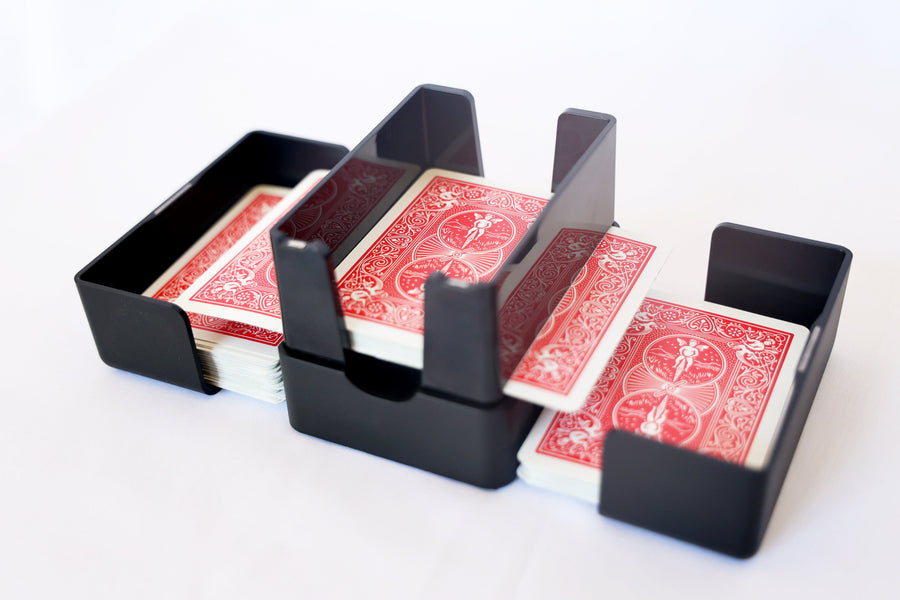
Product photo shows the original Lotus V1.
The one these guides keep pointing to
Lotus Card Shuffler V2
The Tabletop Family rated the Lotus V2 24/25, their Best Overall among the 8 distinct models they bench-tested from 13 shufflers. Lotus supplied its review units.
$89.00 Free US shipping
Order Now