
Your Dining Table Is Social Infrastructure, and Sociologists Mean That Literally
During the 1995 Chicago heat wave, two neighborhoods with nearly identical residents died at very different rates. The variable was where people gathered.
In July 1995, a heat wave settled over Chicago and killed more than 700 people in a single week. When the sociologist Eric Klinenberg went looking for why, he found something the weather alone could not explain. Two adjacent neighborhoods on the city's South Side, Englewood and Auburn Gresham, were nearly identical on paper: both poor, both predominantly Black, both with high proportions of elderly residents living alone, the population most at risk of dying in extreme heat. One of them had a death rate among the highest in the city. The other came through the crisis better than some of Chicago's wealthy lakefront neighborhoods.
The difference was not air conditioning or income. It was the street.
What Klinenberg actually found
In Auburn Gresham, people knew their neighbors. The sidewalks were busy. There were shops, churches, diners, and corner stores still operating, so residents had reasons to leave their apartments and faces they expected to see when they did. When the heat hit, that everyday traffic became a check-in system nobody had designed for that purpose. Neighbors knocked on doors. People noticed when someone hadn't come out.
In Englewood, decades of commercial decline and population loss had thinned the same fabric. There were fewer reasons to go outside and fewer people out there if you did. Older residents, afraid or simply unconnected, stayed behind locked doors in the heat, and too many of them died alone.
Klinenberg gave this a name in his later book, Palaces for the People (2018): social infrastructure. The term sounds abstract, so he made it concrete. Social infrastructure is the set of physical places and organizations that shape how often, and how easily, people come into contact with one another. Libraries, parks, sidewalks, swimming pools, bookstores, places of worship, barbershops, the diner that stays open. Not the relationships themselves, but the conditions that make relationships likely. His point is that connection is not only a matter of individual will. It is partly built. When the places that hold people together are strong, community forms almost as a byproduct. When they decay, isolation follows, and in a crisis, isolation can be fatal.
Social infrastructure is the set of physical places and organizations that shape how often, and how easily, people come into contact with one another.
The phrase he returns to is that social infrastructure shapes whether bonds form by chance. The chance is the whole thing. You cannot will a neighborhood into mutual care. You can only build, or fail to build, the settings where care has somewhere to happen.
The same logic runs through your house
Here is the part that tends to get missed. The logic Klinenberg applies to a library applies, at smaller scale, to a kitchen table. A table is a setting that determines whether the people in one home actually encounter one another or simply pass through. It is social infrastructure for the smallest community most of us belong to.
Ray Oldenburg made a related argument a generation earlier in The Great Good Place (1989). Oldenburg was interested in what he called "third places," the cafes, pubs, and gathering spots that sit between home and work and where informal public life happens. His thesis was that a healthy society needs these neutral, accessible, conversation-centered places, and that as they disappeared, people lost the casual, regular, low-stakes contact that makes a community feel like one. Oldenburg and Klinenberg are pointing at the same truth from different distances: belonging depends on places that gather people without requiring them to perform or produce anything.
A dining table can be that kind of place inside a home. It is neutral ground in the way Oldenburg prized, a spot where no one is the audience and no one is working, where the conversation is the point. But it only functions that way if people actually sit down at it together, with attention to spare. A table that the family passes on the way to separate screens is infrastructure in name only, the household equivalent of a sidewalk no one walks.
Reducing the friction to sit down
If the table is infrastructure, then the practical question is the one a city planner asks: what makes people more likely to use it? Klinenberg's neighborhoods turned on small, almost invisible details, a shop still open, a reason to step outside. The household version is just as small. What lowers the threshold to gather, and what raises it?
A game is one of the oldest answers to that question. Game night is one of the most reliable ways to get adults and children to sit in the same place, face one another, and stay long enough for the real conversation to start. But it carries small frictions that quietly thin the ritual: the fumbling, the arguments over a bad deal, the person who shuffles so poorly the cards barely change order, the lull while someone re-stacks the deck. Each is minor. Together they are the difference between a game night that happens and one that gets quietly skipped.
This is the category an automatic card shuffler belongs to: not the gathering itself, but one of the small, almost invisible details that decide whether the gathering happens. It takes the deck out of the hands of whoever shuffles worst, closes the lull while someone re-stacks, and returns cards mixed thoroughly enough that nobody at the table has to vouch for the deal. That is why we built one (Lotus is ours, so read this paragraph with that disclosed), but the logic does not depend on the product. A shuffler is never the reason anyone connects, any more than a sidewalk was the reason Auburn Gresham's neighbors knocked on doors. It is the condition underneath. Build the setting, clear the small obstacles, and let the gathering take care of the rest.
Your table is one of those places, held up by the same logic that carried Auburn Gresham through the week Englewood could not. The stakes at home are rarely mortal. But the principle holds: connection is built, not assumed, and the building happens in the ordinary places where people are given a reason to sit down together. The work is never the connection itself. It is clearing the small obstacles that stand in front of it, so that when people do sit down, nothing is left to attend to except each other. Modest work, but modest is the whole register of social infrastructure. It holds best when no one notices it holding anything at all.
Sources
- Eric Klinenberg, Palaces for the People: How Social Infrastructure Can Help Fight Inequality, Polarization, and the Decline of Civic Life (2018)
- Eric Klinenberg, Heat Wave: A Social Autopsy of Disaster in Chicago (2002)
- Ray Oldenburg, The Great Good Place (1989)
Infrastructure does its best work unnoticed, and the quiet shuffler at the edge of the table was built for exactly that register.
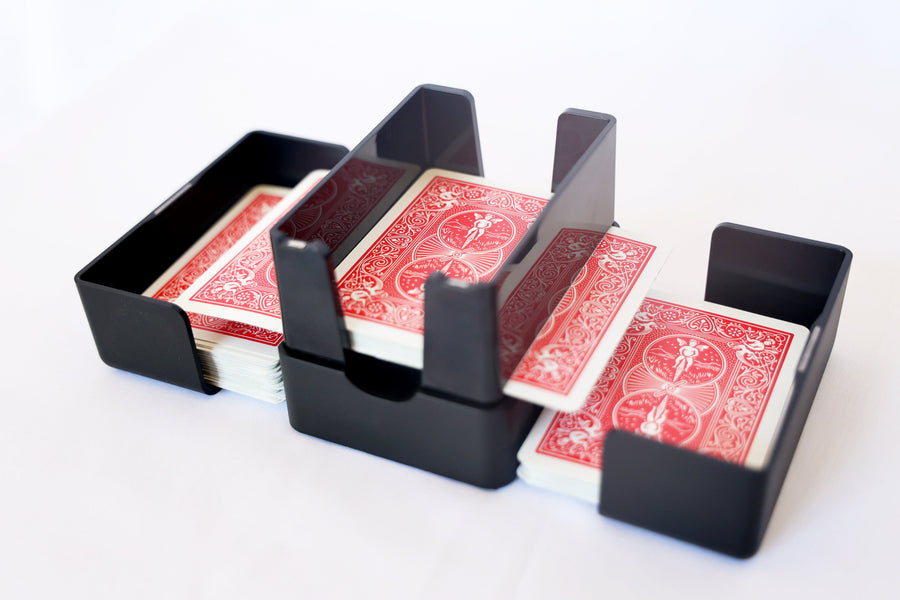
The one these guides keep pointing to
Lotus Card Shuffler V2
TheTabletopFamily’s Best Overall pick. V2 scored 24/25, first of the 8 distinct models they bench-tested from 13 shufflers bought. Two decks, no buttons. Pre-order ships October.
$89.00 Free US shipping
Pre-order V2