
Why a brand-new deck clumps on its first shuffle
One of our early buyers, Mark, reported that his Lotus wasn't shuffling properly with the brand-new deck we sent him. The king, queen and jack of every suit were still together, even after seven shuffles. What Mark caught is one of the most important trade-offs we made between V1 and V2.
The first thing is the fix. If you run into this, take the deck and handle it once. Flip through it, deal the cards out, or play a round with it, anything that breaks them up. Here's a video of me doing just that with a brand-new Lotus and a deck still in the plastic.
We didn't put this in the instructions because in a normal game it never comes up. Once you've handled the cards the first time, it's a non-issue. We're adding it to the documentation going forward.
Why a new deck does this
A brand-new deck sticks. The cards have been pressed against the same neighbors since the day they were cut, and until somebody handles them they hold onto each other. So when the Lotus sends cards left and right, a stuck pair goes the same way as if it were one card, and then it does it again on the next pass, and the one after that. I ran a brand-new deck through mine six times and read the whole deck out after every pass, and the seven and eight of clubs rode together the entire way. After six passes there were 13 pairs still sitting next to their neighbor from the box, and a random deck has about two.
A brand-new deck after six passes. The outlined cards are still next to a neighbor from the box: 13 pairs.
And here's the deck from the video: brand-new, flipped through once, then seven times through a new Lotus. I counted two, which is what a random deck has. All I did was handle the cards.
The deck from the video, after seven passes: two pairs.
Charles's V1 didn't shuffle
The first Lotus had a tighter exit, and it pulled those pairs apart on its own. So why did we increase the opening and add the pinch rollers? Because of Charles. He bought a V1 and wrote to tell me the shuffler only worked with the deck we sent him, and that most of his own decks wouldn't go through. After some back and forth he mailed me a box of his old decks, and indeed, they didn't work. Cards that have been played with bend a little, and an exit that's just right for a crisp new card won't let a bent one out.
So a shuffler has to pick one. Keep the exit tight and it only works with fresh cards, which is how the machines in Las Vegas do it. A casino retires a deck after a handful of uses, so those shufflers only ever see crisp ones. That works great if you go through decks the way a casino does, but you have the decks in your game cabinet, and we want the Lotus to keep working with those for a very long time.
So on the V2 we went the other way. We made the exit larger and added pinch rollers to help the odd ones through, the bent ones, the ones that are a little bit different.
That's the trade, and it's the way we want it to work. It buys you a shuffler that handles the decks you actually own, the ones that have been played with, and the cost is that a brand-new deck needs to be handled once to break it apart.
What random really looks like
Randomness is actually kind of interesting, because a well shuffled deck still has patterns in it. On average a random deck has about two cards sitting next to a neighbor from the box, about three pairs of the same rank touching, and a run of five or six cards of the same color. So the nine and ten of hearts showing up together after a good shuffle is just chance. And if you spread a deck and found none of this, no neighbors, no matching ranks touching, red and black taking neat turns, that's the deck to be suspicious of, because a truly random deck almost always has a few. Thirteen pairs is a new deck that hasn't been handled yet.
The whole test
Here's the full run, start to finish.
If you handle a new deck and it still comes out clumpy, write to me at info@play-lotus.com, because that would be a different thing and I'd want to see it.
Manu
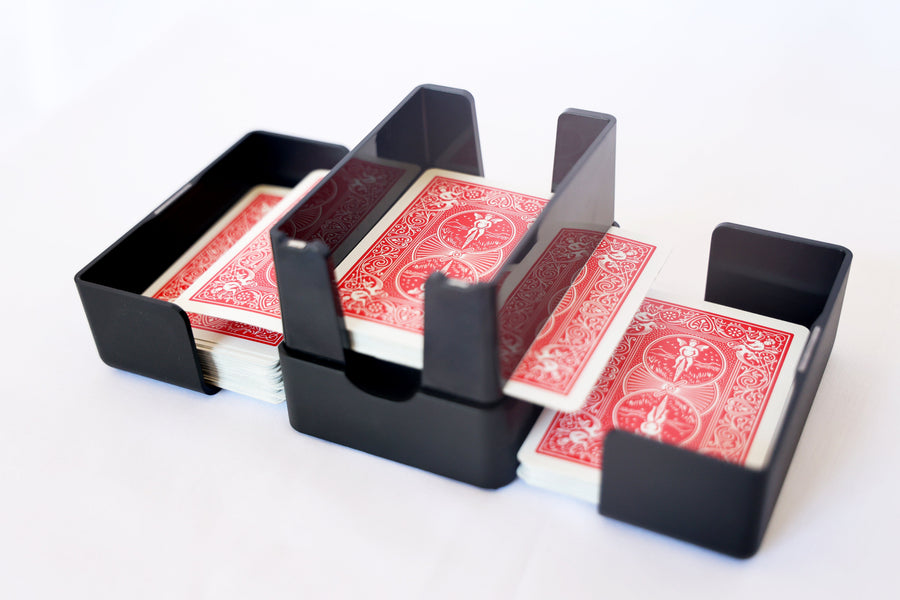
Product photo shows the original Lotus V1.
The one these guides keep pointing to
Lotus Card Shuffler V2
The Tabletop Family rated the Lotus V2 24/25, their Best Overall among the 8 distinct models they bench-tested from 13 shufflers. Lotus supplied its review units.
$89.00 Free US shipping
Order Now