
How to Shuffle Cards: The Four Shuffles, and What Each One Does to the Deck
Most people shuffle the way someone taught them at eight and never ask whether it works. Whether it works depends on which shuffle you mean, because the common ones do different things to the order of a deck, and a published paper stands behind each. Here are the steps for each one and what it does to the deck.
The riffle: split, bend, bridge
Cut the deck near the middle and take a half in each hand, thumbs along the inside edges, fingers behind. Bend each half upward with the fingers so the thumbs can let cards go a few at a time. Bring the two inside corners together so the released cards fall into each other, and when both hands are empty, push the halves square. The bridge is the flourish at the end, bowing the laced deck so it cascades flat, and it is optional.
The riffle is the shuffle that does the work, and Dave Bayer and Persi Diaconis proved it in 1992. Each half keeps its inner order, so one pass leaves two runs still in sequence, and each further pass can double the count. By their table, a 52-card deck's distance from random stays at its maximum through four riffles, begins to fall at five, and drops under one half at seven (Bayer and Diaconis, 1992). That is why the number is seven, and no count of riffles takes the distance to zero. From Magic to Math tells the story behind the number.
A perfect riffle, one card from each half in strict turn, is the faro, and eight perfect out-shuffles put a 52-card deck back in its starting order (Diaconis, Graham and Kantor, 1983). A riffle gets its randomness from its unevenness, so do not train the clumps out of yours.
How to shuffle cards without bending them
The bend that worries people is the bridge, and you can skip it. Riffle with both halves flat on the table, lifting only the inside corners with your thumbs so the cards lace at the corner, then push the halves together square. The cards flex at one corner and nowhere else.
How to shuffle cards like a dealer
That flat version is the table riffle of card rooms: the deck never leaves the cloth, the corners lace, the halves slide square, a cut finishes it. It mixes exactly as the in-air riffle does, because the mathematics counts the lacing and not the altitude.
The overhand: the grip
Rest the deck face down across the fingers of one hand, thumb on top. With the other hand, lift most of the deck from underneath and leave a small packet behind in the first palm. Let packets of a few cards drop from the lifted block onto that packet, one at a time, the thumb catching each, until the lifting hand is empty. That is one pass.
Every card inside a packet keeps its neighbors; the packets change places, and the deck turns over in chunks. Robin Pemantle modeled the move in 1989. Each gap between cards becomes a cut with some fixed probability; the packets trade places and the cards inside each keep their order. He proved the time to mix grows at least as fast as the square of the deck size and at most as the square times its logarithm (Pemantle, 1989). Johan Jonasson showed in 2006 that the square times the logarithm is the true rate (Jonasson, 2006). Those theorems give the growth rate, not a count; a card wanders a few places per pass, so the deck crosses from ordered to mixed in thousands of passes. Jason Fulman, a mathematician at USC who works on shuffling, puts it at about 10,000 overhand shuffles for 52 cards (USC Dornsife, 2023). Nobody does that. The overhand's job is loosening a deck before the shuffle that counts.
The Hindu shuffle: the pull
Hold the deck face down from below, thumb on one long edge and middle finger on the other. With the free hand, grip a packet off the top by its long edges and let it drop into that hand's palm. Draw the next packet and let it land on the first, until the deck is used up. The packets reverse and the cards inside each keep their order, so the same arithmetic covers both shuffles; the only thing that changes is which hand does the pulling. We found no separate published count for it.
How to shuffle cards for beginners
Start with the overhand. It asks the least of the hands, nothing bends, and a dropped packet is no loss. Learn the riffle second, on the table, corners only; the bridge can wait a year. Small hands can start on the wash below and skip the grip altogether.
The wash: the sweep
Spread the deck face down across the table and lay both palms flat on the cards. Slide them around in loose circles for a full minute, pushing cards over and under each other, then gather the spread into a rough stack and square it against the tabletop.
Persi Diaconis and Soumik Pal modeled the wash as cards gathered and spread at random and proved its mixing time grows only with the logarithm of the deck size (Diaconis and Pal, 2022). In their real-world test, 30 and 60 seconds of washing by Stanford students passed all 10 randomness tests and 15 seconds did not (Quanta, 2015). Our guide to shuffling when hands hurt rates it against the other low-grip methods.
How to shuffle cards with one hand
Wash it. One flat palm in loose circles for a minute does the job, and the one-handed riffle is a flourish, not a shuffle you need.
The cut and the strip
Lift the top portion of the deck, set it down, and put the rest on top. That is a cut, and mathematically it is a rotation. Bayer and Diaconis point out that cuts respect the cyclic order of a deck. Picture the cards in a loop with the bottom card followed by the top; a cut turns the loop and changes nothing else. Every card keeps both its neighbors. A cut after the shuffle moves the start to a place the shuffler did not choose, and that is its whole job. The Etiquette of the Deal has the cut's history.
The strip, or running cut, is a run of cuts onto the table: a packet off the top, set down; the next packet set on it; and so on until the deck is used up. The blocks reverse and the cards inside each never move, the overhand's arithmetic on a tabletop. It chops the long runs a riffle leaves into shorter ones, and on its own it is not a shuffle.
The shuffles side by side
| Method | What it does to the order | To a mixed deck | Source |
|---|---|---|---|
| Riffle | Two halves keep their inner order and lace together; the runs can double each pass | About seven passes to near-random | Bayer and Diaconis, 1992 |
| Overhand, Hindu | Packets trade places; cards inside a packet keep their neighbors | Thousands of passes; about 10,000 by Fulman's figure | Pemantle, 1989; Jonasson, 2006; USC Dornsife, 2023 |
| Wash | Every card slides past its neighbors across the table | 30 seconds or more; give it a minute | Diaconis and Pal, 2022; Quanta, 2015 |
| Cut | Rotates the deck; every card keeps both neighbors | Never; it is not a shuffle | Bayer and Diaconis, 1992 |
| Strip | Blocks reverse; cards inside each keep their order | Never on its own | The overhand's arithmetic |
| Faro, the perfect riffle | A fixed rearrangement; eight out-shuffles restore 52 cards | Never | Diaconis, Graham and Kantor, 1983 |
Which shuffle to use
Riffle, and let it be sloppy. For how many times, From Magic to Math has the answer and the story behind it.
Where the Lotus fits
The Lotus runs the riffle backwards, an inverse riffle: the whole deck goes into one center tray, soft rollers deal it out one card at a time into two piles, you restack, about five seconds a pass. No card's pile is set in advance, so a 52-card pass splits 25 and 27 one time and 24 and 28 the next, which is what separates it from dealing into fixed piles. Three passes suit game night, and about seven bring a 52-card deck to near-random, the same count as by hand; the poker shuffler guide the case for a machine, and the Lotus Card Shuffler V2 is the one we make.
FAQ
How many times should you shuffle a deck of cards?
Seven riffles bring a 52-card deck to near-random. In Bayer and Diaconis's 1992 table, the distance from random stays at its maximum through four riffles and first drops under one half at seven. An overhand shuffle takes thousands of passes, and a wash wants 30 seconds or more.
What is the best way to shuffle cards?
The riffle. Each half keeps its inner order, so every pass can double the number of runs in the deck, which is why it mixes far faster than the overhand. Let it be uneven: a perfect riffle, the faro, is a fixed rearrangement, and eight perfect out-shuffles put a 52-card deck back in its starting order.
Does cutting the deck shuffle it?
No. A cut rotates the deck, and every card keeps both its neighbors. After a shuffle it moves the starting point to a place the shuffler did not choose, and that is its whole job.
How do you shuffle cards without bending them?
Riffle flat on the table. Lift only the inside corners with your thumbs so the cards lace at the corner, then push the halves square. Skip the bridge, the bow at the end, which is the only part that bends the cards.
Sources
- Dave Bayer and Persi Diaconis, "Trailing the Dovetail Shuffle to its Lair," The Annals of Applied Probability, vol. 2, no. 2, pp. 294-313, 1992. projecteuclid.org/euclid.aoap/1177005705
- Robin Pemantle, "Randomization time for the overhand shuffle," Journal of Theoretical Probability, vol. 2, pp. 37-49, 1989. doi.org/10.1007/BF01048267
- Johan Jonasson, "The overhand shuffle mixes in Θ(n² log n) steps," The Annals of Applied Probability, vol. 16, no. 1, pp. 231-243, 2006. doi.org/10.1214/105051605000000692
- Ileana Wachtel, "Expert reveals the fascinating link between math and card shuffling," USC Dornsife News, April 21, 2023 (Jason Fulman on the overhand count). dornsife.usc.edu/news/stories/link-between-math-and-card-shuffling/
- Persi Diaconis and Soumik Pal, "Shuffling cards by spatial motion," Stochastic Processes and their Applications, vol. 152, pp. 149-176, 2022. arxiv.org/abs/1708.08147
- Erica Klarreich, "For Persi Diaconis' Next Magic Trick ...," Quanta Magazine, April 14, 2015. www.quantamagazine.org/persi-diaconis-mixes-math-and-magic-20150414/
- Persi Diaconis, R. L. Graham and William M. Kantor, "The mathematics of perfect shuffles," Advances in Applied Mathematics, vol. 4, pp. 175-196, 1983. doi.org/10.1016/0196-8858%2883%2990009-X
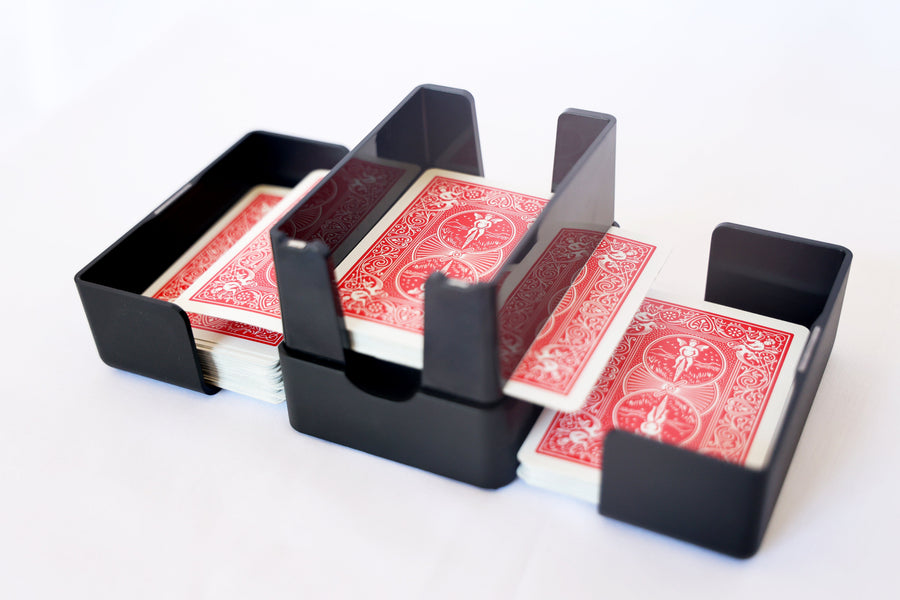
Product photo shows the original Lotus V1.
The one these guides keep pointing to
Lotus Card Shuffler V2
The Tabletop Family rated an early V2 24/25, their Best Overall among the 8 distinct models they bench-tested from 13 shufflers. Lotus supplied their V1 and early V2 review units.
$89.00 Free US shipping
Order Now