
Getting to Perfect: A Story About Rollers
A note from Komnieve, who designed the Lotus, on the one part that took longest.
In engineering your first instinct is usually wrong. When we started on the Lotus I assumed we would use the best off-the-shelf parts we could find and the shuffler would follow. The rollers taught me otherwise, and they took longer than any other part of the machine.
Playing cards are stranger than they look. Hold one to the light and you'll see tiny dimples pressed into the surface. That finish is there on purpose: it traps a thin layer of air between cards so they slide over each other instead of dragging. A card is engineered to be slippery. We set out to build a machine that grips and moves a thing designed to slip, without marking it, and the rollers are where that happens. The whole deck drops into one center tray, the rollers deal it card by card into two piles, and you restack. That is one pass. Everything rests on how the roller holds the card.
The rubber hunt
We tried rubbers first. Rubber grips; that is its job. Some were too grippy and took the card like a tug-of-war. Some were too slick and the card sat there. We needed a material that would hold a card finished to slide, with no more force than it took to move it, and that is a narrow target.
The silicone solution
After a long run of tests we landed on silicone, because it gave us control over how hard the roller grips. Not any silicone: one formulation. And the roller under it mattered as much as the coating.
A plain shaft wrapped in silicone did not hold its shape under load. We machined a metal shaft with calibrated sections and a drilled seat for the gear at the end, which is more than a consumer product usually gets. At the factory the shaft is heated and the silicone is applied in layers. It is expensive. Every time I look at the cost breakdown a voice asks why we are spending this much on a roller for a card shuffler.
Soft rollers reduce wear per pass; they do not reduce it to zero, and nobody selling a shuffler should tell you otherwise. What they do is hold a card with the least force that will move it, pass after pass. The damage guide covers what wears a card and what does not.
The happy accident
Then the surprise. The roller we thought was finished was not. We found that if the cards feed too consistently they can fall into a race condition where they don't shuffle properly, so we had to design in a slight oscillation. The cards need to lose their grip sometimes. That imperfection is what makes the whole thing work.
Was it worth it
Every time I look at one of these rollers, a machined metal shaft with silicone bonded on in layers, I smile. It is probably more than a card shuffler needs. Most people will never see it. But when you hold the finished shuffler and feel how solid and consistent it is, that is when you know it was worth it.
The roller taught me something I relearned across every year we spent on this shuffler: what looks like overengineering on paper is often the right amount in your hands. Spend the precision where it matters and refuse to compromise there. Everywhere else, the standard part will do.
And a machined piece of metal is a beautiful thing. You wouldn't expect to find one inside a consumer card shuffler, and that is the point. The right solution is rarely the obvious one.
Engineering is making things work well, not only making them work. Sometimes that means a long time on silicone formulations. Sometimes it means machining a shaft to tolerances a card shuffler was never supposed to need.
If you're going to obsess over something, obsess over every detail. Even the ones nobody will ever see.
The current model is the Lotus V2: $89 with free US shipping.
Lotus makes a quiet, clamshell automatic card shuffler for game night. play-lotus.com
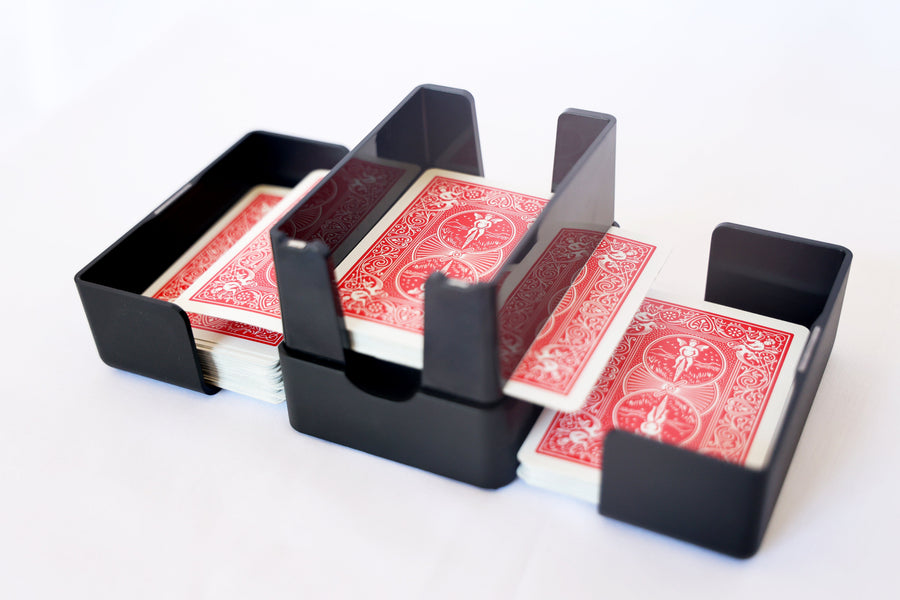
Product photo shows the original Lotus V1.
The one these guides keep pointing to
Lotus Card Shuffler V2
The Tabletop Family rated the Lotus V2 24/25, their Best Overall among the 8 distinct models they bench-tested from 13 shufflers. Lotus supplied its review units.
$89.00 Free US shipping
Order Now