
Do Automatic Card Shufflers Damage Cards?
Some automatic card shufflers damage cards and some do not. The mechanics decide it, not the brand. The Tabletop Family bench-tested 8 distinct models from 13 shufflers; their notes on the low scorers describe the feeds and jams, and misfeeds are where card damage concentrates. Hard rollers, fast feeds, and open exit paths cause the wear; the mechanics below are what to check.
The difference is not the brand name. It is the mechanics: what the rollers are made of, how fast they feed, and where the cards go when they leave the rollers. Cheap shufflers with hard plastic rollers and fast feeds bend corners, dent faces, and fray edges over time, especially on paper cards. Machines with soft rollers, a gentler feed, and a contained exit path treat cards roughly the way careful hand shuffling does. Below is how the mechanics work, what to check before you buy, and where any machine, including ours, has limits.
How a roller shuffler touches your cards
Almost every consumer shuffler uses the same basic move. A roller pinches the bottom card of a stack and drives it out from under the rest of the deck. Three things happen in that moment, and each one is a chance to hurt the card.
- The pinch. The roller presses the card against a surface to get grip. Too much pressure on a hard roller creates a dent line across the card face. You see this as a faint stripe on paper cards after heavy use.
- The feed. The card accelerates from zero to roller speed instantly. A hard, fast roller slaps the card into motion. That impact concentrates on whatever edge the roller catches first.
- The exit. The card has to land somewhere. In the classic two-sided crank-style shuffler, cards fly into a center well and smack the pile or the far wall. Corners take the hit. Do that a few hundred times and you get soft, rounded corners and edge fuzz.
None of this ruins a deck in one session. Card damage from shufflers is cumulative, like tire wear. The question is whether the machine wears your cards faster or slower than your own hands would, and hand riffle shuffling is not gentle either. Anyone who has bowed a deck into a bridge finish knows a human riffle bends every card in the deck, every time.
Where the wear comes from
The battery-crank shufflers that fill the budget shelf share a design lineage, and with it the same three problems.
- Hard rollers. Rigid plastic or thinly coated rollers need more pinch pressure to grip a card. More pressure means more denting and more surface polishing, which shows first on matte paper stock.
- Speed over control. These machines are tuned to feel fast in a demo. A fast hard feed means every card gets slapped, not gripped, and misfeeds are common. A misfed card that gets caught and dragged is how you get a creased card, which is the one kind of damage that ends a card's life immediately.
- Open exit paths. Cards launch across a gap and hit something. The landing zone is where corner wear accumulates.
There is also a jam problem that gets counted as damage. When two cards feed at once or a card catches on the well edge, people pull the jammed card out against the roller. That tug does more harm than a hundred clean passes. A machine that misfeeds often is a machine that gets cards yanked out of it often.
What to check before you buy
You usually cannot test a shuffler before buying it, but product pages and reviews reveal the mechanics if you know what to look for.
| What to check | Gentler on cards | Harder on cards |
|---|---|---|
| Roller material | Soft rubber-like rollers that grip | Hard plastic rollers that slap |
| Feed behavior | Controlled, one card at a time | Fast bursts, frequent double feeds |
| Exit path | Cards stay inside the machine or drop a short distance | Cards fly across a well and hit a wall |
| Jam handling | Rare misfeeds, easy card removal | Reviews full of jam complaints |
| Capacity | Stated deck sizes it handles | "Holds 6 decks" with no feed detail |
Reviews are the best proxy for the jam question. Search any listing's reviews for jam, stuck and bent. If those words show up in the first page of reviews, the mechanics are telling on themselves. Independent testing helps too. The Tabletop Family bench-tested 8 distinct models side by side from a field of 13 shufflers, and their testing surfaces exactly these feed and jam differences. Lotus supplied its own two review units; the method and the scores were theirs. We covered their results in our guide to the best card shufflers.
How Lotus approaches it
The Lotus is designed around the pinch, the feed, and the exit, because those are the three places damage happens.
- Soft rollers. Lotus uses soft rollers that grip the card rather than slap it. Grip needs less pinch pressure than slap, so there is less denting force on the card face and less impact on the leading edge.
- A gentler feed. Lotus runs an inverse riffle: it deals the deck card by card into two piles, and you stack them. Each pass takes about 5 seconds. The card is placed, not launched.
- Cards stay inside. There is no open well for cards to fly across. The piles build inside the machine, so corners are not repeatedly striking a wall.
Operation is a touch sensor, no buttons and no crank, so nobody is muscling a handle while cards are mid-feed. It holds up to two poker-size decks and handles 104, 108, and 112-card loads. On randomness, we say what the math says: about three passes suit game night, and about seven reach near-random, which is as far as any riffle goes.
In TheTabletopFamily's bench test, 8 distinct models from 13 shufflers, the Lotus V2 scored 24 out of 25, the best overall result. Our return rate runs under 1 percent. If a card ever does get damaged in a way that traces back to the machine, the 30-day full refund and 1-year warranty exist for exactly that conversation. Lotus is $89 with free US shipping, designed in the US.
The limits
Any machine handles your cards. That is the whole job. A shuffler that touches cards thousands of times will always produce more total contact than a deck that sits in a drawer. Soft rollers and a contained exit reduce wear per pass. They do not reduce it to zero, and nobody selling a shuffler should tell you otherwise.
Some decks make any machine look bad:
- Worn or warped decks. A deck that has bowed from humidity or heavy play misfeeds more in every shuffler, ours included. Misfeeds are where damage risk concentrates, so a tired deck is at more risk than a fresh one.
- Sleeved cards. No. Most sleeves push the deck outside the feed channel, which is sized for unsleeved poker-size cards. Some tighter single sleeves feed some of the time, and some of the time is not a standard we sell on. Shuffle sleeved Magic and other collectible decks by hand or by mash; do not buy a Lotus for a sleeved deck.
- Very glossy finishes. Bridge-size works for most decks, and Bicycle-brand bridge cards feed well, but very smooth, glossy finishes can slip on the rollers. Texture is the deciding factor, not the size label on the box.
- UNO is a confirmed fit, and family card games are where a shuffler earns its keep, since kids' decks get replaced for a few dollars when they wear out anyway. More on that in our UNO shuffler guide.
How to keep your decks healthy in any shuffler
- Square the deck before loading. A ragged stack invites misfeeds. Tap it flush first.
- Respect capacity. Overloading past the rated deck count strains the feed. Lotus is rated for two poker decks; do not force a third.
- Never yank a jammed card. If a card catches, remove the deck first, then free the card with no roller pressure on it.
- Retire warped decks. If a deck has a visible bow, it will misfeed everywhere. Flatten it under a heavy book overnight or replace it.
- Use plastic cards for heavy rotation. 100 percent plastic poker cards shrug off wear that would fray paper stock in a month of nightly games.
- Wipe rollers occasionally. Card coating residue builds up on any roller and reduces grip, which causes slipping and double feeds.
One more note for anyone buying a shuffler because hand shuffling has become physically hard: gentleness on cards and gentleness on hands come from the same design choices. We wrote separately about shufflers for arthritis and limited grip strength if that is the real question behind your search.
FAQ
Has anyone had a card damaged by a shuffler?
Yes, on the wrong machines, and the complaints are consistent: chewed edges, creased corners, cards that come out mangled. Those stories trace to two causes. First, hard or misaligned rollers that slap the card instead of gripping it. That slap is where edge wear comes from on cheap units. Second, forced feeds: too many cards in the tray, or a card size the feed was never built for. A well-aligned soft-roller feed is a different machine in practice: our return rate across all reasons runs under 1 percent. If a shuffler is eating cards, the feed is telling you something is wrong: wrong size, overloaded tray, or rollers that were never aligned to begin with.
Do automatic card shufflers bend cards?
Cheap shufflers can bend cards over time. Hard rollers, fast feeds, and open exit wells cause dent lines, rounded corners, and edge fray on paper cards; machines with soft rollers, controlled feeds, and contained exits wear cards roughly in line with careful hand shuffling. The Tabletop Family bench-tested 8 distinct models from 13 shufflers; read their notes on the cheapest units and the feed and jam complaints line up with the hard-roller group. The single biggest bend risk on any machine is pulling a jammed card out against roller pressure.
Will a card shuffler damage sleeved Magic cards?
Do not put them in. Most sleeves push the deck outside the feed channel, including on a Lotus, and the ones that squeeze in feed only some of the time. For collectible cards with resale value, hand shuffle. No machine's convenience is worth a creased card that costs real money.
Is a shuffler safe for UNO cards?
UNO is a confirmed fit in the Lotus. It is also a low-stakes test case: a worn UNO deck costs a few dollars to replace.
Do plastic playing cards hold up better in a shuffler?
Yes. 100 percent plastic cards resist the edge fray and surface wear that accumulate on paper stock. If you shuffle nightly, plastic decks are the single best upgrade for longevity, in a machine or in your hands.
Does a shuffler wear cards faster than shuffling by hand?
It depends on the machine and on your hands. A hand riffle bends every card in the deck on every shuffle, and a bridge finish bends them hard. A gentle machine with soft rollers produces less flex per pass than that. A harsh machine with a hard fast feed produces more. Neither is zero.
Why does my old deck jam in every shuffler?
Warped or humidity-bowed cards do not sit flat, so the roller catches them unevenly and feeds two at once or none at all. Flatten the deck under weight overnight, or retire it. A fresh deck is cheaper than the frustration.
Jams and misfeeds have their own fix-it page: the Lotus troubleshooting guide walks through every symptom (jams, double feeds, a machine that will not start) and which ones point at the deck rather than the machine.
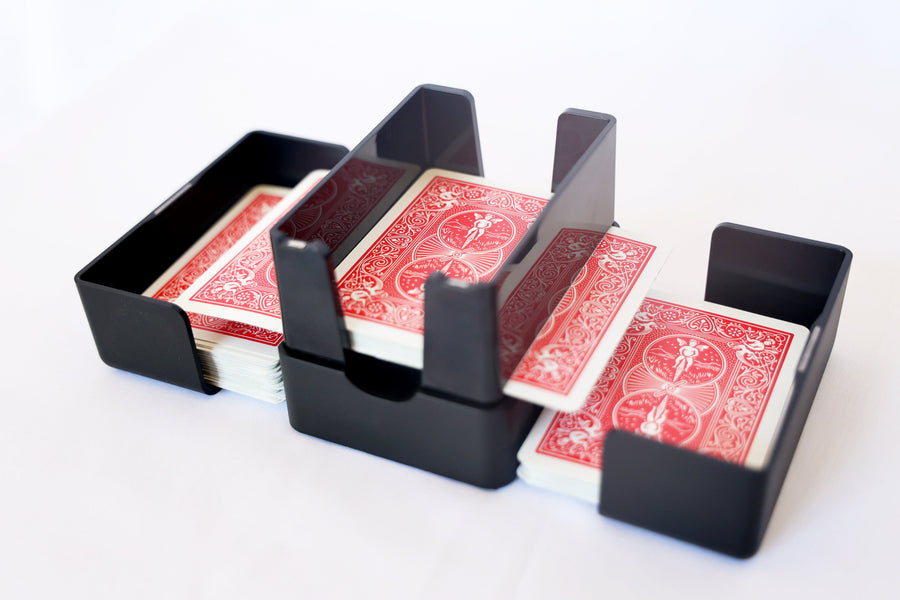
Product photo shows the original Lotus V1.
The one these guides keep pointing to
Lotus Card Shuffler V2
The Tabletop Family rated the Lotus V2 24/25, their Best Overall among the 8 distinct models they bench-tested from 13 shufflers. Lotus supplied its review units.
$89.00 Free US shipping
Order Now