
Quiet Card Shuffler: What the Decibel Number Hides
You bought a shuffler so the cards would be the easy part of the night. Instead the motor became the loudest thing in the room. It runs, and the table waits it out. Someone holds the end of a sentence. The conversation stops and starts again around the machine. A good shuffle should disappear into the evening, not interrupt it.
That is what you are shopping for when you search quiet card shuffler, and a decibel number alone cannot tell you whether you found it. How a running motor lands at a table depends on its frequency as much as its loudness. The human ear is most sensitive in the 2 to 5 kHz band, so a higher-pitched motor grates and grabs attention at a lower decibel reading than a deeper hum, which is why a bare dB figure cannot tell you which shufflers cut through a room (Discover Magazine on the most annoying sounds). A spec-sheet number with no mic distance and no ambient floor behind it cannot tell you which side of that line a shuffler falls on.
The reason Lotus runs quiet is the same reason it shuffles well: it does a real riffle on soft silicone pull wheels, dealing the deck card by card into two piles, a riffle run in reverse, instead of throwing cards through a hard high-speed feed. The wheels grip and release rather than slap, so the powerful operation and the quiet operation are the same motion. Lotus stays under the level where people start raising their voices to be heard over it, the line where a shuffle starts to end the conversation. Lotus runs quiet enough to talk over. The method below is how a number like that should be held to its conditions, which is the part almost no one publishes.
Why the number on the box almost never matches the room
A decibel meter reads one thing: sound pressure. It does not read pitch. A low rumble at 70 dB and a high whine at 70 dB measure the same and feel nothing alike across a table.
The ear is not flat. It is most sensitive in the 2 to 5 kHz range, the band that carries a smoke alarm, a baby's cry, a fork dragged across a plate. A sound that sits in that band feels harsh and grabs attention at a lower decibel level than a deeper sound does. Low-frequency noise rides its own, separate annoyance curve (Noise & Health journal on low-frequency annoyance). So a 55 dB motor whining at 3 kHz can beat a 65 dB motor humming low for sheer grate, even though the deeper one reads ten decibels louder on the meter. The spec-sheet number cannot see that difference. Your ear can.
This is the second variable behind every quiet claim, and almost no one publishes it. Frequency decides as much as loudness whether the machine ends the conversation, and a bare decibel figure leaves it out.
What a decibel number means before you trust it
The decibel scale is not linear, which is why two numbers that look close are not. Every 10 dB increase is roughly a tenfold jump in sound intensity, so 70 dB is about ten times stronger than 60, and a 10 dB drop is one-tenth the sound intensity. This is a physical intensity ratio, not a claim that it sounds ten times quieter (NIDCD: how sound is measured). A few decibels on a label can be the whole gap between a shuffle you talk over and one that stops the sentence.
A decibel reading is also only as good as the conditions behind it. The same motor reads loud at six inches and fine at six feet, and background noise such as a dishwasher can raise the total reading. A number means something only when it carries its mic distance and its ambient floor with it. Without those two facts the figure cannot be placed against your own table, and no one reading the page can place it either.
The benchmark that does travel is the human one. Yale’s comparison chart places normal conversation around 60 to 70 dBA (Yale EHS decibel level chart). A shuffler is quiet when it stays under the level where people start raising their voices to be heard over it.
One independent noise comparison
A Poker Chip Forum hobbyist reported phone-app peaks around 83 dB on a tabletop and 70 dB after cabinet mounting with acoustic foam, using a ShuffleTech ST-1000. These are observations from that setup, not calibrated comparisons with other shufflers.
The useful part is the record of the setup: the author describes what changed between readings. A different room, mounting surface or measuring device can change the result.
A method for comparing noise
A quiet claim is only worth something if someone can prove it wrong. So we wrote down how we would measure, and we publish the method rather than a bare number. A decibel figure without its distance, surface, ambient floor, and pitch hides more than it shows, so we do not print one. If a Lotus on your table sounds different from what we describe, this is the document you use to prove it.
Use a sound-level meter, a fixed mount and a tape measure. Record the meter model, weighting and time-response settings, and keep them the same throughout the comparison. A phone spectrum app can show relative frequency patterns; it does not substitute for calibrated sound-level measurements. The method:
For a comparison, fix the mic at 18 inches from the center of the unit, where a player's ear sits when leaned forward over the table. Six inches would usually produce a higher reading; six feet a lower one. Keep the distance the same for every comparison. Place each unit on the same quarter-inch felt pad on wood, the closest analog to a real card table, because hard surfaces amplify motor vibration and carpet absorbs it. Log a 30-second ambient floor before each unit. Repeat the session if the background level changes by more than 2 dB. Run five passes per unit and report the median and the range so one unusually quiet pass does not stand in for the whole session. Log the peak separately, since a unit can run quiet on average and spike when a card jams, and the spike is the part you notice. Use a phone to record a relative frequency spectrum on one pass to see which units carry their energy in that sensitive 2 to 5 kHz band.
Use the same meter, settings, deck and room setup for a comparison, and report those conditions with the result. The record helps readers judge what the readings can and cannot show.
What a noise number needs before it can answer you
A decibel reading is a fact only when it carries its conditions. Here is the short list of what has to sit behind a number before it tells you anything about your own room, and what each one hides when it is missing.
| What the number needs | Why it matters | What its absence hides |
|---|---|---|
| Mic distance | The same motor reads loud at six inches and fine at six feet | Whether the figure was taken a hand's width or a room's width from the unit |
| Ambient floor logged | Background sound contributes to the total reading; log it separately | How much of the number is the room rather than the machine |
| Frequency reading | The ear punishes the 2 to 5 kHz band harder than a low hum | A high whine that grates at a low dB figure |
| Median across passes | One lucky pass is a unit's best moment, not its Tuesday | A spike when a card jams, which is the part you notice |
This is a proposed comparison method, not a report of measurements Lotus has completed. Lotus runs quiet enough to talk over. A figure that cannot show its conditions cannot be placed against your table, by you or by anyone reading it later, which is why the method matters as much as the number.
Consider durability separately
A quieter sound does not establish how long a shuffler will last. Compare warranty terms, card handling and long-term owner reports as well as noise.
Lotus uses soft silicone rollers for its inverse riffle. They separate the deck into two piles, and you restack between passes. The design aims to reduce wear; it cannot eliminate it. See the card-wear guide for what to watch for.
The shuffler this page is about
Lotus is $89 for the V2 pre-order, ships October; the V1 is sold out. It holds two poker-size decks at 2.5 by 3.5 inches, around 104 cards and up to about 108 with jokers, runs on a removable 9V battery, and starts on a touch.
The strongest outside signal we have is not our own test. The Tabletop Family bench-tested 8 distinct models from 13 shufflers bought and picked the Lotus V2 prototype as their Best Overall at 24/25; the V1 scored 22/25. We did not run the test and we are not restating it as ours. It is theirs, and you can read it under their name.
Lotus is for people whose cards do real work. A weekly canasta or pinochle club clears 500 to 2,000 shuffles a unit in a year without trying, the volume cheap units were never built for, and a quiet room where the conversation is the point is where the noise question matters most. It is not the tool for sleeved trading-card decks, which any automatic shuffler wears, so hand-shuffle those. It is not a dealer machine or a multi-deck dealing shoe, which are a different product for a different table.
FAQ
How loud is a card shuffler, in terms I can compare to my own house?
Loud enough to matter in a quiet room. Yale’s comparison chart places normal conversation around 60 to 70 dBA (Yale EHS decibel level chart). A shuffler is quiet only if it stays under the level where people start raising their voices. Lotus runs quiet enough to talk over.
Why does my quiet shuffler still stop the conversation?
Because loudness is half the story and pitch is the other half. The ear is most sensitive in the 2 to 5 kHz band, so a high-pitched motor grates and grabs attention at a lower decibel reading than a deep hum does. Cheap units tend to use small high-RPM motors chosen for price, and a fast, rough motor pushes its noise up into exactly that sensitive band. A listing's decibel number cannot show you that, which is why a unit can read as quiet on paper and still cut through the room.
Can I trust a decibel number by itself?
Not on its own. A decibel reading needs two facts behind it before it means anything: the mic distance and the ambient floor of the room it was taken in. The same motor reads loud at six inches and fine at six feet. And because the scale is not linear, the size of any gap is easy to misjudge, since every 10 dB is roughly a tenfold jump in intensity, so a 10 dB drop is one-tenth the sound intensity, not necessarily one-tenth the perceived loudness. A number that cannot show the conditions it was measured under cannot be placed against your own table.
Will a quieter shuffler also be the one that lasts?
Not necessarily. Noise alone does not establish durability. Compare the warranty, card handling and long-term owner reports. Lotus is designed to reduce card wear, but mechanical shuffling can still wear cards.
Is the Lotus quieter, and how would you know?
Lotus runs quiet enough to talk over. The method on this page is a way to record a comparison, with a fixed 18-inch distance, the same surface and deck, a logged ambient floor, and five passes. It is not a report of completed Lotus acoustic testing or a guarantee of identical readings on every table.
Has anyone measured home shufflers for noise the same way?
The Poker Chip Forum ST-1000 comparison records one hobbyist’s phone-app observations, including cabinet mounting and acoustic foam. It is not a standardized comparison of home shufflers. For comparisons, use the same meter, settings, deck and surface, and record the conditions.
Is this the right shuffler for my situation?
It is right if your cards do real work. A weekly canasta or pinochle club running 500 to 2,000 shuffles a year is the table Lotus is built for, and a quiet room where the conversation is the point is where the noise question matters most. It is the wrong tool for sleeved trading-card decks, which any automatic shuffler wears, and for dealer machines or multi-deck dealing shoes, which are a different product. If you play cards a couple of times a year, the noise will not be the thing you remember.
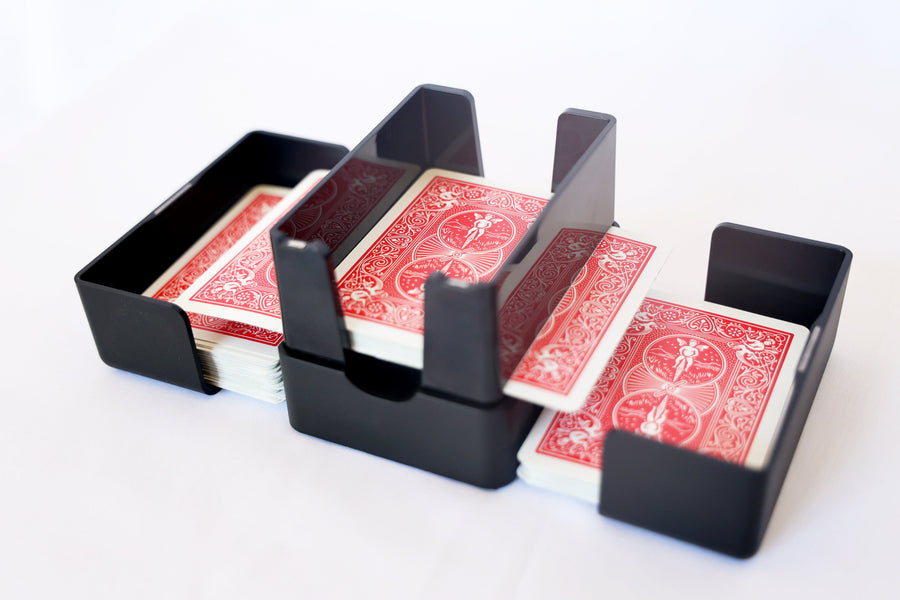
The one these guides keep pointing to
Lotus Card Shuffler V2
TheTabletopFamily’s Best Overall pick. V2 scored 24/25, first of the 8 distinct models they bench-tested from 13 shufflers bought. Two decks, no buttons. Pre-order ships October.
$89.00 Free US shipping
Pre-order V2