
Electric Card Shuffler: What the Word Actually Tells You
You bought the machine so the night keeps moving. So the person who hates dealing stops carrying it. So a kid can play a hand before bed without bridging 108 cards across the table. The word under your search is electric, but what you want is a unit that still works in a year and mixes the deck while it does.
Electric tells you a motor is doing the work your hands used to do. It says nothing about whether the deck comes out mixed. In 2000, Stanford statisticians Persi Diaconis and Susan Holmes tested a casino shuffling machine and found that a single motorized pass randomized a 52-card deck only about as well as three riffle shuffles, short of the seven a deck needs to be fully mixed (Science News). So electric is a power-source label. It is not a quality grade, and it is not a promise of a good shuffle.
A Lotus answers the question the word skips. It does a real riffle, the most powerful thing you can do to a deck. Drop in a poker deck, tap, and the rollers deal it card by card into two piles, a riffle run in reverse. You restack, quietly and the same way every time. Run it three times and a home deck is mixed clean for any Thursday game; about seven riffles brings a deck to near-random by the Bayer-Diaconis result.
What electric actually means at a home table
The live web answers one plain question three contradictory ways. Some guides define electric as plug-in or AC-only and treat battery as a separate category. Others use electric and automatic as the same word. A third group describes four-C-battery or dual-power AC-adapter designs that have nothing to do with how the home segment works. A buyer reading those ends up comparing labels instead of machines.
Here is the plain translation for the units a home player will see. Electric means there is a motor, and that motor runs off a battery or a wall plug. Automatic means you press a button or touch a pad and the unit feeds the cards itself. Battery-powered, for the home, means a 9V battery driving the rollers that feed the cards through. Almost every home unit is all three at once.
So when a listing stacks the words electric automatic battery card shuffler, it is describing one ordinary machine three times. The words point at the same thing. The questions that matter sit underneath them. Will it keep working, and does it mix the deck.
Why one motorized pass is a weak shuffle
A motor is fast. Fast is not the same as mixed. The Diaconis and Holmes finding draws the line cleanly: a single machine pass left a 52-card deck only about as random as three hand riffles, short of the seven riffles a deck needs to reach near-random (Science News).
That is mechanism, not a flaw to apologize for. A riffle, forward or in reverse, mixes the deck once per pass. A full home mix is three passes, and Dave Bayer and Persi Diaconis proved in 1992 that seven brings a 52-card deck to near-random (Annals of Applied Probability). Three is plenty for a Thursday game, the common practical reading rather than the theorem. The fix for a weak single pass is the obvious one. Run an electric unit three times. The riffle itself is world-class, so three trips through the rollers get a home table to a clean mix.
The usage line is the whole takeaway, simpler than the math. If a clean shuffle matters to the game, run it three times, and judge a unit by whether it feeds reliably enough that three passes are no trouble.
What separates a cheap unit from a good one
Price in this category is not paying for the word electric, since every unit clears that bar. It shows up in failure modes you can see and hear. A tabletop-review team at The Tabletop Family picked the Lotus V2 as their Best Overall at 24/25; the V1 scored 22/25 (The Tabletop Family). The cheapest units failed in ways anyone would notice on the first night.
One cheap unit ran extremely loud and had a tray that did not attach properly. A cheap poker machine had no sensor to detect when shuffling was complete, so it ran until the user pressed the button again (The Tabletop Family). That second one is the failure most buying guides miss. A unit with no completion sensor does not know it is done. It keeps feeding and waits for you to stop it.
Repair logs add two more. Gears slip out of alignment so one side stops moving, and some units run a few rounds then quit even on fresh batteries. The deeper teardown of those mechanical failure points lives on the best card shufflers guide. The point here is narrow. The price gap buys a unit that knows when it is finished, holds its tray, and survives a real two-deck load.
How many decks, and which cards
Capacity is the one place the label finally tells the truth, because it is a physical limit and not a marketing word. A home 9V-class electric unit holds one to two standard poker-size decks, the 2.5 by 3.5 inch cards in a Bicycle or Copag pack. Two decks covers a poker night and a canasta hand at 108 cards. A modern UNO deck is 112 cards (Mattel added a Wild Shuffle Hands card and three customizable Wilds to the old 108-card deck in 2018), inside the count, though UNO stock runs narrower than poker-size and it feeds cleanly in our testing.
One card type needs a different tool, and this is plain compatibility. Sleeved trading-card decks, the kind a Magic or Pokemon player protects, run too wide for the intake. Hand-shuffle those. Bridge-size cards run narrower than poker-size and vary by finish: Bicycle-brand bridge cards generally feed well, while very smooth or glossy bridge stock can slip. A motorized unit is built for standard cards at a home table, and within that range it does the job a riffle is meant to do.
The Lotus electric shuffler
Lotus is a 9V electric shuffler built for home play. It holds two standard poker-size decks, starts on a touch with no held button, and closes like a clamshell when the game ends, shutting the way a book closes so it sits on a shelf without sprawling. Today’s V2 pre-orders at $89 and ships October; the original V1 is sold out. Set a deck in, tap, and run it three times for a clean mix.
The removable 9V is a deliberate choice. A sealed internal cell gives a unit a hard expiration date, the day that battery stops holding charge. A 9V you can swap keeps the unit alive for years. We picked the design that outlasts the battery.
A single 9V is good for 500+ shuffles, so a battery lasts a long run of game nights before a swap. We state that as a rating we stand behind, not a marketing line. The noise question, the decibel and frequency reading, belongs to the quiet card shuffler page, where we publish a test you can run at your own table.
For the battery side of the story, see battery-powered card shuffler. For the mechanical failure modes a good unit is built against, see best card shufflers.
FAQ
Is an electric card shuffler the same as an automatic one?
For a home unit, yes. Electric means there is a motor. Automatic means you press a button or touch a pad and it feeds the cards itself. Nearly every electric home shuffler is both, so the two words describe one machine.
Is a hand-crank shuffler gentler on cards than an electric one?
Not inherently. Gentleness is decided by the feed mechanism and the card's texture, not by what spins the rollers. A crank gives you control over speed, which sounds gentler, but uneven cranking wobbles the feed, and a card fed at a wobble is more likely to catch an edge than a card fed at a motor's steady rate. What actually protects cards is roller design: soft rollers that grip the card rather than slap it, and a feed path sized to the card. Judge any shuffler, crank or electric, by its rollers, not its power source.
Should I get a battery or a plug-in shuffler for home?
A removable 9V keeps the unit portable and serviceable for years, which suits almost everyone playing at home. Plug-in earns its place only for continuous casino-style dealing that runs for hours, since a battery cannot hold that load for a full session. A home table never asks the motor to run that long.
Do electric shufflers actually shuffle randomly?
One pass does not fully randomize a deck. Diaconis and Holmes found a single machine pass mixes only about as well as three riffles, short of the seven a deck needs. Run it three times for a clean shuffle, and about seven riffles to reach near-random by the Bayer-Diaconis result. At a home table, where no one is reading the deck for money, three is enough.
Why do cheap electric shufflers stop working after a few weeks?
Repair logs show two common causes: gears slip out of alignment so one side stops moving, and an undersized motor strains under a full two-deck load until it quits, sometimes on fresh batteries. A hollow shell and a thin motor produce both.
What separates a $20 electric shuffler from an $89 one?
Not the word electric, which every unit clears. The Tabletop Family's test found the cheapest units ran loud, had trays that would not attach, and in one case had no sensor to detect when shuffling was done, so the machine ran until the user stopped it. The gap is in failure modes you can see and hear.
How many decks can an electric shuffler handle, and will it really do two?
A home 9V-class unit holds one to two standard poker-size decks. Two decks is the design target for a poker night or a 108-card canasta hand, not a stretch limit. A 112-card UNO deck is inside the count, though UNO stock runs narrower than poker-size, so it feeds cleanly in our testing.
What card sizes work in an electric shuffler?
Standard 2.5 by 3.5 inch poker-size cards: Bicycle, Copag, most board-game decks. UNO decks work too: the narrower UNO stock feeds cleanly on Lotus in our testing. Bridge-size cards vary by finish: Bicycle-brand bridge decks generally feed well, while very smooth or glossy stock can slip. Sleeved trading-card decks run too thick for the intake, so hand-shuffle those.
Will the motor burn out?
The failures on record come from the cheapest units, where an undersized motor strains under a full deck until it quits, per The Tabletop Family bench and public repair logs. A well-sized motor runs cooler under the same load. Lotus runs a motor chosen for daily use, and a single 9V is good for 500+ shuffles, so the limit you hit first is the battery, swapped in seconds, not the motor.
Which electric shuffler do board gamers recommend?
The Tabletop Family picked the Lotus V2 as their Best Overall at 24/25; the V1 scored 22/25. Their full comparison and our build details are on the best card shufflers guide.
More guides: Battery-powered card shuffler · Best card shufflers · Quiet card shuffler
For the direct power-source comparison (removable 9V vs sealed rechargeable vs wall plug), see the battery vs plug-in shuffler head-to-head.
If the listing you are weighing also promises to deal, that is a different category with its own failure modes, covered honestly in our shuffler and dealer machines guide.
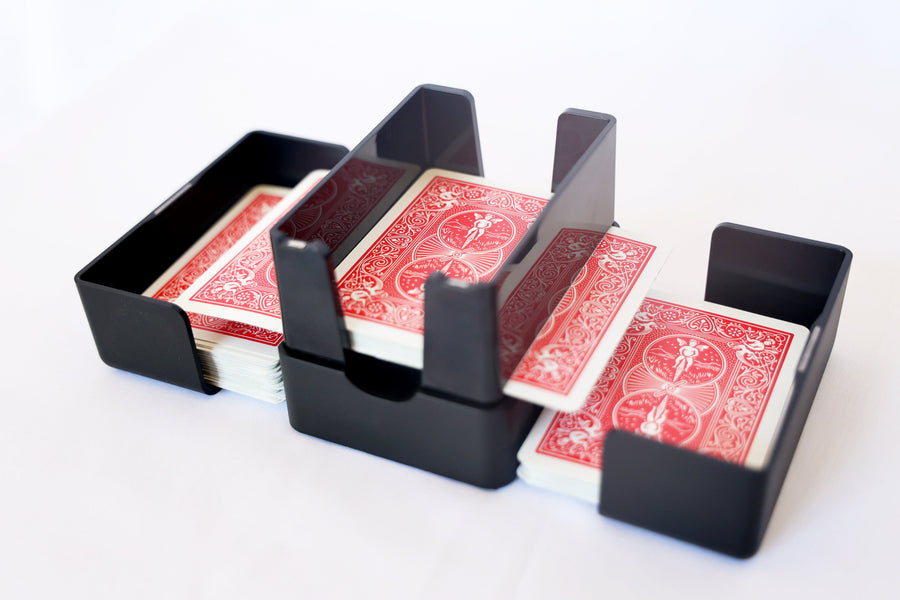
The one these guides keep pointing to
Lotus Card Shuffler V2
TheTabletopFamily’s Best Overall pick. V2 scored 24/25, first of the 8 distinct models they bench-tested from 13 shufflers bought. Two decks, no buttons. Pre-order ships October.
$89.00 Free US shipping
Pre-order V2