
How to Shuffle Cards When Your Hands Won't Cooperate
You do not need working thumbs to shuffle a deck of cards. The table wash (spread the cards face down and swirl them with flat palms for about 60 seconds) takes almost no grip strength and mixes a deck thoroughly. That is not folk wisdom; it is an experimental result from Persi Diaconis, the Stanford mathematician who studies shuffling: in his experiments, 30-second and one-minute washes passed all 10 of his randomness tests. This guide covers five hand methods rated for grip and mixing (arthritis, tremor, one working hand, small hands, it is the same list) and then the tool option for the day technique stops being fun.
The wash: the best low-grip shuffle there is
Every hard part of a riffle shuffle is a grip move: splitting the deck, bending the halves, bridging them back. The wash deletes all three. Spread the deck face down across the table, place your palms flat on the cards, and slide them around in loose circles. Casino dealers call it a wash or a smoosh, and poker rooms use it on fresh decks. When you are done, gather the cards and square the deck against the tabletop instead of pinching it square in the air.
The question is whether swirling mixes. Diaconis tested it: 15-second washes failed his randomness checks badly, but 30-second and 60-second washes passed all 10 tests, and his practical read is that a minute of ordinary smooshing is enough for real play (Quanta Magazine's profile of the research). Give it the full minute, keep the motion loose, and you have a properly mixed deck without one grip-strength move. A cloth or felt surface makes the slide easier on both the cards and your hands.
Overhand, in small packets
The overhand shuffle (deck resting in one hand, the other hand pulling small packets off and letting them fall back in a new order) asks much less of your thumbs than a riffle, which is why it is most people's fallback. As a mixer it is weak: mathematician Robin Pemantle analyzed the overhand shuffle and found it takes on the order of thousands of repetitions to genuinely randomize a 52-card deck. Diaconis puts the practical figure at around 10,000; Pemantle's analysis gives the order of magnitude (Pemantle, "Randomization Time for the Overhand Shuffle"). A riffle needs about seven passes; the full story of that number is in our essay, From Magic to Math.
The practical use: pull the smallest packets you comfortably can (smaller packets mix better per pass), use it to loosen and break up a deck, then finish with a wash. Overhand as the opener, wash as the shuffle.
The box-shake method
Seniors' forums pass this one around: drop the cards in a large box or tin, close it, shake. It asks nothing of the hands, which is its whole appeal, but it mixes poorly. Cards in a box press face to face and slide as blocks, so shaking mostly rearranges chunks of the old order rather than separating cards from their neighbors. It is also rough on the deck, since corners take the impacts. As a pre-mix before a wash it does no harm. As the shuffle your game relies on, it is the weakest option on this list.
Dealing into piles is not shuffling
Dealing the deck into piles and restacking feels thorough and asks little grip, but it is not randomizing at all: every card's destination is fixed by its starting position, the same way every time. It is ordering, not mixing. A Lotus pass also leaves two piles, but which pile a card lands in is not fixed by its position, which is why one pass comes out 25 and 27 one time and 24 and 28 the next. That is an inverse riffle, not a pile shuffle, and the math treats it as a riffle. Magic: The Gathering's tournament rules make the same call: pile shuffling alone is explicitly not sufficient randomization (MTR 3.10). Use piles to count a deck or break up clumps between games, then wash.
Five methods, rated
| Method | Grip needed | To a well-mixed deck | Verdict |
|---|---|---|---|
| Riffle | High: split, bend, bridge | About 7 passes (Bayer–Diaconis) | The standard, if your hands allow it |
| Wash / smoosh | Minimal: flat palms only | About 60 seconds | Best low-grip method; passed Diaconis's tests |
| Overhand | Light | Thousands of passes (~10,000 commonly cited) | Gentle on hands, weak as a mixer, opener only |
| Box shake | None | Not reliably ever | Cards slide as blocks; pre-mix at best |
| Dealing into piles | Light | Never: it is ordering, not mixing | Use for counting, not fairness |
| Automatic shuffler | One tap | ~7 passes ≈ 35 seconds of machine time, plus the restack between passes (Lotus: ~5 s/pass) | Same math as a riffle, no grip in the loop |
When technique stops being fun
The phrasing barely changes from one card forum to the next: my hands don't work the way they used to, I can't shuffle for the life of me, and I don't want to give up the game. Technique buys real room, and for many people the wash alone settles it. But when even a minute of swirling is a minute of aching, the next step is taking grip out of the loop entirely, and that is precisely what an automatic shuffler is for.
This is the machine we make, and for stiff or weak hands it is the right tool. The Lotus loads by dropping one or two decks flat into a single center tray: no halving the deck, no squaring two thin stacks into separate slots. It starts from a single touch sensor under a resting fingertip, and a sensor inside reads whether one deck or two is loaded, so there is nothing to select. No button to press and hold, no crank to turn. A pass takes about 5 seconds; three passes suit most games and about seven reach near-random. It runs quiet enough to talk over, takes a standard 9V rated for 500+ shuffles, folds shut like a clamshell with the cards inside, and costs $89 with free US shipping, a 30-day full-refund guarantee, and a 1-year warranty. The two motions arthritis punishes hardest, the split and the bridge, do not exist on it.
If you are working around arthritis specifically, the arthritic hands guide goes deeper on loading and activation mechanics. Buying for a parent or grandparent who is quietly sitting out the shuffle? The gift guide is written for exactly that.
FAQ
What is the easiest way to shuffle cards with arthritis?
The table wash: spread the cards face down, swirl them with flat palms for about 60 seconds, gather, and square the deck against the tabletop. It removes the three grip moves that make a riffle hurt (the split, the bend, and the bridge), and Diaconis's experiments found washes of 30 to 60 seconds passed all 10 of his randomness tests. If even the wash is too much on bad days, a touch-activated automatic shuffler removes grip from the job entirely.
Can you shuffle a deck of cards with one hand?
Yes: wash it. Spread the cards face down, swirl them in loose circles with one flat palm for about a minute, then gather them against the table edge and square the deck on the tabletop. It genuinely mixes and needs no second hand. The one-handed riffle you have seen in videos is a card-flourish trick that takes months of practice; the one-handed wash works the first time.
Is shaking cards in a box a real shuffle?
No. Cards in a box press face to face and slide around as blocks, so shaking rearranges chunks of the old order more than it separates cards from their neighbors, and the corners take a beating. It does no harm as a pre-mix, but follow it with a table wash before any game where the order matters.
How can a kid with small hands shuffle cards?
The same methods that suit stiff hands suit small ones. Start kids on the wash (spreading and swirling is easy, fun, and genuinely mixes the deck), then the overhand in small packets as dexterity grows. The riffle can wait; it is the last shuffle a hand grows into, not the first.
How many times do you need to shuffle?
For a riffle, about seven passes takes a 52-card deck to near-random (the Bayer–Diaconis result), and around three passes suit most casual games. For a wash, give it about 60 seconds. For the overhand, the real number is out of reach: analysis puts thorough mixing at thousands of repetitions, which is why it should open a shuffle rather than be one.
Will an automatic shuffler chew up my cards?
Less than a hand riffle does, on a well-built one. Soft rollers reduce wear per pass; they do not reduce it to zero, and nobody selling a shuffler should tell you otherwise. Damage stories trace to hard, misaligned rollers that slap cards instead of gripping them, and to forced feeds: wrong card size or an overloaded tray. The Lotus uses soft rollers that grip rather than slap, and our return rate across all reasons runs under 1 percent. Worn shufflers of any brand should be retired the way worn decks are: when the feed stops running clean.
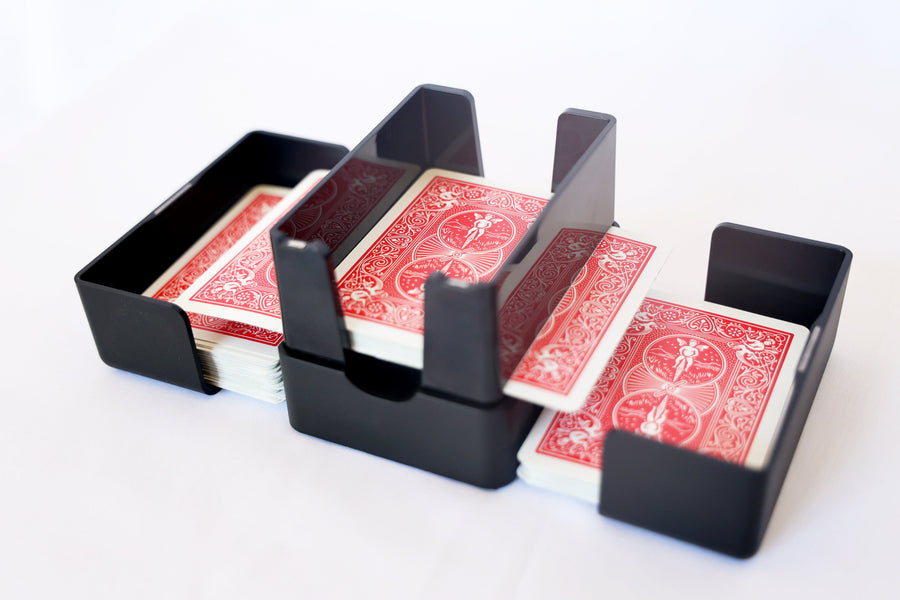
Product photo shows the original Lotus V1.
The one these guides keep pointing to
Lotus Card Shuffler V2
The Tabletop Family rated the Lotus V2 24/25, their Best Overall among the 8 distinct models they bench-tested from 13 shufflers. Lotus supplied its review units.
$89.00 Free US shipping
Order Now