
Can a Card Shuffler Be Rigged?
A home card shuffler cannot be rigged in any useful sense, and the reason is physical, not reassurance. Rigging a deck means knowing card identities, and a home riffle shuffler has no way to know them. It has rollers, a motor, and a touch sensor whose only job is to start the motor. No camera, no card-reading sensor, no software that can tell the queen of spades from the two of clubs. The casino machines behind the headlines (the Deckmate 2 security research in 2023, the federal poker indictments in 2025) are a different category entirely: machines that read every card with an internal camera. This guide walks through both, plainly.
Rigging requires reading
Stacking a deck means putting known cards in chosen positions, or at minimum knowing what order the cards ended up in. Either way, the first requirement is the same: something has to read the cards. A person does it by peeking. A machine does it with a camera or an optical sensor. No reading, no rigging: a device that cannot see the cards has nothing to work with.
A home riffle shuffler like the Lotus is rollers, a motor and a tray, and nothing that can see. The deck sits in a center tray, soft rollers deal it card by card into two piles, and you stack them into a mixed deck. At no point does any part of it register which card is which. The touch sensor on top closes a circuit and starts the motor, and a second sensor inside reads how many cards are in the tray, one deck or two, never which cards. That is the entire software story. The machine can randomize an order. It cannot choose one.
The casino hack everyone half-remembers
The paranoia is not baseless. It is aimed at the wrong machines. In 2023, researchers at the security firm IOActive showed that the Deckmate 2, the shuffler used in casino poker rooms, could be compromised through an exposed USB port with a device small enough to hide in a palm (IOActive's own write-up). The attack worked because the Deckmate 2 contains an internal camera, installed to verify that a full deck is present, and that camera reads card identities. A compromised unit could relay the exact order of the deck to a nearby phone. In October 2025, federal prosecutors alleged that exactly this class of tampering was used to rig private high-stakes poker games (NPR's report on the indictments).
Read those stories closely and the pattern is the point: every documented attack targets a card-reading machine, because the camera is the thing worth hacking. Even the compromised casino unit was not made to reorder the deck. The cheaters read the order and exploited the knowledge. A machine with no eyes offers an attacker nothing. You could wire a chip into a home shuffler and the most it could ever tell you is that the motor is running.
The worst a broken or tampered home shuffler can do is mix poorly: leave the deck closer to the order it arrived in. That is a real, if small, fairness point, and the fix costs seconds: run more passes.
What random means
No shuffle, human or machine, gets a deck to pure, mathematical randomness. The standard comes from mathematicians Dave Bayer and Persi Diaconis: about seven riffle shuffles take a 52-card deck to near-random, the point where remaining patterns stop mattering for play. Around three passes suit most casual games. The math counts riffles, not hands, so a machine riffle scores the same as a hand riffle. The machine just makes the full count effortless. A Lotus pass takes about five seconds, so seven passes is roughly half a minute of machine time, with a restack between each. The full story is in our essay, From Magic to Math: How Many Times Should You Really Shuffle Cards?
Why you keep getting the same hands
This is the observation that launches most rigging suspicions, and it has three boring explanations.
- Too few passes. Cards that traveled together last hand, a gathered trick or a mucked pair, stay near each other through one or two shuffles. Clumping is a shuffle-count problem, not a machine problem, and it happens with hand shuffling at exactly the same rate.
- Base rates. There are 2,598,960 possible five-card hands, but only a handful of hand types you would notice and remember. Deal enough hands and repeats of a type are guaranteed.
- Memory. You remember the second pocket kings of the night. You do not remember the hundred unremarkable deals between them.
If the same cards keep arriving in clusters, that is evidence of under-shuffling. Run about seven passes and the clusters dissolve. Our essay on why we trust a game's fairness covers the deeper reason the suspicion feels so sticky: randomness is doing social work at a card table, so people audit it hard.
Are card shufflers allowed in tournaments?
It depends on who runs the table, so here is the map. Casinos and licensed card rooms use their own equipment; you do not bring a shuffler to a casino. Home games, bar leagues, and club nights set their own rules, and most allow any method that genuinely randomizes. Many leagues welcome a machine because it standardizes the shuffle. For sanctioned Magic: The Gathering play, the Magic Tournament Rules do not name machines either way: they require decks to be "sufficiently randomized," they explicitly rule that pile shuffling alone is not sufficient, and at competitive levels your opponent gets to shuffle your deck after you do (MTR 3.10, Card Shuffling). If you want to use a machine at a sanctioned event, ask the head judge before round one. The judge's ruling is the one that counts.
The rigging audit, run on a Lotus
| Question an auditor would ask | Lotus answer |
|---|---|
| Can it see the cards? | No. No camera, no card-reading hardware of any kind. The one sensor inside reads how many cards are loaded, never which cards. |
| What does the electronics do? | A touch sensor starts the motor, and a second sensor reads whether one deck or two is in the tray. That is the whole circuit's job. |
| Can it place a chosen card in a chosen spot? | No. Rollers deal the deck card by card into two piles; the machine has no notion of which card is which. |
| What can it do to the deck's order? | Randomize it: near-random after about 7 passes (Bayer–Diaconis). |
| What is its worst failure mode? | Mixing weakly if you run too few passes. The fix is more passes, about 5 seconds each. |
| What would hacking it get an attacker? | Control of a motor. Nothing about card identities exists inside the machine to steal. |
FAQ
Can the Lotus card shuffler be rigged?
No. There is no mechanism to rig. The Lotus contains rollers, a motor, a touch sensor that starts the motor, and a second sensor that reads how many cards are in the tray. It has no camera or card-reading sensor, so it cannot know card identities, and without identities a device cannot stack a deck or report its order. The only thing it can do to a deck is mix it. Its worst failure mode is mixing weakly, and the fix is running more of its roughly five-second passes.
Do casino card shufflers cheat?
Not by design. Casino machines in licensed rooms are regulated equipment. The documented risk is tampering: 2023 security research showed the card-reading Deckmate 2 could be compromised through its USB port to reveal deck order, and 2025 federal indictments alleged hacked shuffling machines were used to rig private, illegal games. Both cases turn on the same detail: those machines read cards with an internal camera. Machines that cannot read cards have nothing equivalent to attack.
Why do I keep getting the same hands from a shuffler?
Almost always under-shuffling plus memory. Cards that were together last hand stay near each other through one or two passes, so clumps repeat. The same thing happens with a lazy hand shuffle. And with 2,598,960 possible five-card hands but only a few memorable hand types, repeats you notice are statistically guaranteed. Run about seven passes, the Bayer–Diaconis threshold for near-random, and the pattern disappears.
Are card shufflers allowed in tournaments?
House rules decide. Casinos use their own equipment. Most home games and leagues allow any method that genuinely randomizes, machines included. Magic: The Gathering's tournament rules require decks to be sufficiently randomized and let your opponent shuffle your deck afterward; they do not ban machines, but the head judge's ruling governs, so ask before round one.
Could a shuffler stack the deck for one player?
Only a machine that knows card identities could even attempt it, which is why the question only arises for camera-equipped casino machines. A home riffle shuffler physically cannot: it deals whatever deck it is handed into two piles, one card at a time, with no record of which card went where. Even in the well-known casino hack, researchers read the deck's order rather than rearranged it. Knowing every card was already a winning cheat.
Is hand shuffling safer than a machine?
Mathematically they are the same operation: an inverse riffle mixes a deck exactly as a riffle does, and the same seven-pass math applies. The differences run the other way: human shufflers usually stop at two or three passes, and a dishonest human can peek and false-shuffle, which is the oldest cheat at any card table. A home machine can do neither. It runs the same pass every time, in front of everyone, on a deck it cannot see.
The best card shufflers guide covers the one third-party bench test of home machines and what separates the field.
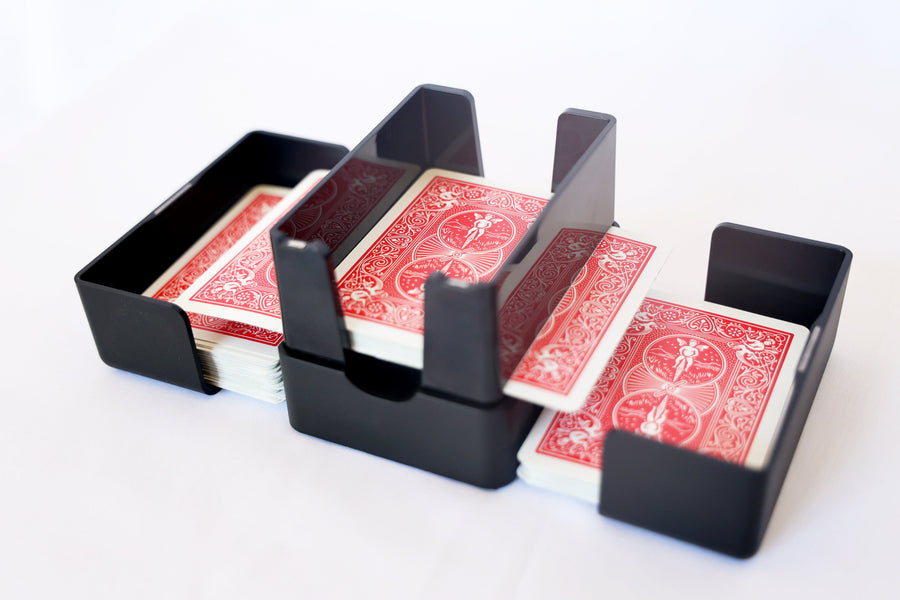
Product photo shows the original Lotus V1.
The one these guides keep pointing to
Lotus Card Shuffler V2
The Tabletop Family rated the Lotus V2 24/25, their Best Overall among the 8 distinct models they bench-tested from 13 shufflers. Lotus supplied its review units.
$89.00 Free US shipping
Order Now