
Battery-Powered Card Shuffler: The 9V You Can Replace
The table you play on moves. The kitchen one week, the back porch the next, the cabin at Thanksgiving, and most of those spots have no outlet within reach. So a battery shuffler is the obvious pick. The worry under that choice is not whether the battery survives a single game night. It is whether the shuffler still works next winter, and the winter after, when you pull it from the closet and reach for the deck.
That outcome turns on one fact about battery chemistry most buyers never hear. A rechargeable lithium cell loses capacity through calendar aging that happens even when the cell is never used, driven by lithium consumed by the growing SEI layer on the graphite anode, and the rate climbs with temperature and state of charge (ScienceDirect, calendar aging under realistic conditions; IOPscience, the graphite anode and capacity fade). A built-in pack stored full and warm between play seasons loses capacity with zero use. When that cell is one you cannot reach, its calendar becomes the shuffler's calendar.
Lotus runs on a single user-replaceable 9V. When the battery weakens, a fresh one costs a few dollars and the shuffler keeps working for years. The battery you can swap beats the one you can't, on the only timeline a table owns a machine: years.
Two ways to power a home shuffler
A battery shuffler runs on one of two designs. One is a user-replaceable cell you change yourself, a 9V or a set of AA. The other is a built-in rechargeable pack you charge over USB-C and never open. The built-in pack reads clean on a spec sheet: one charge does hundreds of shuffles, nothing to buy, plug it in like a phone.
Every one of those points is about the first year. None is about the third. The spec sheet sells the runtime per charge, a cycle-aging number, and never mentions the clock that decides whether the unit survives three off-seasons in a closet. That clock is calendar aging, and it never makes the box.
Lotus uses the replaceable 9V. A cell you can pull and swap is a cell whose end is not the shuffler's end.
Calendar aging is the clock the spec sheet leaves off
A rechargeable cell runs on two clocks. Cycle aging is the wear from charging and discharging, the number the runtime spec implies you control by how often you play. Calendar aging is the wear that accrues with time alone, and playing less does not slow it (ScienceDirect, calendar aging under realistic conditions). A shuffler that comes out four times a year still ages on the calendar clock the other 361 days, sitting in a drawer.
Two storage conditions make it worse, and a closet supplies both. Heat speeds the reaction, and a high state of charge speeds it too, so a cell put away full and warm sits in the worst case (IOPscience, the graphite anode and capacity fade). With a sealed pack there is no move to make against this. You cannot pull the cell to slow its aging, and you cannot replace it once it is spent.
A 9V gives you both moves. Pull it before months of storage and the cell leaves the equation entirely. Swap it when it weakens. The shuffler's life stops being chained to one battery's life.
Leave a 9V in the closet, or take it out
A 9V alkaline holds usable power for years in storage, and the leak risk that worries people is the one part you can fully remove. Energizer rates its Power Seal to prevent leaks for up to two years after the battery is fully discharged, and Duracell rates its 9V at five years in storage when used as directed. Pulling the 9V before a long stretch in the closet takes leak risk to zero.
This is the everyday version of the calendar-aging point. A 9V left in a holiday-only unit stays low-risk for years; a 9V pulled for the off-season is no-risk. Either way the shuffler comes out of the closet ready, and you riffle the first hand without a second thought.
Flying with it
Pack the shuffler however you like; the battery rides in your carry-on. TSA rules put loose or spare batteries, including a 9V alkaline, in carry-on only and never in checked baggage, with the terminals taped or kept in original packaging so they cannot short (TSA, what can I bring: batteries; American Airlines, restricted items). A single loose 9V can ignite if its two terminals bridge across keys or coins in a bag. Tape the top, or leave it in the blister pack, and carry it on.
If the 9V is seated in the shuffler, the unit travels as a normal device. The spare you bring for the trip is the one that needs the tape.
Cold cabins and winter RVs
Alkaline batteries lose a large share of their usable capacity near freezing, because the water-based electrolyte conducts less and internal resistance rises, with losses running up to roughly 60% at freezing temperatures. Lithium primary cells hold about 95 to 98% at 32F (Redway Tech, AA batteries in low temperatures; imuto, lithium vs alkaline in cold weather). At a winter cabin or in an RV, a shuffler that sat in the cold reads slow not because the motor is failing but because the chemistry stalled.
The replaceable battery turns that into a habit instead of a defect. Keep the 9V in a warm pocket and seat it at play time, or run a lithium 9V, which barely notices the cold. The replaceable slot makes the fix possible: you can only carry a warm spare when the battery comes out.
Why 9V instead of AA or a sealed pack
A 9V delivers the voltage the motor needs from a single battery, where an AA approach wants a four-cell pack that adds bulk to the housing for the same job. One cell, one slot.
A user-accessible slot keeps a second choice open: you pick the chemistry. A standard alkaline for the kitchen table, a lithium 9V for the cold, or a rechargeable 9V if you would rather recharge than buy. A NiMH rechargeable runs at a lower nominal voltage than alkaline, 1.2 volts per cell against 1.5, which can read as slightly slower operation, and it runs the shuffler. The slot stays yours.
The Lotus battery-powered shuffler
Lotus does a real riffle, run in reverse. The deck sits in the center tray, soft silicone wheels deal it card by card into two piles, you restack, and the action runs even and quiet. It holds two standard poker-size decks at 2.5 by 3.5 inches, starts on touch instead of a held button, and closes like a clamshell when you are done. The 9V seats in a standard clip behind a single sliding cover, no screws and no tools. The current model is the V2, pre-ordering at $89 (ships October); the original V1 is sold out.
A single 9V is good for 500+ shuffles, plenty for a long stretch of game nights before a swap. That figure is a rating we stand behind, not a marketing line we dressed up, and we name it as a rating rather than a lab result we have not published.
Lotus handles poker-size and UNO decks, and Bicycle-brand bridge cards generally feed well (very smooth or glossy bridge stock can slip). A six-deck dealing shoe is a different machine for a different table. If you play canasta with two full decks at once, the canasta shuffler guide covers that load, and the electric shuffler guide walks the broader buying logic.
FAQ
How long does the battery last during a game, and will it die mid-session?
A single 9V is good for 500+ shuffles, so a single game night barely touches it. A weakening battery announces itself first: the motor slows and sounds like it is working harder before it stops, so you get a warning to swap, not a dead unit mid-hand.
What battery does it use, and can I replace it myself?
A single 9V, swapped through a sliding cover with no tools and no screws. When it weakens you drop in a fresh one for a few dollars. You are never stuck with a unit you cannot reopen.
If I leave it in the closet between holidays, will it still work?
Yes. A 9V alkaline holds power for years in storage, and Energizer rates its leak protection for up to two years after full discharge. For a long off-season, pull the 9V and the shuffler comes out next year with zero battery risk. A sealed rechargeable cell keeps aging on the calendar even when it is never used, which is exactly why being able to pull the battery matters.
Is a battery unit slower or weaker than a plug-in one?
No. Plug-in units are built for capacity and continuous runtime, not speed. A two-deck battery unit clears a standard home deck as fast, and you run it through three passes for a home game.
Can I fly with it, and where does the battery go?
The battery goes in your carry-on, never checked. TSA requires loose or spare batteries, including a 9V, to ride in the cabin with terminals taped or kept in original packaging, because a loose 9V can short against keys or coins. Tape the top and carry it on.
Will it work at a cold cabin or in an RV in winter?
Yes, with one habit. Alkaline batteries lose up to about 60% of capacity near freezing, so keep the 9V in a warm pocket and seat it at play time, or run a lithium 9V, which holds roughly 95 to 98% at freezing.
Why isn't the Lotus rechargeable?
Because a removable 9V wins on the axes that matter at a table. A standard 9V swaps in seconds, runs 500+ shuffles, and puts no charging cable on the table and no dead-battery downtime in the game. If it dies mid-session, the spare goes in and play continues. A built-in cell ages on the calendar whether you play or not, and when it finally fails, it strands the whole unit. And if you want rechargeable anyway, you can have it: the battery is user-replaceable, so a rechargeable 9V works in the same compartment.
Can I use a rechargeable 9V instead of buying alkalines?
Yes. A rechargeable 9V, NiMH or lithium-ion, works because the battery is user-accessible. NiMH runs at a lower nominal voltage than alkaline, which can read as slightly slower, and it runs the shuffler fine.
Why 9V instead of AA or a sealed rechargeable?
A 9V delivers the motor's voltage from one battery instead of a bulkier four-cell AA pack. It also keeps the choice that matters open: when the battery ages out, you swap it for a few dollars and keep the shuffler, instead of retiring the machine with the cell.
If the replaceable-9V design is what you are after, that shuffler is the Lotus Card Shuffler V2 ($89 pre-order, ships October).
Still weighing wall power against a battery? The battery vs plug-in head-to-head compares removable 9V, sealed rechargeable, and corded machines, including the one setting where the cord actually wins.
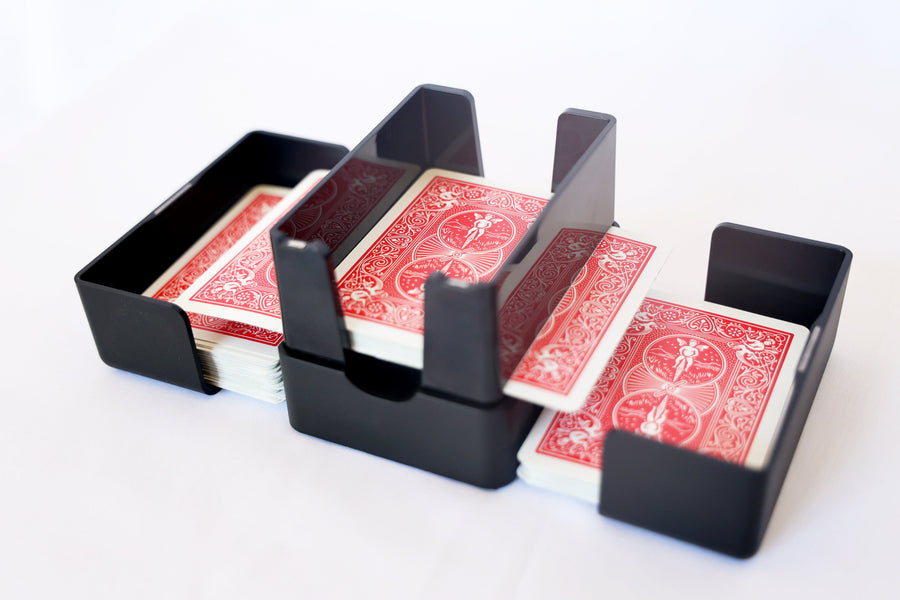
The one these guides keep pointing to
Lotus Card Shuffler V2
TheTabletopFamily’s Best Overall pick. V2 scored 24/25, first of the 8 distinct models they bench-tested from 13 shufflers bought. Two decks, no buttons. Pre-order ships October.
$89.00 Free US shipping
Pre-order V2