
Battery vs Plug-In Card Shufflers: The Honest Head-to-Head
For a home game table, battery power is the right call, and the reason is placement: a shuffler earns its keep sitting on the table where the game is. A battery machine has no cord to run across the table, no outlet to hunt for behind the couch, and it travels to whichever house is hosting this week. A standard removable 9V runs the Lotus for 500+ shuffles and swaps out in seconds when it dies. Plug-in power wins in exactly one setting: commercial card rooms running continuous duty, where the machine never leaves its spot. If that is not your table, the cord buys you nothing. Here is the honest head-to-head.
Why battery wins at home
Home shuffling is intermittent. A pass here between hands, a few passes when the next game starts, then nothing for twenty minutes while people argue about rules. That duty cycle is exactly what a battery is for: the machine sits in the middle of the table, gets touched a few dozen times a night, and never needs to be near a wall.
The cord is not a small thing. A plugged-in machine either lives at the table edge nearest an outlet, which is never where the deck is, or it drags an extension cord across a table covered in drinks and snacks. And a shuffler that cannot leave the house misses half its use: game night rotates, and a battery machine goes in the bag with the cards.
There is a deeper dive on this category in our battery-powered card shuffler guide.
Removable 9V vs sealed rechargeable
"Battery-powered" hides a split that matters more than battery vs plug-in: whether you can take the battery out.
A sealed rechargeable cell sounds modern and works fine at first. The honest cons show up later. Rechargeable cells degrade with charge cycles, and in a sealed unit that degradation is terminal: when the cell dies, the machine dies with it. And charging runs on its own timeline: a sealed unit that goes flat mid-game-night is out of the game until it has spent time on a cable, which is precisely when you wanted it working.
A removable standard 9V has none of those failure modes. Dead battery, fresh battery, back in play in under a minute, the same swap you would do on a smoke detector. The machine itself has no charging hardware to wear out and no built-in expiry date. One 9V is rated for 500+ shuffles in the Lotus, so you are not swapping often, and a spare in the game cupboard covers the rest.
When plug-in is the right answer
Fairness requires saying this plainly: if a machine shuffles hundreds of passes a day, every day, wall power wins. Commercial card rooms run continuous-duty machines because no battery chemistry is the right tool for that workload, and the machine bolts into one spot anyway, so the cord costs nothing. That is what casino-grade shufflers are built for.
That buyer is not the home buyer. A home table does not run continuous duty, does not keep the machine in one spot, and does not want commercial hardware pricing for a Tuesday UNO night. Buying a plug-in machine for home use means paying for a duty cycle you will never reach and accepting a tether you will notice every game. The wider category, including corded machines, is covered in our electric card shuffler guide.
The comparison
| Power type | Best for | Failure mode | Running cost |
|---|---|---|---|
| Removable 9V | Home game tables; travels to the host's house | Battery runs down: swap in a fresh 9V and keep playing | One standard 9V per 500+ shuffles |
| Sealed rechargeable (USB) | Light, occasional use near a charger | Flat mid-game until charged; cell degrades and eventually retires the unit | Charging downtime now, a replacement unit later |
| Wall plug-in | Card rooms and continuous commercial duty | Tethered to an outlet; the machine stays where the cord reaches | Electricity, plus commercial hardware up front |
Where the Lotus lands
The Lotus uses a removable standard 9V by design, included in the box, rated for 500+ shuffles. No cord, no charging dock, no sealed cell with an expiry date. It runs on a single touch sensor, and a sensor inside reads whether one deck or two is loaded, so there is nothing to select, no app and no pairing. The power story and the setup story are the same: battery in, touch, shuffle.
A pass takes about five seconds, it holds up to two poker-size decks loaded together, and it folds shut like a clamshell with the cards inside, which is what makes the travel case unnecessary. In TheTabletopFamily's independent bench test (8 distinct models bench-tested from 13 shufflers bought), the Lotus V2 scored 24 out of 25, their Best Overall, and the original V1 scored 22; the full field is in our best card shufflers guide. It sells for $89 as a V2 pre-order (ships October) with free US shipping, US addresses only for now, with a 30-day full refund and a one-year warranty against manufacturing defects.
FAQ
How long does a 9V battery last in a card shuffler?
In the Lotus, a standard 9V is rated for 500+ shuffles, and each pass takes about five seconds. For a weekly game night, that is months of use per battery. When it runs down, it swaps like a smoke-detector battery: no charger, no downtime.
Can I use a rechargeable 9V?
It fits. The Lotus takes the standard 9V form factor, and rechargeable 9Vs come in that form factor. The honest caveat: our 500+ shuffle rating is measured with standard 9Vs, and we have not published run times for rechargeables, which vary by cell. Expect it to work; do not expect us to promise identical battery life.
Why not USB-C charging?
Deliberate choice. USB-C on a shuffler means a sealed cell: charging downtime when it goes flat mid-game, and gradual degradation that eventually retires the whole unit. A removable 9V swaps in seconds, needs no charging hardware, and means the machine is never ended by its own battery.
Do plug-in shufflers shuffle better?
No. The power source does not decide shuffle quality. The mechanism does. A riffle process reaches near-random order after about 7 passes whether the motor is fed by a battery or a wall socket. Plug-in machines exist for continuous commercial duty, not for better shuffling.
Is a plug-in shuffler worth it for home use?
Rarely. Plug-in machines are built for card rooms running hundreds of passes a day. At home you would be paying for a duty cycle you will never reach and living with a cord across the table every game night. For intermittent home shuffling, a removable-battery machine is the better-matched tool.
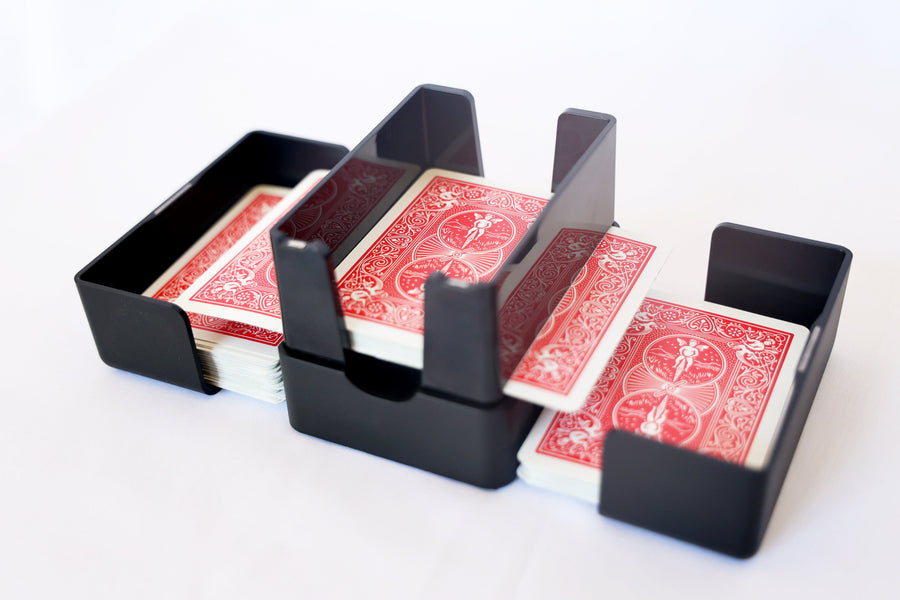
The one these guides keep pointing to
Lotus Card Shuffler V2
TheTabletopFamily’s Best Overall pick. V2 scored 24/25, first of the 8 distinct models they bench-tested from 13 shufflers bought. Two decks, no buttons. Pre-order ships October.
$89.00 Free US shipping
Pre-order V2