
From Magic to Math: How Many Times Should You Really Shuffle Cards?
The short answer: about seven riffle shuffles takes a 52-card deck to near-random. Here's the story behind that number.
The Man Who Shuffled into History
Persi Diaconis started out as a young magician who ran away to join the circus - not your typical path to academia. After a decade on the circus circuit, he returned to school and became driven by a newfound obsession: the concept of randomness. Years of rigorous study culminated in a professorship at Harvard, where Persi embarked on a quest to decode the mysteries of card shuffling. His groundbreaking paper would forever change the game, finally giving us an answer to the question: how many times do you really need to shuffle a deck of cards?
The Seven Shuffle Discovery
Working with mathematician Dave Bayer, Diaconis developed a key tool in understanding randomness. Combining the methodology of mathematicians who came before them, they built on the Gilbert-Shannon-Reeds model to figure out exactly what happens when you shuffle cards.
In a riffle shuffle, you split a deck in two, then let the cards from each half fall back together in a mixed order. This is the gold standard of card shuffling but doing it one time isn’t enough to get close to random.
Using the Gilbert-Shannon-Reeds model, Bayer and Diaconis discovered that it takes about seven riffle shuffles for the deck to reach near-random, the point where it’s close enough to a randomly ordered deck that the difference stops mattering for play. After seven shuffles, every card is mixed in relation to every other card to a degree that lingering patterns are hard to spot. It’s a surprisingly precise answer to a question all card players ask themselves!
A Practical Tip
The seven-shuffle rule is perfect for a fresh deck of cards, one that’s in perfect order right out of the box. But once you’re a few games in, the deck is already somewhat randomized. For casual, friendly games, three shuffles should be more than adequate. So the next time you’re hosting game night, feel free to save a little time between rounds, knowing that three shuffles are all it takes to keep things fair and fun!
Beyond Game Night
Persi’s insights about randomness have made their way into all sorts of fields, including encryption algorithms that keep your data secure, random number generators used in scientific simulations, and computer graphics that create realistic-looking textures. In these types of graphics, for example, using the Gilbert-Shannon-Reeds model ensures that digital textures avoid repetition, achieving a level of realism that breathes life into virtual worlds. It's a testament to how interconnected our understanding of randomness is, from the shuffle of a deck of cards to the intricate details of computer-generated imagery.
Persi took something that seems simple, shuffling cards, and revealed the fascinating math hiding just beneath the surface. His work reminds us that even the most familiar objects, like a deck of cards, can hold secrets that revolutionize our understanding of the world. So the next time you shuffle a deck, remember: you're not just mixing cards, you're touching one of the most studied questions in probability.
What about automatic shufflers?
Bayer and Diaconis counted riffles, not hands. Their seven-shuffle threshold describes the operation itself, so a machine riffle counts the same as a hand riffle: it is the same operation, done consistently, pass after pass. With an automatic shuffler like the Lotus V2 ($89 pre-order, ships October), each pass takes about five seconds: roughly three passes suit most games, and about seven reach near-random. The math doesn’t care who does the riffling; the threshold is the same.
FAQ
How many times should you shuffle a deck of cards?
About seven riffle shuffles take a fresh 52-card deck to near-random, the threshold Bayer and Diaconis proved in 1992. Once a deck is a few hands into the night it is already partly mixed, and three riffles keep a home game fair.
How many times do you have to shuffle a deck to make it random?
No count of shuffles reaches a mathematically exact random order. Seven riffles get a 52-card deck near-random, close enough that nothing at the table can tell the difference, and that is the number worth remembering.
Is shuffling three times enough?
For a home game in progress, yes. Three riffles keep a deck that was already mixed fair for the next hand. For a brand-new deck straight from the box, run it to seven.
Does an automatic card shuffler need seven passes too?
Yes. One pass through the Lotus is one riffle, run in reverse: the deck is dealt card by card into two piles and you restack. Three passes suit game night and about seven reach near-random, the same threshold as by hand.
Sources
- Persi Diaconis, groundbreaking paper (Stanford Digital Repository)
- Dave Bayer, mathematician (Wikipedia)
Lotus makes a quiet, clamshell automatic card shuffler for game night. play-lotus.com
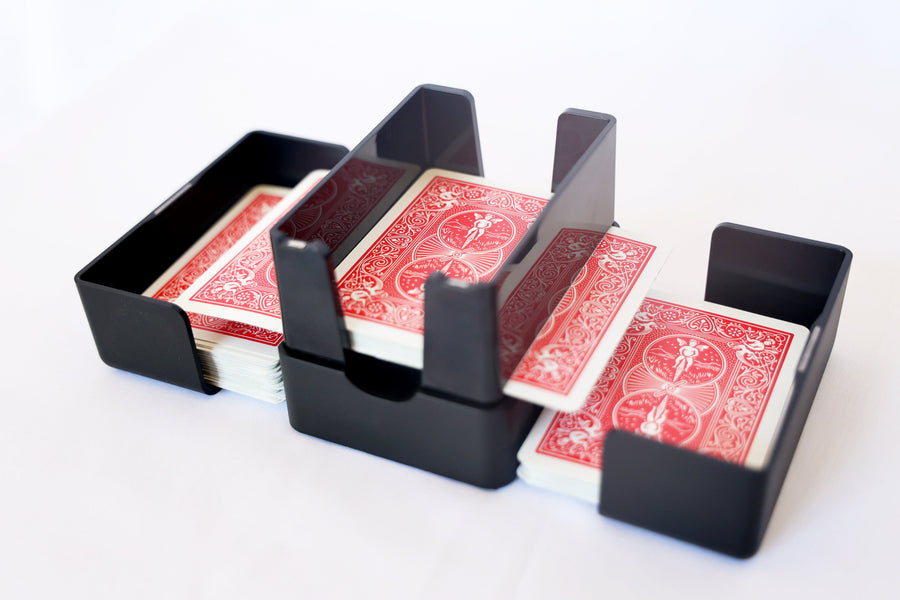
The one these guides keep pointing to
Lotus Card Shuffler V2
TheTabletopFamily’s Best Overall pick. V2 scored 24/25, first of the 8 distinct models they bench-tested from 13 shufflers bought. Two decks, no buttons. Pre-order ships October.
$89.00 Free US shipping
Pre-order V2