
The Hidden Symmetry of Inverted Riffles
The way we shuffle cards seems straightforward enough: split the deck, interweave the halves, and repeat until randomized. This classic riffle shuffle transforms an ordered sequence like 1-26 in one hand and 27-52 in the other into an interwoven pattern, perhaps 1, 27, 2, 28, and so on. It's a process that card players, magicians, and casino dealers have perfected over centuries.
But what happens if we invert this process? Instead of splitting the deck in half and then combining it card by card, what if we begin with a complete deck and split it card by card into two piles, odds in one pile, evens in another, before recombining the two halves? This inverse riffle might seem like a mere mechanical variation, but it raises a fascinating question: are these processes comparably effective at randomizing a deck?
To answer this, we need to understand how mathematicians measure shuffling effectiveness. In their landmark 1992 paper "Trailing the Dovetail Shuffle to its Lair," Dave Bayer and Persi Diaconis introduced a metric that examines sequential runs, how many cards appear in ascending or descending order before a reset occurs. For instance, in the sequence 1, 2, 5, 3, we see a reset at 3, as it breaks the ascending pattern. The longer these runs, the less random the shuffle.
Computer simulations comparing standard and inverse riffles reveal something interesting. While they initially follow different paths to randomness, with the inverse riffle showing higher early randomization, their trajectories weave back and forth, sometimes one proving more effective and sometimes the other. Run enough shuffles and both methods settle into the same near-random territory, just by slightly different routes.
What this tells us is that the inverse riffle isn't a watered-down imitation of the classic shuffle. It's a legitimate randomization technique in its own right. The order in which you separate and recombine the cards matters less than the fact that you keep interleaving them. Both paths through the landscape of randomness lead to a well-mixed deck.
This is exactly the principle the Lotus Shuffler is built on. Rather than forcing cards together like a cheap mechanical shuffler, the Lotus uses an inverse riffle motion, pulling cards apart one by one into two piles before they recombine. It's the same mechanism described here, automated, so a few passes leave a deck near-random after about seven riffles without bending or jamming your cards. The current model, the Lotus V2, pre-orders at $89 and ships October.
So the inverse riffle is more than a mathematical curiosity. It's a reminder that even in systems designed to create randomness, there's real structure underneath, and that structure is something you can engineer around.
Sources
- Dave Bayer and Persi Diaconis, "Trailing the Dovetail Shuffle to its Lair," The Annals of Applied Probability (1992)
Lotus makes a quiet, clamshell automatic card shuffler for game night. play-lotus.com
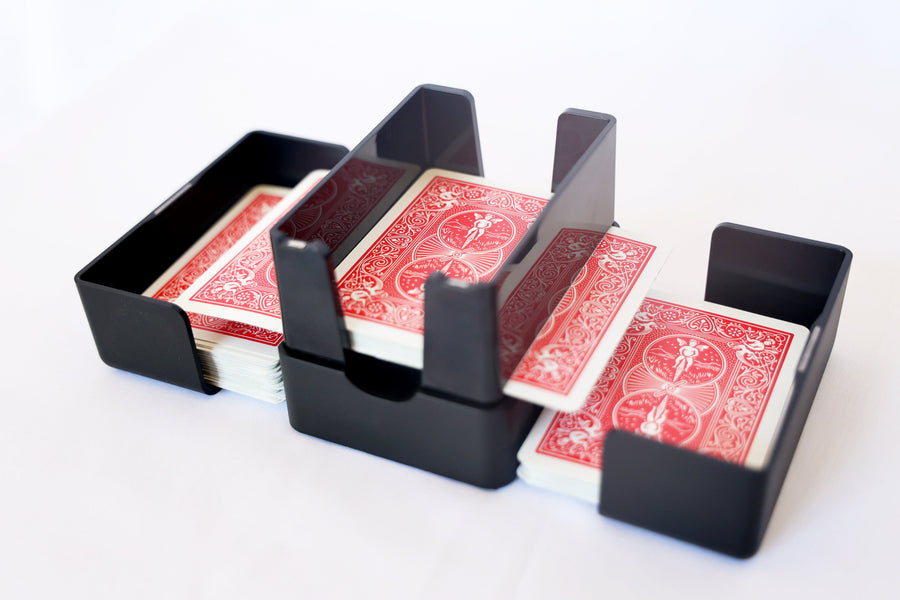
The one these guides keep pointing to
Lotus Card Shuffler V2
TheTabletopFamily’s Best Overall pick. V2 scored 24/25, first of the 8 distinct models they bench-tested from 13 shufflers bought. Two decks, no buttons. Pre-order ships October.
$89.00 Free US shipping
Pre-order V2