
Why Cheap Card Shufflers Break (And What to Actually Look For)
If you've ever bought a card shuffler from Amazon and watched it die within a month, you're not alone. Here's why it happened, and what to look for instead.
The gap shows up in testing: in TheTabletopFamily’s bench of 8 distinct models (13 units bought), most budget units scored far below the Lotus V2’s 24/25 (the original V1 scored 22/25), and it shows up in returns, where Lotus runs under a 1% return rate. Cheap shufflers get returned; that’s the business model working as designed.
Every card shuffler under $25 on Amazon has the same story in its reviews. It works twice. Maybe three times. Then it jams. Then it bends your cards. Then it sits in a drawer until you throw it away.
It's not because card shufflers are a bad idea. It's because the ones most people buy are built to a price point, not a quality standard.
So why do cheap shufflers fail? And what should you actually look for if you want one that works?
The 5 Reasons Cheap Shufflers Break
1. Plastic gears that strip immediately
Most sub-$25 shufflers use all-plastic internal gears. Plastic on plastic creates friction, and after a few dozen uses, the teeth start to strip. Once a single gear loses its grip, the whole mechanism fails. You'll hear it: the motor runs but nothing moves.
What to look for instead: steel shafts and reinforced gears. Metal internals cost more to manufacture but last dramatically longer.
2. Aggressive feeding mechanisms that jam
Cheap shufflers try to force cards through the mechanism at steep angles. If a card is slightly bent, slightly sticky, or slightly thicker than average, it catches. Once one card jams, the whole deck piles up behind it. This is a common complaint in reviews of budget shufflers.
The underlying problem is the mechanism design itself. Most cheap shufflers use a "push-through" approach that shoves cards together. It's fast to engineer but terrible in practice.
What to look for instead: a mechanism that separates cards rather than forcing them together. An inverse riffle design pulls cards apart one by one into two piles, the opposite motion of cheap shufflers. Fewer jams, less card damage.
3. Hard rubber rollers that destroy your cards
The rollers inside a shuffler are what grip and move your cards. Cheap shufflers use hard plastic or low-grade rubber rollers. These grip too aggressively, leaving marks on card edges, bending cards during feeding, and wearing out quickly as the rubber hardens.
What to look for instead: silicone rollers. Silicone is softer, grips more gently, and maintains its texture over time. Your cards come out the same way they went in.
4. Motors that are way too loud
This one doesn't cause the shuffler to break, but it makes you stop using it, which is effectively the same thing. Cheap shuffler motors sound like small appliances. Some of them are loud enough to bring a kitchen blender to mind. If you're playing cards in a quiet room, the noise is genuinely disruptive.
What to look for instead: a motor designed for low noise output. Quieter motors cost more, but the difference in experience is night and day. The quiet card shuffler guide covers how to judge a noise claim without a spec sheet.
5. Physical buttons that fail
Most cheap shufflers have plastic push buttons to activate the mechanism. These buttons are usually the cheapest component in the entire device. They get stuck, they stop registering, or the internal spring gives out. Once the button fails, the shuffler is dead even if the motor still works.
What to look for instead: touch-activated sensors. Capacitive touch sensors have no moving parts, so there's nothing to wear out or break. A light touch activates the shuffler every time.
The Real Problem: Nobody Took This Category Seriously
The card shuffler market is split into two extremes. At the bottom, you have $15-25 plastic devices that are essentially disposable. At the top, you have professional machines that cost $5,000 to $15,000. They're built for commercial use and weigh as much as a microwave.
In between? Almost nothing. For decades, nobody built a card shuffler for the person who plays cards at home once or twice a week and wants something that simply works well, looks good, and doesn't break.
That's why we built the Lotus Shuffler.
What We Did Differently
Inverse riffle mechanism. Instead of forcing cards together, the Lotus separates them one by one into two piles. You stack the piles and repeat. It's the same principle as a hand riffle shuffle, just automated. Fewer jams, less card damage, more consistent results.
Steel internals with silicone rollers. The gears and shafts are metal, not plastic. The rollers are silicone, not hard rubber. The result is a mechanism that's gentle on cards and built to last.
Touch-activated. No physical buttons. A light touch on a single sensor starts the shuffler, and a sensor inside reads whether one deck or two is loaded. Nothing to break, nothing to wear out.
Whisper-quiet motor. You'll hear it working, but it's closer to an electric toothbrush than a blender. Quiet enough for late-night games without waking anyone up.
Clamshell design. A clamshell design that closes to hold your cards inside. It was designed to sit on your game table, not hide under it.
At $89, it costs more than the disposable options. But it also actually works, and keeps working.
The Bottom Line
If you've been burned by cheap card shufflers before, you're not picky. You just bought a product that was never built to last. The entire category has a quality problem, not a concept problem. Automatic card shuffling is a great idea. Most of the products just aren't.
Look for steel internals, silicone rollers, a gentle shuffling mechanism, and touch activation. Avoid anything with all-plastic construction, physical push buttons, and aggressive card feeding.
Or skip the research and try the one we built to solve all of these problems.
Lotus makes a quiet, clamshell automatic card shuffler for game night. play-lotus.com
The same mechanics that break cheap shufflers also chew up cards. Here is when a shuffler damages cards, and when it doesn't.
The flip side of why cheap shufflers break is what a considered one does differently. The premium card shuffler guide lists the specific choices: soft rollers, cards kept inside the housing, a shell dense enough not to resonate.
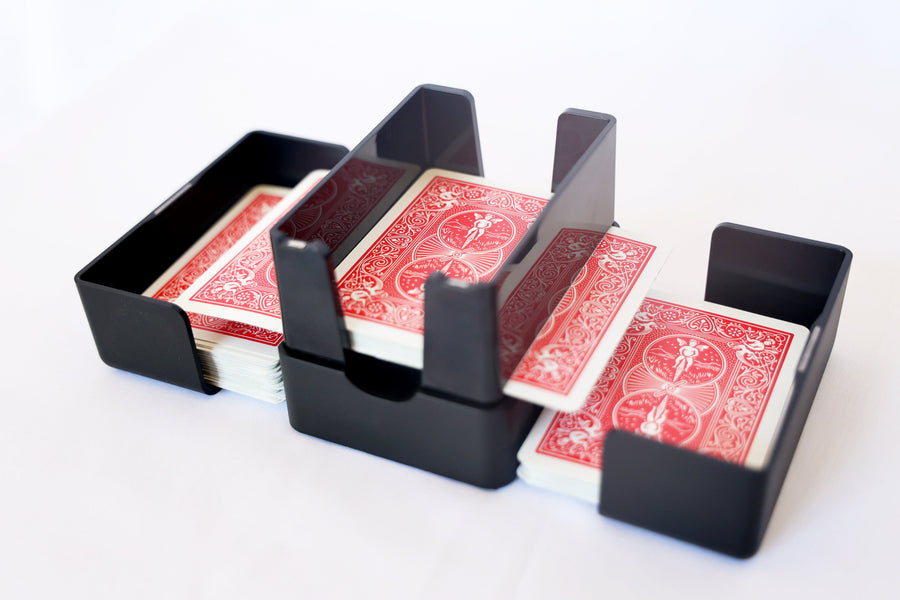
The one these guides keep pointing to
Lotus Card Shuffler V2
TheTabletopFamily’s Best Overall pick. V2 scored 24/25, first of the 8 distinct models they bench-tested from 13 shufflers bought. Two decks, no buttons. Pre-order ships October.
$89.00 Free US shipping
Pre-order V2