
What a Premium Card Shuffler Buys You
Yes, but not where the word premium usually points. The shuffler shelf is dominated by $15–25 battery-crank machines that share a design lineage: hard plastic rollers, a slapping feed, an open exit well, and a shell that weighs almost nothing. Premium in this category is not gold trim or a walnut veneer. It is a short list of engineering choices you can hear and feel: soft rollers that grip cards instead of slapping them, cards that stay inside the housing, a touch sensor instead of a mushy button, a low hum instead of a coffee-grinder whine. The Lotus V2 makes those choices at $89. Here is what build quality means in this category, and what it does not include.
Why almost every shuffler feels cheap
Search "card shuffler" and the results look like one product wearing twenty brand names, because that is close to the truth. The $15–25 crank and budget-electric units share a design lineage, and with it a set of cost decisions you feel the moment the box opens.
- Hollow shells. Thin plastic with air behind it. It flexes under your thumbs, and it turns the housing into a drum: the motor's vibration gets a resonating chamber to amplify it.
- Hard plastic rollers. Hard rollers need more pinch pressure to grip a card, and they slap each card into motion instead of feeding it. That slap is most of the noise, and most of the wear.
- Open exit wells. Cards launch across a gap, smack the pile or the far wall, and settle wherever they land. It looks chaotic and sounds worse.
- A crank or a mushy button. Either you are the motor, or you are pressing a membrane switch that gives nothing back.
When a design gets cloned, its compromises get cloned with it. The cheap feel is not one brand's mistake. It is the shared ancestor.
What premium means in a shuffler
Not adjectives: mechanisms. These are the specific choices that separate a machine you tolerate from a machine you hand to guests.
- Soft rollers that grip instead of slap. Grip needs less pinch pressure than slap, so the feed is quieter and gentler on the cards. The full mechanics (pinch, feed, exit) are in our guide to whether shufflers damage cards.
- Cards stay inside the housing. No open well, no cards flying across a gap. The piles build inside the machine, which is quieter, gentler on corners, and visibly more controlled.
- A touch sensor, not a button. On the Lotus you rest a fingertip on a single touch sensor, and a sensor inside reads whether one deck or two is loaded. No crank, no mushy membrane click, nothing to muscle while cards are mid-feed.
- Quiet enough to talk over. So the table keeps talking while the deck shuffles. The test method is on our quiet card shuffler page.
- A clamshell that closes with the cards inside. The Lotus folds shut like a clamshell and the deck stays in it, so it goes into the game cupboard as one object, not a machine plus a loose deck to find next week.
- Materials chosen on purpose. The Lotus shell is plastic with a matte finish. That is a texture decision, not a disguise: it reads as a considered object rather than a toy.
Every item on that list is something you notice in the first minute of use, without reading a spec sheet.
The three tiers of the shuffler market
| Tier | Price | What you get | Who it serves |
|---|---|---|---|
| Crank and budget electric units | $15–25 | Shared-lineage hardware: hard rollers, open exit wells, hollow shells | Once-a-year decks |
| Lotus V2 | $89 | Soft rollers, cards stay inside, touch sensor, clamshell fold | Weekly game nights, families, home poker groups |
| Casino-grade machines | Hundreds to thousands | Continuous-duty, in-table units with casino security features | Poker rooms and dedicated card rooms |
The middle tier exists because the gap between the other two is enormous. The jump from $20 to $89 buys the mechanics above: the things you hear and feel at a home table. The jump from $89 to a casino machine buys continuous-duty hardware and security features built for poker rooms, not living rooms.
Evidence over adjectives
Feels premium is easy to write and impossible to verify, so here are third-party numbers instead. The Tabletop Family bench-tested 8 distinct models side by side from a field of 13 shufflers. The Lotus V2 scored 24 out of 25, the best overall result. Lotus supplied the units they tested; the field, the method, and the scores were theirs. The full field, including the budget units, is in our best card shufflers guide.
From our own books: the return rate runs under 1 percent. The purchase is backed by a 30-day full refund and a one-year warranty against manufacturing defects.
The limits
The Lotus is plastic done carefully: a dense shell, a matte finish, soft rollers. A metal shell would add weight and cost without changing how the rollers treat your cards.
$89 also does not buy casino continuous-duty. Casino machines are built for dealer shifts at card-room prices. The Lotus runs on a removable 9V battery (included) rated for 500+ shuffles, and it is built for game nights. If your table runs hundreds of hands a night, you are shopping in a different tier.
The practical boundaries: it holds up to two poker-size decks (104 bare cards, with 108-card canasta and 112-card UNO decks inside capacity), and a pass takes about five seconds. Shipping is free to every US address. It is designed in the US.
FAQ
Why do all the cheap card shufflers look identical?
Because most of them are close to the same machine. The $15–25 units share a design lineage (the same feed geometry, the same open well, often what looks like the same molds), sold under different brand names. That is why their reviews describe the same jams and the same coffee-grinder noise. When a design gets cloned, its compromises get cloned with it.
What makes a card shuffler feel premium?
Mechanics, not trim. Soft rollers that grip cards instead of slapping them, a feed that keeps cards inside the housing, a touch sensor instead of a mushy button or crank, a noise level you can talk over, and a shell dense enough not to resonate. Each of those is something you notice in the first minute of use.
Is the Lotus made of metal?
No. The shell is plastic with a matte finish. Engineering plastic is the right material for a battery-powered machine you carry to the table and fold into a cupboard; a metal shell would add weight and cost without changing how the rollers treat your cards.
What does the price gap between a $20 and an $89 shuffler buy?
The differences are the ones you hear and feel, and they compound with every game night: soft rollers versus hard ones, cards contained versus cards flying across a well, a low hum versus a whine, a touch sensor versus a crank. We compared the whole field, with TheTabletopFamily's independent bench scores rather than our own adjectives, in the best card shufflers guide.
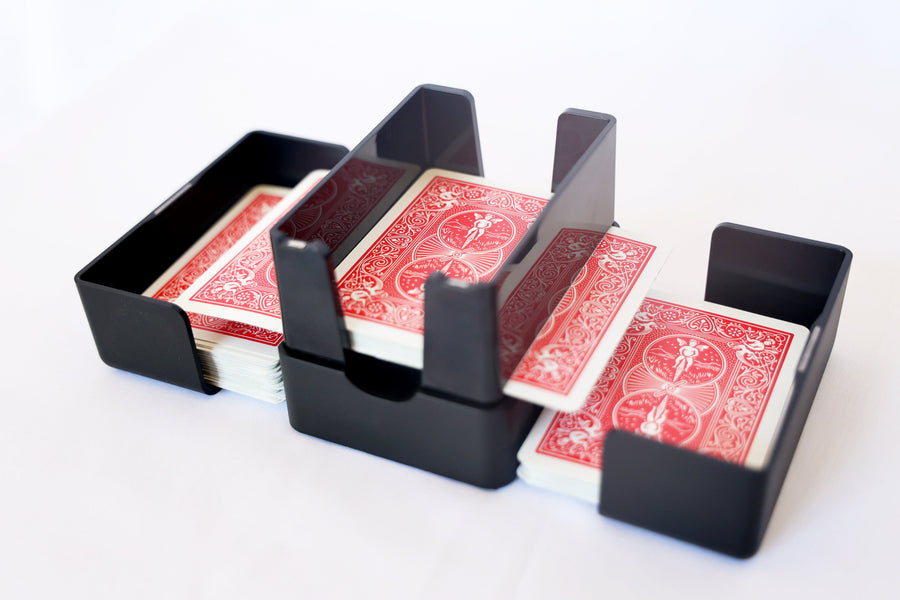
Product photo shows the original Lotus V1.
The one these guides keep pointing to
Lotus Card Shuffler V2
The Tabletop Family rated the Lotus V2 24/25, their Best Overall among the 8 distinct models they bench-tested from 13 shufflers. Lotus supplied its review units.
$89.00 Free US shipping
Order Now