
Best Card Shufflers for Home Games
Open any best-shuffler list and six machines stare back at nearly the same price, in nearly the same shell. The question that decides your purchase is not which one has the most stars. It is which one is actually different, and why. The answer is build and testing, because the budget end of this list is a row of near-identical units in different shells.
One group settled the comparison by ordering 13 machines, cutting the duplicates, and running 8 distinct models side by side. The Tabletop Family named Lotus its Best Overall pick (thetabletopfamily.com/best-card-shufflers). Their review gives you a named source and a side-by-side comparison to read before buying. The V2 they reviewed was a prototype; its score is not a production-unit test result.
What The Tabletop Family found
The Tabletop Family ordered 13 machines, cut the duplicates, and ran 8 distinct models against each other, and named Lotus its Best Overall pick (thetabletopfamily.com/best-card-shufflers).
The Lotus does a real riffle, run in reverse. The full deck sits in the center tray, soft silicone rollers deal it card by card into two piles, you restack, and the action runs even and quiet.
Why several units at the same price look identical
Pick any home-shuffler ranking and you will see three or four units at nearly the same price that look like the same unit in different boxes. They often are. Many cheap units are near-identical hardware sold under different brand names.
One fact explains it. A handful of generic suppliers build the cheap end of this category, the same basic roller mechanism, lightly restyled and badged for whoever orders a run. So a ranking that lists one of those units at number one, another at number three, and a third near-identical unit at number seven is really listing the same hardware three times.
That is the part worth knowing before you spend. How a machine is built and tested tells you more than its star count, because those stars are spread across near-identical units. What actually separates one is the build and the shuffle itself, which is where the Lotus earns its place at the top.
A word on noise
A noise figure is useful only with its test conditions: the deck, distance, surface and background sound. Look for those conditions before comparing two loudness numbers. Lotus runs quiet enough to talk over. If quiet is the spec your table lives or dies on, the quiet shuffler guide walks through the test rig and the threshold logic.
Where Lotus sits
Lotus V2 at a glance
| Spec | Lotus V2 |
|---|---|
| Price | $89 V2 pre-order, free US shipping (US only), ships October. V1 sold out |
| Mechanism | Inverse riffle: deals the deck card by card into two piles; restack and repeat |
| Pass time | About 5 seconds; ~3 passes for casual play, ~7 for near-random |
| Capacity | Two poker-size decks: 104 cards; 108-card canasta and 112-card UNO loads inside capacity |
| Noise | Quiet enough to talk over |
| Power | Removable standard 9V (included), 500+ shuffles |
| Activation | Single touch sensor; a sensor inside reads one deck or two, nothing to select. No buttons, no app |
| Storage | Folds shut like a clamshell; cards stay inside |
| Guarantee | 30-day full refund; 1-year warranty |
| Bench result | TheTabletopFamily: Best Overall, V2 prototype 24/25 of the 8 distinct models they bench-tested from 13 shufflers bought; V1 22/25, “buy with confidence” |
Lotus is designed in the US. V2 is available to pre-order for $89, ships October, with free US shipping; the original V1 is sold out. It holds two standard poker-size decks at 2.5 by 3.5 inches, runs on a removable 9V battery, starts on touch instead of a held button, does a real riffle, and closes like a clamshell when you are done. It carries a 1-year warranty and a 30-day return window, and it sells direct at play-lotus.com.
The unit is rated for 500-plus shuffles on a single 9V battery. That is the manufacturer's rating, given as a rating, not a count run under fixed conditions.
What it will not shuffle
Roller shufflers are built around standard poker-size cards, 2.5 by 3.5 inches. Sleeved Magic decks feed poorly through that geometry and need a different tool. Narrower bridge-size decks vary by finish: Bicycle-brand bridge cards generally feed well, while very smooth or glossy bridge stock can slip. That is a plain fact about the mechanism, the same way a paper shredder is sized for paper. It decides fit, not quality.
FAQ
Is there a card shuffler that actually works?
Yes, but the question is fair, because most of the cheap ones don't. The $20 shufflers on Amazon are largely one white-label machine sold under many names, and their failure modes (jamming mid-shuffle, spraying cards, motors dying within months) are why people ask. In The Tabletop Family's bench of 8 distinct models (13 shufflers bought), the Lotus V2 prototype scored 24/25, their Best Overall; the original V1 scored 22/25. A pass takes about five seconds, the 9V battery ships in the box, and returns run under 1%.
How often do you have to play for an automatic shuffler to be worth it?
If you play once or twice a year, the machine mostly lives in a drawer, and the spec that matters is whether it survives storage and a dead battery. If you have a weekly game and have already worn out a cheap one, build and feel carry the decision, because you lean on the machine fifty times a session. The Tabletop Family bench weighted both, which is why Lotus took Best Overall rather than winning on any single number.
One deck or two, and does it change what to buy?
Poker runs on a single standard deck. Canasta, hand and foot, and pinochle want two. A two-deck machine shuffles one deck fine, so two-deck capacity is the safer default for a household that plays a mix. The Lotus holds two standard poker-size decks, which covers both ends of that range. The canasta shuffler guide covers the two-deck games in full.
Why do several shufflers at the same price look identical?
Because they often are. Many cheap units are near-identical hardware sold under different brand names. A handful of generic suppliers build the cheap end of the category, so the same basic unit gets restyled and badged for different listings. The stars get split across that near-identical hardware, which is why a ranking looks fuller than the field actually is. What separates a good shuffler is build quality and the shuffle itself.
Can a roller shuffler handle my Magic deck or bridge-size cards?
Sleeved decks, no: valuable sleeved trading-card decks feed poorly and risk damage, so hand-shuffle those. Bridge-size decks vary by finish: Bicycle-brand bridge cards generally feed well, while very smooth or glossy bridge stock can slip. This is a compatibility fact about the mechanism, not a ranking.
How long does the battery last, and where do you buy Lotus?
The Lotus is rated for 500-plus shuffles on a single 9V, which is the manufacturer's rating rather than a count run under fixed conditions. The battery is a removable 9V you can swap yourself, not a sealed cell. Lotus sells direct at play-lotus.com. The battery-powered shuffler guide covers why a replaceable battery outlasts a sealed one over the years a table owns a machine, and the Lotus shuffler review covers how the v2 tested.
Worried a machine will wear your decks out? We broke down exactly when automatic shufflers damage cards: the pinch, the feed, and the exit, and what to check before you buy.
If your question is less "which shuffler" and more "why do they all feel cheap," we wrote about what premium actually means in a card shuffler: mechanics you can hear and feel, not trim.
And at the top of the market: our honest comparison with casino-grade machines covers what a Deckmate-class unit does for thousands of dollars that no kitchen table needs.
Worried less about which machine works and more about whether a machine can be trusted? The honest fairness explainer, can a card shuffler be rigged?, covers the casino hacking stories and why a home riffle shuffler has nothing to hack.
Shopping for a machine that deals as well as shuffles? Read the shuffler-and-dealer breakdown first: what combo units do, what tends to jam, and why the biggest poker rooms automate the shuffle but keep a human deal.
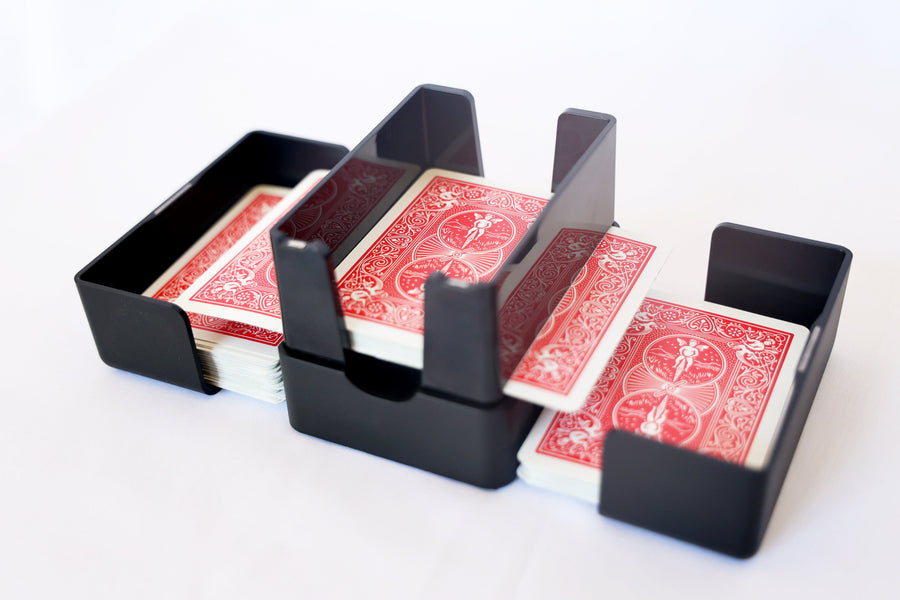
The one these guides keep pointing to
Lotus Card Shuffler V2
TheTabletopFamily’s Best Overall pick. V2 scored 24/25, first of the 8 distinct models they bench-tested from 13 shufflers bought. Two decks, no buttons. Pre-order ships October.
$89.00 Free US shipping
Pre-order V2