
Do Card Shufflers Work With Sleeved MTG Cards?
If you are asking which automatic card shuffler works best with a sleeved Magic: The Gathering deck, here is the answer: probably none of them, including ours. The Lotus shuffler is built around standard poker-size cards, 2.5 by 3.5 inches. Standard MTG sleeves add width and thickness that push most sleeved decks outside that tolerance. Some tighter sleeves feed some of the time, but "some of the time" is not a standard we will sell you on. For a sleeved Commander or Modern deck, your hands are still the best tool available. We will explain why, and where a machine does fit into an MTG household.
Why sleeved cards jam most shufflers
This is not a quality problem you can pay your way out of. It is geometry.
A poker-size card measures 63.5 by 88.9 mm. A standard MTG sleeve typically measures around 66 by 91 mm, and the card sits inside it with a little play. That is 2 to 3 mm of extra width on every card. Feed channels on consumer shufflers, ours included, are cut close to poker-size dimensions so that unsleeved cards track straight instead of skewing. Sleeved cards either bind against the channel walls or sit loose enough inside the sleeve that the card and the sleeve try to move at slightly different moments.
Three separate things go wrong at once:
- Width. The sleeve is wider than the card the machine was designed around. Even a millimeter matters when a roller is trying to pull one card at a time from a stack.
- Thickness. A sleeved 60-card deck stands far taller than 60 bare cards, and a sleeved 100-card Commander deck is taller than any consumer hopper expects. Double-sleeved decks are further out still.
- Surface. Feed rollers are tuned for cardstock. Polypropylene sleeves are slicker and softer than paper, so rollers that grip a bare card cleanly will sometimes slip on a sleeve, or grab the sleeve and leave the card behind by a fraction. That is how you get double feeds and the occasional creased sleeve edge.
Matte sleeves with textured backs feed more often than glossy ones because the roller has something to bite. More often still means inconsistent, and inconsistent is the one thing a shuffler is not allowed to be. Results vary by sleeve brand, sleeve age, and humidity, which is exactly why we tell MTG players not to buy a Lotus for their sleeved decks.
What MTG players do instead
The MTG community solved this problem by hand a long time ago, and the solutions are worth knowing even if you never buy a machine.
Mash shuffling is the default for sleeved decks. You split the deck and push the two halves into each other side-on. It puts no bend on the cards, works fine with sleeves, and it is what you will see at most tournament tables. The tradeoff is that a single mash moves cards in chunks, so it takes many repetitions to genuinely randomize, which is why judges expect a thorough shuffle rather than three quick mashes.
Riffle shuffling randomizes faster per pass. Bayer and Diaconis showed in 1992 that about seven riffles bring a 52-card deck near-random. But riffling puts a bend across the deck, and most players will not riffle sleeved cards, let alone cards worth real money. Sleeves crease at the corners and the cards develop a memory of the bend. This is a live debate in the community, and the cautious position wins: riffle bare bulk cards if you like, do not riffle your sleeved Legacy deck.
Pile shuffling deals the deck into piles and restacks. On its own it is not randomization at all, it is a deterministic rearrangement, which is why tournament rules treat it as a card-counting step rather than a shuffle. Players use it to verify deck count and unstick sleeves, then mash afterward.
So the working answer for a sleeved 100-card Commander deck is mash shuffling, done more times than feels necessary, sometimes with a pile shuffle first to count the deck. No consumer machine currently changes that.
When a shuffler still earns a place in an MTG household
Most Magic players do not only play Magic, and most Magic tables see plenty of cards that are not sleeved.
The Lotus shuffler makes sense in an MTG household for everything around the sleeved decks:
- Unsleeved kitchen-table decks. Bulk commons, precons that never got sleeved, the deck your cousin built out of the draft leftovers. Poker-size, bare cardstock, exactly what the machine was built for.
- Everything else on game night. Standard playing cards. UNO is a confirmed fit. Bridge-size cards work for most decks, with one caveat: very smooth, glossy finishes can slip, so texture is the deciding factor. Most game-night card games ride on poker-size or near-poker-size cards.
- Big mixed loads. The hopper takes two full poker-size decks at once and handles 104, 108, and 112-card loads, which covers double-deck games and most family card games without splitting the stack.
- Players whose hands are the bottleneck. Arthritis, grip issues, or a kid who cannot bridge a deck yet. If shuffling is the reason someone opts out of game night, a machine fixes that for every unsleeved game on the table. We wrote separately about shufflers for seniors and players with arthritis.
Fit guide by card type
| Card type | Fits the Lotus? | Notes |
|---|---|---|
| Poker-size, unsleeved (2.5 x 3.5 in) | Yes | The design target. Standard cardstock playing cards. |
| UNO | Yes, confirmed | Tested and confirmed fit. |
| Bridge-size, unsleeved | Most decks | Bicycle-brand bridge cards feed well. Very smooth, glossy finishes can slip. Texture decides it. |
| MTG, unsleeved | Yes | Standard MTG cards are poker-size. Fine for bulk and casual decks you would hand-shuffle bare anyway. |
| MTG, single-sleeved | Mostly no | Most sleeves are too wide for the feed channel. Some tighter sleeves feed sometimes. Results vary. Do not buy for this. |
| MTG, double-sleeved | No | Too wide and too thick. Hand shuffle. |
| Tarot / oversized (approx. 2.75 x 4.75 in) | No | Larger than the poker-size feed channel. Hand shuffle. |
What the machine does when the cards do fit
For the cards it is built for, the Lotus runs an inverse riffle: it deals the deck card by card into two piles, you restack, and each pass takes about five seconds. Around seven passes gets a deck near random, the same benchmark as hand riffling. For casual play, three passes is plenty. There are no buttons; a touch sensor starts each pass, and the whole thing folds shut like a clamshell when the night is over.
Two details matter for card longevity. The rollers are soft and grip the cards rather than slapping them through, which is gentler than a hard high-speed feed. And the cards stay inside the housing during the shuffle instead of spraying across the table. It runs quiet enough to talk over. If noise is your main concern, the quiet shuffler guide goes deeper.
On proof rather than promises: The Tabletop Family bench-tested eight distinct models from a field of thirteen shufflers, and the V2 scored 24 out of 25, the best result on their bench. Lotus supplied the units they tested; the field, the method, and the scores were theirs. The V2 is $89 with free US shipping, a 30-day full refund window, and a one-year warranty. Our return rate runs under 1 percent, our own figure rather than a bench result. If a sleeved-deck player buys one anyway and it does not earn its keep, the refund window exists for exactly that.
The bottom line for MTG players
Keep mash shuffling your sleeved decks. That advice does not change no matter which shuffler you look at. Buy a Lotus if your table also runs unsleeved cards, UNO, standard decks, or double-deck family games, or if someone at your table physically struggles to shuffle. Skip it if sleeved Magic is the only thing you play. If you want to see how it stacks up across every category, the full best card shufflers comparison covers the independent bench and what separates the field.
FAQ
Will the Lotus shuffler handle a sleeved Commander deck?
Mostly no. A sleeved 100-card deck is both wider and thicker than the machine is designed for. Some tighter single sleeves feed intermittently, but we do not consider that reliable and we do not recommend buying a Lotus for sleeved decks.
Does any automatic shuffler work reliably with sleeved MTG cards?
Not that we have seen at consumer prices. The width, thickness, and slick surface of sleeves defeat the feed mechanisms these machines share. Hand mash shuffling remains the standard for sleeved decks.
Can I unsleeve my deck, machine-shuffle it, and re-sleeve?
You can, and unsleeved MTG cards are poker-size so they feed fine. In practice, unsleeving and re-sleeving 100 cards takes far longer than a good mash shuffle, so this only makes sense if you were re-sleeving anyway.
Will the shuffler damage unsleeved Magic cards?
The rollers are soft and grip rather than slap, which is gentler than hard high-speed feeds, and the cards stay inside the housing. Any shuffling method, hands included, produces wear over time on bare cards. Cards you would only handle sleeved should stay sleeved and hand-shuffled.
Is riffle shuffling bad for sleeved cards?
Most players avoid it. Riffling bends the deck, sleeves crease at the corners, and valuable cards can hold the bend. Mash shuffling puts no bend on the cards and is the community default for sleeved decks.
What MTG-adjacent cards does the Lotus shuffle well?
Unsleeved poker-size cards of any kind, including bare Magic cards, standard playing cards, and UNO (confirmed fit). Bridge-size works for most decks depending on finish texture. Capacity is two poker-size decks, including 104, 108, and 112-card loads.
Can it shuffle tarot or oversized oracle cards?
No. Tarot decks typically measure about 2.75 by 4.75 inches, well past the poker-size feed channel, and most oracle decks are larger still. Hand shuffle those.
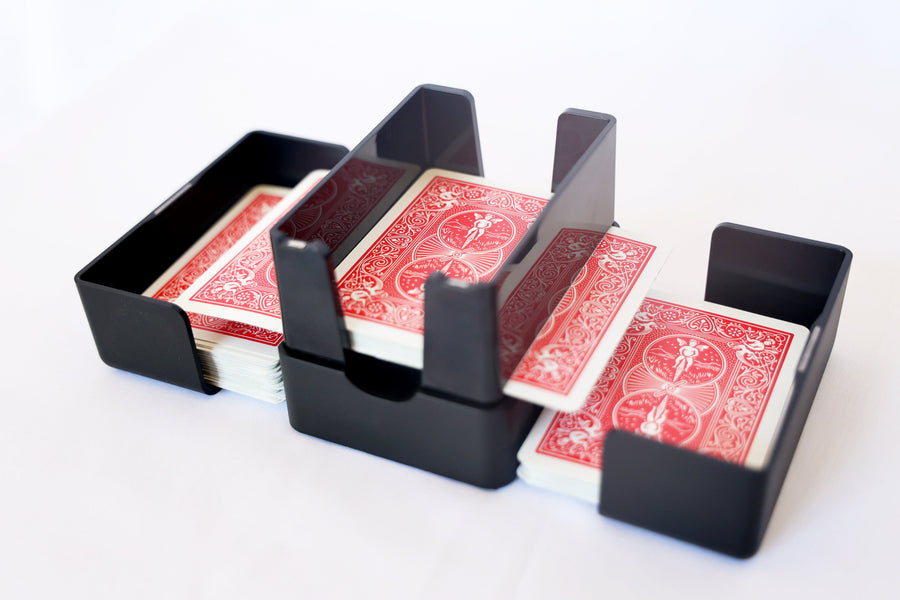
Product photo shows the original Lotus V1.
The one these guides keep pointing to
Lotus Card Shuffler V2
The Tabletop Family rated the Lotus V2 24/25, their Best Overall among the 8 distinct models they bench-tested from 13 shufflers. Lotus supplied its review units.
$89.00 Free US shipping
Order Now