
The Best Card Shuffler for Arthritic Hands
The best card shuffler for arthritic hands is a touch-activated model with drop-in loading. The Lotus takes a whole deck in one flat drop and starts from a resting fingertip on a sensor: no buttons, no grip, no force. A pass takes about five seconds, and it costs $89 (V2 pre-order, ships October) with free US shipping and a 30-day full-refund window. It runs on a standard removable 9V battery rated for 500+ shuffles. The rest of this guide is the two motions that decide whether any shuffler works for a worn grip: loading it and starting it.
Someone at your table used to riffle the deck without thinking about it. Now the bridge that arch and snap takes makes the knuckles ache, so the cards get pushed around in clumps, or they pass the deck and sit out the part they used to do best. The question people ask is whether a shuffler is automatic. That is the wrong question. Automatic shuffling was solved decades ago. What decides whether a worn grip can play is quieter: can that hand get the cards into the machine, and can it start the machine, without help.
Those are two separate motions, and a shuffler can make each one easy or hard. A riffle asks for the exact dexterity arthritis takes first: the deck bridged in two hands, thumbs releasing cards in an even cascade, fingers squaring the stack after. Take the riffle away and you have not removed the problem if the machine then asks for a two-handed pinch to load it and a held squeeze to run it. The Lotus removes all three. One whole deck dropped flat into one tray, started with a single touch.
This page is about engineering, not health. A shuffler does not treat anything. It shuffles cards, and the right one is built so that getting the cards in and getting them moving never reintroduces the grip you came to it to avoid.
The barrier is loading, not running
Watch where the difficulty lands. The motor runs itself; nobody with stiff hands struggles with the part where the machine does the work. The struggle is everything around it, and the biggest piece is the load.
Loading styles are different for an arthritic hand, and no source on the open web says this plainly. One style is the drop-in: a whole deck, or two whole decks, laid flat into a single center tray in one motion, set down the way you would set down a coaster. The other is split-loading: you halve the deck yourself, then square two thin half-decks into two separate side trays, both hands working, before anything runs. Split-loading rebuilds the riffle's hardest demand right at the start, pinching and aligning thin stacks, which is the motion a worn grip fumbles. The load, not the motor, is the fine-motor barrier. A machine that loads the drop-in way has removed it. A machine that loads the split way has hidden it one step earlier.
This follows what occupational therapists teach. The Arthritis Foundation's joint-protection guidance is to do a stubborn task a different way, using both hands or a tool, rather than forcing the old grip until it gives. A whole-deck drop-in shuffler is that kind of tool. It does not ask the hand to recover a motion it has lost. It accepts the deck the way the hand can still give it, flat and whole, in one drop.
The Lotus loads the drop-in way. One or two standard decks go flat into a single center tray. There is no halving, no squaring two thin stacks, no second tray to align against the first.
The start is the second barrier
Getting the cards in is one task. Starting the machine is another, and a held button quietly undoes the work the drop-in tray did.
Sustained pressure on a small button is its own fine-motor demand, separate from loading. A hand with tremor or a weak grip can set a deck down and still struggle to hold a button down through a full cycle, because holding asks for steady force over time, the thing that fails. A start you tap once and release asks for a fraction of a second of contact instead. Tap, lift, done.
The Lotus starts on a touch sensor. You tap it, the shuffle runs and stops itself, and the hand gives one input and then rests. There is no button to hold down through the cycle. A pass takes about five seconds, and the hand is free the whole time. The point is the shape of the input, not its length: one touch, not a held squeeze.
What the Lotus is, in plain facts
The Lotus holds two standard poker-size decks, about 104 cards, dropped flat into one center tray. It runs on a removable 9V battery, the kind you swap at the drawer rather than charge overnight, and the manufacturer rates a 9V for 500+ shuffles. It starts on a touch sensor. The action is a riffle run in reverse: the rollers deal the deck card by card into two piles, and you set one pile on the other, no thumbs required. When you are done it closes like a clamshell. It carries a one-year warranty.
The Lotus runs quiet enough that it does not stop the conversation, which matters more at a long table than most specs do. It runs quiet enough to talk over; the quiet card shuffler page covers the test method and why a bare number cannot tell you whether a shuffler is quiet on your table.
A shuffler solves shuffling
Be clear about scope, because it is the difference between buying the right tool and being disappointed by the right tool. Shuffling, holding a fan of cards, and gripping to deal or pick up are three different motions. A shuffler removes the first one cleanly. It does not hold your hand for you while you play.
If you want to try technique before a machine, we rated the low-grip hand methods honestly (the wash wins) in how to shuffle cards when your hands won't cooperate.
If holding the hand is also hard, the shuffler pairs with a card holder, a spring-action tray or a revolving stand that grips the fan so the player only has to read it. The two tools solve two different motions, and together they cover most of what an arthritic hand finds hard at a card table. Buying a shuffler expecting it to do the holder's job is the one way to come away unhappy with a machine that does its own job well.
Compatibility, stated plainly
The Lotus is built for poker-size cards: Bicycle, Copag, anything cut to the 2.5 by 3.5 inch standard. Bridge-size cards are narrower; Bicycle-brand bridge decks generally feed well, while very smooth or glossy stock can slip. That is a fit fact, the same way a wrench comes in sizes. Most home games, canasta with its two-deck load included, run on poker-size cards, which is exactly what the Lotus is sized for. UNO stock runs a little narrower than poker-size, and the UNO guide covers that fit.
For elderly parents and grandparents
"Card shuffler for elderly" is what most people type when they are shopping for a parent or grandparent, and the logic is the arthritis logic above. Aging hands lose grip strength and thumb dexterity even without a diagnosis, and shuffling is usually the first part of a card game to go. The person keeps playing (the canasta group, the bridge club, family UNO nights) but starts quietly handing the deck to a neighbor every round.
What matters when buying for a senior is the same short list: loading that takes no force, a start that requires nothing to be held down, and no setup. The Lotus is touch-activated (resting a fingertip on the sensor is the entire operation), runs on a standard removable 9V battery with no cords or charging, and has no app, account, or pairing. For an eighty-year-old who is done learning new technology, that last part is often the decider.
If it is a gift, the card shuffler gift guide covers the terms that make it low-risk: a 30-day full refund window and a one-year warranty.
Related reading
- The quiet card shuffler: why a shuffle should not stop the conversation, and the noise-test method.
- The best card shufflers: the field, and how to tell them apart.
- The battery-powered card shuffler: why a battery you can replace beats one you cannot.
FAQ
Is an automatic shuffler too complicated for a senior who avoids technology?
The good ones are simpler than a TV remote. The Lotus has no buttons, no app, no account, and no charging: drop the cards in and rest a finger on the sensor. If they can deal a hand, they can run it.
What is the best card shuffler for elderly parents or seniors?
The best card shuffler for elderly parents or seniors is one with no force anywhere in the sequence: drop-in loading, a touch-sensor start, and nothing to learn. The Lotus was designed around exactly that sequence (load, touch, play) and runs on a removable 9V battery rated for 500+ shuffles, with no cords, apps, or pairing. Those are the features that matter for aging hands, with or without an arthritis diagnosis.
What is the easiest card shuffler to load for arthritic hands?
The easiest card shuffler to load with arthritic hands is a drop-in design: the whole deck set flat into a single center tray in one motion, no splitting or squaring thin stacks. The Lotus loads this way and takes up to two poker-size decks, 104 cards, in one flat drop. Split-load designs make you halve the deck and square two thin half-decks into two side trays first, rebuilding the pinch-and-align motion a worn grip has lost; the drop-in load asks only for the motion the hand can still do, setting a flat stack down.
Why do the two loading styles matter so much?
Because loading, not the motor, is where a worn grip struggles. Split-loading rebuilds the riffle's hardest demand right at the start, pinching and aligning thin half-decks, which is the exact motion arthritis fumbles. Drop-in loading skips that step entirely. A machine can be fully automatic and still be hard to use if it loads the split way.
Is there a shuffler that does not need a button held down?
Yes. A held button is its own fine-motor task, separate from loading the cards, because holding asks for steady force over time. A touch start asks for a fraction of a second of contact instead. The Lotus starts on a touch sensor: tap it once, and the shuffle runs and stops itself.
What should I look for when buying a shuffler as a gift for someone with limited hand strength?
Two mechanics decide it. First, how it loads: look for a whole-deck drop-in into one tray, not a split-deck two-tray design. Second, how it starts: look for a single touch rather than a button held down through the cycle. Those two together remove the grip the riffle used to demand. Capacity and speed matter far less than these.
Can someone keep dealing the cards themselves after the shuffler does its part?
Yes, and that is the right division of labor. A shuffler handles shuffling, the motion the riffle made hard. Dealing is a different motion, and many players who find shuffling impossible can still deal a card at a time comfortably. The machine does the part that aches and leaves the parts that do not to the player.
What is the difference between a card shuffler and a card holder?
They solve two different motions. A shuffler mixes the deck so no one has to riffle. A card holder, a spring-action tray or revolving stand, grips a fan of cards so no one has to pinch and hold them while they play. An arthritic hand often needs both, and using them together covers most of what is hard at the table.
What makes a shuffler work for limited hand strength?
The load and the start, not the motor. Following the Arthritis Foundation's joint-protection principle, use a tool and both hands rather than forcing the old grip, the right shuffler is one that accepts the deck flat and whole and runs on one touch. The Lotus does both: a whole-deck drop-in into one center tray, started on a touch sensor.
Can one person load and start it one-handed?
The drop-in load is a single motion with one hand: set the deck flat into the center tray. The touch start is a single tap. Neither step requires bracing the machine against the body or holding anything down, so one hand can complete both. The shuffle then runs on its own.
If shuffling is the painful part of card night, the fix is one touch: the Lotus Card Shuffler ($89). Drop the deck in, touch the sensor, take back a mixed stack.
Buying for a parent or grandparent rather than yourself? The card shuffler gift guide covers who it fits, who it doesn't, and the return terms that de-risk it.
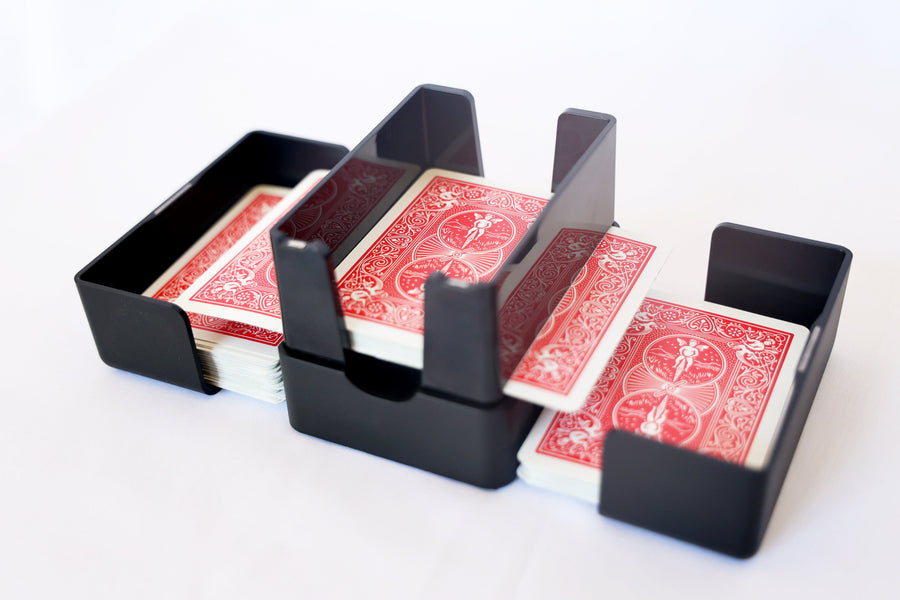
The one these guides keep pointing to
Lotus Card Shuffler V2
TheTabletopFamily’s Best Overall pick. V2 scored 24/25, first of the 8 distinct models they bench-tested from 13 shufflers bought. Two decks, no buttons. Pre-order ships October.
$89.00 Free US shipping
Pre-order V2