
The Family Game Night Card Shuffler, One Object for the Whole Table
The short answer: one two-deck machine covers the whole table. The Lotus holds up to two poker-size decks at once (104 cards, with 108-card canasta and 112-card UNO loads inside capacity) and starts from a touch sensor a four-year-old can run. Each pass takes about five seconds, quiet enough to talk over, on a replaceable 9V battery. $89 pre-order, free US shipping.
Game night is built around the whole table, and a shuffler is the one object that serves every hand at it. It hands the four-year-old who cannot riffle a real job. Drop the deck in, touch the top, watch it work. It is built for the poker-size decks most family games run on, and it survives a year of weekly play on a battery you swap in ten seconds. The night runs on a mixed-age table, and this is the machine that fits all of it.
Start with the youngest player. A riffle is the single most powerful thing you can do to a deck, and pinching a thick stack of cards into a clean shuffle is exactly the motion a small hand cannot make. So the kid waits while a parent shuffles, or makes a mess of it and the round goes lumpy. A shuffler hands that job back to them in a form they can do. Cards into the intake, a touch on the top, and the machine takes over. The youngest player runs the table instead of watching it.
The mixed-age table
The hard part of a mixed-age night is not the rules. UNO plays the same for a four-year-old and a grandparent, simple turns and a light reading load. The gap is dexterity. A twelve-year-old deals and riffles without thinking; a four-year-old cannot, and asking them to wait through every reshuffle is how a young kid drifts off and the table loses a player.
The reshuffle is the one part of the game that does not cross the age gap, and it is the part a shuffler fixes. Loading needs no fine motor control. The shuffle starts on a touch, with no button to hold down. Drop the deck in, touch the top, take back one mixed stack. That is the case for a shuffler at a mixed-age table. Not that it shuffles better than a parent. That it gives the youngest player a real job and keeps the round moving while they do it.
Why family night is a 112-card problem
Most shuffler pages assume a 52-card poker deck. A family night usually does not run on one. The card game most likely to be on the table is UNO, and a UNO deck is not 52 cards. It is not even the 108 most sources cite.
A modern UNO deck holds 112 cards. In 2018 Mattel added one Wild Shuffle Hands card and three customizable blank Wild cards to the 108-card deck that had been standard for decades (Mattel official UNO rules; Wikipedia, Uno)). Most listings, and most quick answers from a chatbot, still say 108. They are counting a deck Mattel stopped shipping years ago. The deck on a family's table is 112 cards, more than twice a poker deck and two cards past nearly every count you will read.
UNO sitting at the top of the family list is not a guess about taste. By Mattel's count it is the top-selling card game in the world, with more than 150 million decks sold since 1971 and close to one set sold every second in the United States in 2024 (CNN Business on UNO's sales). When a family pulls a dedicated deck for game night, it is the one most likely to be on the table. That is the deck a family-night shuffler has to load, and it is 112 cards, not 52 and not 108.
What a family-night shuffler has to do
Speed is not the spec that matters here. The night is not better because the cards mix faster. Three jobs decide whether a shuffler belongs on a family table.
It has to hold the real deck. Lotus holds two poker-size decks, so the 112-card count is the easy part, well inside capacity. Lotus handles UNO decks; the narrower UNO stock feeds cleanly, covered in full below. The action is a riffle run in reverse: silicone rollers deal the deck card by card into two piles and a kid stacks them, the same mix a hand riffle gives without forcing cards through young fingers.
It has to be quiet enough that the night does not stop for it. A shuffle should not announce itself. When everyone is laughing, the deck needs mixing and the conversation should keep going while it happens. A motor that ends the conversation is the problem; a quiet one disappears into the night. Lotus runs quiet enough to talk over, and why frequency matters as much as loudness lives on the quiet card shuffler page.
It has to survive a year of weekly play. A family that plays every week clears hundreds of shuffles without trying, the volume a disposable unit was never built for. Lotus runs on a removable 9V battery you swap in about ten seconds, no charging cable and no sealed cell that wears out and strands the unit. A single 9V is good for 500+ shuffles, well past a year of weekly hands before a swap. The advantage that holds either way is that when the battery does run down, you replace it in seconds instead of retiring the machine.
Poker-size yes, sleeved decks no
Lotus is built for poker-size decks, dropped in whole. Load one, touch the top, take back one mixed stack. UNO stock runs a little narrower than poker-size, about 2.2 inches against 2.5, and Lotus handles it; the UNO guide covers the width question in full.
There is one deck Lotus is not for, and family-night tables sometimes have it. Sleeved trading-card decks, the kind Magic and Pokemon players build, jam automatic shufflers. The Tabletop Family fed sleeved cards into the machines they tested and reported every one jammed (Tabletop Family card-shuffler test). Sleeves run thicker and grippier than bare cards, and the feed wheels that carry a bare deck cleanly bind on them. If your twelve-year-old plays sleeved Pokemon, hand-shuffle those. That is a plain fit fact, the same reason a poker-tuned tray skews on a sleeve, not a verdict on anyone's cards.
The shuffler this page is about
Lotus is $89, the current V2 pre-order (ships October). It holds two poker-size decks, runs on a removable 9V battery, starts on contact, and closes like a clamshell when the night ends, about the size of a paperback on its side. It is designed in the US.
The strongest signal is not ours. The Tabletop Family bench-tested 8 distinct models from 13 shufflers bought and picked the Lotus V2 as their Best Overall at 24/25; the V1 scored 22/25 (Tabletop Family). We did not run that test and we do not restate it as ours. It is theirs, under their name.
FAQ
Will a shuffler handle UNO cards, or only standard playing cards?
A modern UNO deck is 112 cards, well inside Lotus's two-deck count. UNO cards run about 2.2 inches wide, narrower than the 2.5-inch poker stock the machine is built for, and Lotus handles them. The UNO guide covers the width question in full.
Why is a card shuffler worth it for a mixed-age table?
A riffle, and pinching a thick deck of cards into a clean shuffle, is exactly the motion a four-year-old cannot make. A shuffler hands that job back to them in a form they can do, drop the cards in and touch the top, so the youngest player runs the table instead of waiting through every reshuffle. The play already works across the ages; the shuffle is the part a machine fixes.
What makes a family-night shuffler worth $89?
The volume a weekly table puts on it, plus a battery you can replace. A family that plays every week clears hundreds of shuffles a year, and Lotus runs on a removable 9V you swap in about ten seconds, with no sealed cell to wear out and strand the unit. The Tabletop Family picked the Lotus V2 as their Best Overall at 24/25; the V1 scored 22/25 in their independent test (Tabletop Family).
Is it quiet enough to play without stopping the conversation?
A shuffle should not announce itself. The goal is a motor that disappears into the night rather than one that ends the conversation every time the deck needs mixing. Lotus runs quiet enough to talk over, and the quiet card shuffler page covers why a bare decibel number cannot tell you whether a shuffler is quiet on your table.
Will Lotus shuffle Magic or Pokemon cards for the kids?
No. Sleeved trading-card decks jam automatic shufflers, and the Tabletop Family reported every machine they tested jammed on sleeved cards (Tabletop Family). Sleeves are thicker and grippier than bare cards. Hand-shuffle sleeved decks, and see the best card shufflers page for how the field handles different stock.
We'll shuffle; you play.
See the Lotus shuffler · Read the quiet shuffler guide · Compare every card shuffler
If the shuffler is really for the grandparents at your table (aging hands, stiff thumbs), the dedicated guide to card shufflers for elderly players and arthritic hands goes deeper on loading and the one-touch start.
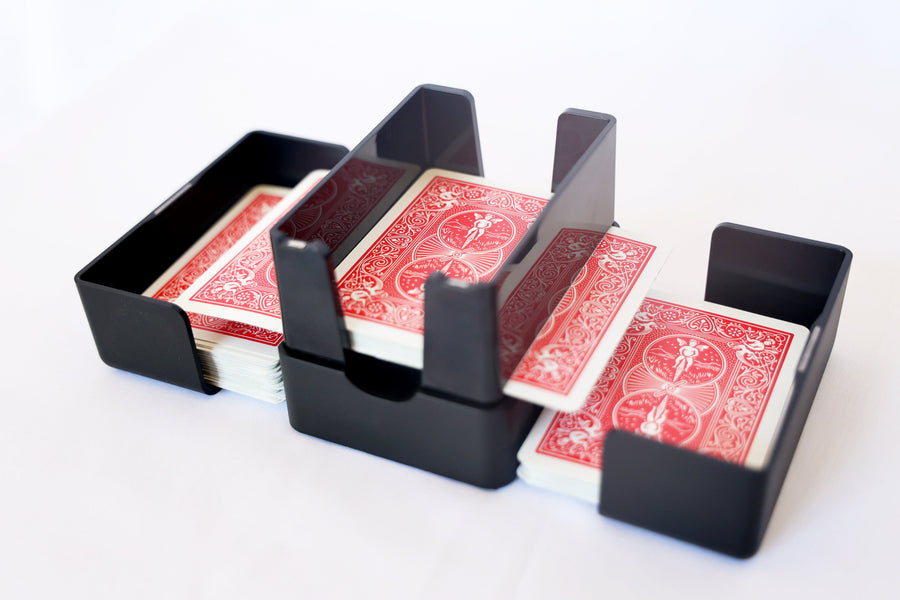
The one these guides keep pointing to
Lotus Card Shuffler V2
TheTabletopFamily’s Best Overall pick. V2 scored 24/25, first of the 8 distinct models they bench-tested from 13 shufflers bought. Two decks, no buttons. Pre-order ships October.
$89.00 Free US shipping
Pre-order V2