
The Poker Card Shuffler, and the Math That Makes It World-Class
The Lotus does a real riffle, and a real riffle is the most powerful thing you can do to a deck of cards. Run it enough times and the order you are holding has almost certainly never existed before in the history of the world. A 52-card deck has 52! possible orderings, roughly 8.07 x 10^67, a number so large that if every person who ever lived had shuffled a deck once a second for the entire age of the universe, they would not have made a noticeable dent in it. The deck in your hands after a clean shuffle is new to humanity.
The deck is near-random after about seven riffles, well-mixed for fair play. Pick up the Lotus, drop in a poker deck, and tap. The silicone rollers deal the deck card by card into two piles, a riffle run in reverse, and you restack. It is quiet, and it is the same every time. The math behind why seven riffles gets you there is worth seeing, and we will show you the math.
Seven shuffles, and what a casino unit actually buys you
In 1992, Dave Bayer and Persi Diaconis published a paper with one of the best titles in mathematics, "Trailing the Dovetail Shuffle to its Lair," in the Annals of Applied Probability. They proved how many riffle shuffles it takes to randomize a 52-card deck. The answer is seven. After about seven good riffles the deck is, for any practical purpose, near-random and well-mixed for fair play, and every shuffle past seven buys you almost nothing. Three is plenty for a Thursday game at the kitchen table.
And if anyone at your table has read the casino-shuffler hacking headlines, we wrote the plain-language fairness explainer: can a card shuffler be rigged? Short version: rigging requires reading the cards, and a home riffle shuffler has no way to read them.
Hold that result next to a casino shuffler and the price difference stops looking like a quality difference. Run a Lotus about seven times and, by the theorem, the deck you hold is near-random, well-mixed for fair play, the same place a few good riffles by hand get you. The casino paid for the speed and the tamper-resistance a card room needs across a thousand hands a night. You paid for your table. The shuffle that matters for a home game is the riffle, and that is what Lotus does.
Read Bayer and Diaconis, 1992 if you want the proof in full. It is the source nearly every serious write-up about shuffling traces back to, and it is why seven is the number poker players quote.
What a riffle is
A riffle interleaves the two halves of the deck into each other. Run in reverse, the same operation deals one stack card by card into two piles, and the mathematics treats the two as one operation run backwards, so the seven-shuffle result holds for both. Either way it is the move that does the real work of mixing, because it scatters cards that were near each other across the whole deck in a single pass, and about seven passes compound that into a near-random, well-mixed deck. It is the operation the Bayer-Diaconis result is about.
Compare it to a hand strip or an overhand shuffle, where you push small packets off the top and stack them in a new order. That barely mixes the deck. Blocks of cards travel together, their internal order untouched, so it takes a long string of those to approach what a few riffles do. The riffle is the powerful operation, and the Lotus performs a real one in reverse, drawing the deck through its rollers one card at a time and dealing it into two piles you restack, without the noise.
For home play, run the deck through three passes. One pass is a real shuffle, but not a finished one. Three is the home standard, plenty for any game you are dealing on a weeknight. About seven gets the deck near-random and well-mixed for fair play, the point past which extra passes buy almost nothing. Most nights you will tap it three times and deal.
Two decks, dropped in together
The Lotus holds two standard poker-size decks at once, loaded together as a single batch. That is the real advantage of the design, and it has nothing to do with cards spilling over. A 104-card load riffles in one go, which is exactly what a double-deck game or a canasta-style reset asks for: the whole stack mixed as one, no halving it yourself and no shuffling in shifts. For a poker night dealt from one deck, the advantage is pace. Each pass takes seconds, so a three-pass routine has the deck back on the table before the chips are stacked.
The poker variant you play changes the deal, not the shuffle. Hold'em, Omaha, seven-card stud, five-card draw, every one of them runs on a single standard 52-card deck. The number of hole cards and the betting rounds differ; the deck and the shuffle do not. So a shuffler built to riffle one 52-card deck cleanly, twice over, fits every poker game you are likely to host.
What it fits
| Deck or game | How the Lotus handles it |
|---|---|
| Poker-size decks (Bicycle, Bee, most standard) | Runs reliably; this is what it is built for. Holds two at once. |
| Bridge-size (narrower) decks | Narrower than poker stock; results vary by finish. Bicycle-brand bridge decks generally feed well; very smooth or glossy stock can slip. |
| Sleeved trading cards (MTG, Pokemon) | Sleeves are too thick and grippy for any roller shuffler. Hand-shuffle these. |
| Six-deck blackjack shoe | The wrong tool. A casino shoe needs a casino machine; this is a two-deck home shuffler. |
It is right-sized for poker, not pretending to be a card-room shoe. That is the point.
On the table
The Lotus closes like a clamshell when you are done, shutting the way a book closes, so it sits on the shelf or in the bag without sprawling. It starts on a touch, no held button, so you set the deck in and tap. It runs on a removable 9V battery, which means a late-night game in the backyard or the garage needs no outlet and no cord across the table.
It runs quiet enough that the conversation never stops for it. A shuffle should not announce itself, and the motor that ends the laughter every time the deck needs mixing is the thing we built against. It runs quiet enough to talk over, and you can read how we measure it on the quiet card shuffler page, alongside the battery notes. The warm part is simple: the host who used to spend the night shuffling gets to play it instead.
What an independent bench found
The Tabletop Family tested eight automatic shufflers and picked the Lotus V2 as their Best Overall at 24/25; the V1 scored 22/25. We did not run that test; they did, and you can read it at thetabletopfamily.com. We point you to it because it is the one independent bench on the open web, and it found the build holds up.
FAQ
Is one pass through the shuffler random enough?
One pass is a real riffle, but not a finished shuffle. For home play, run the deck through three passes, which is the practical standard for any weeknight game. About seven passes gets the deck near-random and well-mixed for fair play, the point Bayer and Diaconis identified, after which more shuffling changes almost nothing.
How does it compare to a casino shuffler?
Run a Lotus about seven times and, by the 1992 theorem, the deck is near-random and well-mixed for fair play, the same place a few good riffles by hand get you. The expensive machine buys speed and tamper-resistance for a room dealing all night. For a home game, the riffle is the part that matters, and that is what Lotus does.
Does it hold one deck or two?
Two standard poker-size decks at once, dropped in together as a single batch. A 104-card load riffles in one go, which is what double-deck games and canasta-style resets ask for. Every poker variant, from Hold'em to five-card draw, uses a single 52-card deck, so a poker night runs well inside the capacity.
Will it shuffle bridge-size cards?
It is built for poker-size decks, the standard width of Bicycle, Bee, and most decks you own. Bridge cards are narrower and results vary by finish: Bicycle-brand bridge decks generally feed well, while very smooth or glossy stock can slip. Sleeved trading cards are too thick for any roller shuffler, so hand-shuffle those.
Is it quiet enough for a real game?
It runs quiet enough that the conversation never stops for it, which is the standard that matters at a table full of people. Lotus runs quiet enough to talk over; the quiet card shuffler page walks through exactly how we measure it.
Will it look like a cheap gadget on a serious table?
No. It is the house your cards live in, not a toy, and you will not be embarrassed pulling it out at a table with real money on it. It closes like a clamshell, starts on a touch, and sits about the size of a paperback. The object reads as built, not plastic.
Is it built to last?
The Tabletop Family picked the Lotus V2 as their Best Overall at 24/25; the V1 scored 22/25, with build quality among the categories they scored. That is an independent test, not our own measurement, and you can read it at thetabletopfamily.com.
Can it handle a long night without dying?
It runs on a removable 9V battery, so a marathon session in the garage needs no outlet, and when the battery does run down you swap it instead of waiting on a charge. The vendor rates a 9V for 500-plus shuffles; that is their rating, not a count we have measured. The battery card shuffler page covers the trade-offs.
When is a home shuffler the wrong call?
When you need a six-deck blackjack shoe. That is a card-room job and wants a card-room machine. For a home poker night dealt from one or two standard decks, a two-deck riffler is exactly the right tool, and an oversized shoe shuffler would only be slower and harder to store.
More guides: Best card shufflers · Electric card shuffler · Canasta card shuffler · Battery-powered card shuffler · Quiet card shuffler
Curious how a home machine relates to the Deckmates you see in poker rooms? The Lotus vs casino-grade comparison lays out what casino money buys, and what a home game actually needs.
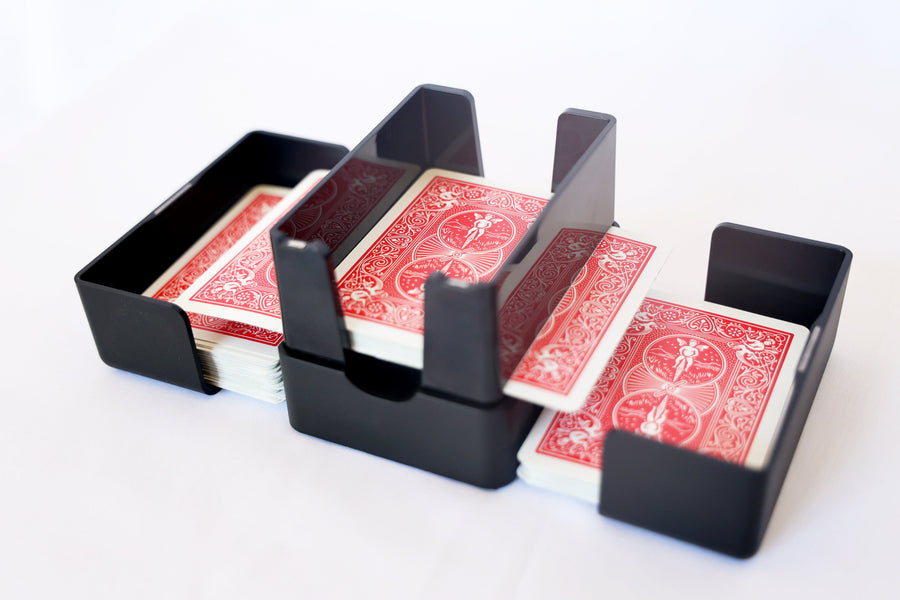
The one these guides keep pointing to
Lotus Card Shuffler V2
TheTabletopFamily’s Best Overall pick. V2 scored 24/25, first of the 8 distinct models they bench-tested from 13 shufflers bought. Two decks, no buttons. Pre-order ships October.
$89.00 Free US shipping
Pre-order V2