
The Card Shuffler Gift Guide: Who Plays Every Week
The short answer
A card shuffler makes a good gift for someone who plays cards every week: the game night host, the grandparent who keeps the canasta table going, the UNO family, the home poker group. The one deck it is not built for is a sleeved deck. The deciding question is which deck they use, so ask before you buy.
The Lotus V2 is $89 with free US shipping. It is in stock, and orders ship within one business day.
Lotus V2 starts with one touch and runs an inverse riffle. You load the whole deck into the center tray, the rollers deal it card by card into two piles, and you restack the piles between passes.
Why a card shuffler works as a gift
A shuffler lives on the card table and comes out every time the deck does, so a weekly card night puts it to work all year.
Lotus needs no app, account, pairing or charger. A standard 9V battery comes in the box, and the first pass takes one touch.
Anyone at the table can start a pass with a fingertip, so the shuffle stops being one person's job.
Match the gift to their card table
The person who hosts game night
Lotus sits on the table and folds shut with the cards inside when play is over. One touch starts each pass. The motor and cards are audible, but it runs quiet enough to talk over. The player gathers and reloads the cards between passes. The quiet card shuffler guide covers the sound in more detail.
Grandparents and players who find hand shuffling difficult
For a grandma or grandpa with a weekly canasta, bridge or rummy table, the touch sensor starts the machine without pressing a button. The rollers perform the riffle, so the player does not need to bend and release the deck by hand. They still need to load the cards, pick up both piles and restack them. Consider those movements when choosing it for someone with limited hand movement. The card shuffler guide for seniors goes further on what to check.
UNO families and canasta groups
Lotus lists a standard 112-card UNO deck and a 108-card canasta load as compatible, each loaded whole. A 108-card Phase 10 deck also fits. Standard Skip-Bo cards fit, but the 162-card deck needs two loads. Check the compatibility table for the game and edition they own, and the UNO card shuffler guide if UNO is the main game.
Home poker players
For a boyfriend, husband or dad who hosts poker night, V2 holds up to two standard poker-size decks, 104 bare cards. Lotus recommends about three passes for casual home play and about seven for near-random mixing of a standard 52-card deck. Each pass takes about five seconds of machine time, plus time to restack and reload. The setup guide shows the sequence, and the poker card shuffler guide covers the home game.
Ask which deck first
Lotus is the wrong gift for a Magic: The Gathering or Lorcana player whose cards live in protective sleeves. Most sleeves make a deck too wide for reliable feeding, so Lotus is not recommended for sleeved decks. The sleeved cards guide explains the fit.
Oversized cards, tarot included, do not fit. Unsleeved poker-size cards are the reference fit. Bridge-size decks vary by finish: Bicycle bridge cards feed well, while smoother or glossier decks can slip.
Lotus ships to the US, Canada, Australia, New Zealand and Japan.
What $89 buys
- The shuffle: an inverse riffle. Soft rollers deal the deck card by card into two piles, about five seconds of machine time per pass.
- Capacity: two standard poker-size decks, 104 bare cards, with 108-card canasta and Phase 10 decks and the 112-card UNO deck loading whole.
- Controls: one touch sensor starts each pass, and a second sensor inside reads whether one deck or two is loaded, so there is nothing to select.
- Storage: a clamshell body that folds shut with the cards inside.
- Power: a removable standard 9V battery, included. Rated for 500+ shuffles per battery.
- Shipping and warranty: free US shipping and a one-year warranty against manufacturing defects.
Lotus is designed to limit card wear, but any powered shuffler can wear cards, especially when cards are damaged or feed poorly. Use a compatible deck and follow the setup instructions.
What reviewers tested
The Tabletop Family rated the Lotus V2 24/25 and named it Best Overall among the 8 distinct models they bench-tested from 13 shufflers. Lotus supplied its review units. Their article describes the test and scores.
Dale Yu reviewed the V2 for Opinionated Gamers on October 9, 2026 and rated it I love it. Chris James reviewed it for Casual Game Revolution in September 2026. Ryan Gutowski of One Board Family ran more than 30 different decks through it over two weeks. Lotus supplied each of those units.
The New York Post put the V2 in its 2026 list of Christmas gifts for a boyfriend, under Best for Boys Night. The Post may earn a commission on orders placed through its links.
Every piece is linked from the press page. The best card shufflers guide covers how automatic shufflers differ.
The fit at a glance
| The person you're buying for | Good fit? | What to check |
|---|---|---|
| Hosts a regular game night | Yes | About five seconds a pass; you restack between passes |
| Grandparent, or finds hand shuffling difficult | Often | One touch starts it; loading and restacking stay manual |
| UNO family | Yes | The standard 112-card deck loads whole; check special editions |
| Canasta or Phase 10 group | Yes | 108-card decks load whole |
| Home poker group | Yes | Up to two decks, 104 bare cards |
| Bridge player | Usually | Bicycle bridge cards feed well; glossy decks can slip |
| Skip-Bo player | Yes, in two loads | The 162-card deck exceeds two-deck capacity |
| Magic, Lorcana or other sleeved decks | No | Most sleeves make the deck too wide to feed |
| Tarot or other oversized cards | No | Larger than poker-size |
Shipping and returns for a gift
- Shipping: Free shipping to US addresses. Canada, Australia, New Zealand and Japan go by DHL Express, with duties and taxes paid at checkout. Check the delivery estimate on the product page before choosing Lotus for a birthday, holiday or other deadline.
- Return window: Contact Lotus within 30 days of delivery to request a return. The clock starts when the order is delivered, not when the gift is opened. Buying early does not extend that window.
- Trying it: Opened and tried units are eligible. Include the original packaging and proof of purchase. Lotus provides a prepaid return label and pays return shipping on US and Canadian orders, with a full refund once the returned product is received. See the refund policy for full terms.
- Warranty: One year against manufacturing defects.
For a question about a particular deck or gift order, contact info@play-lotus.com.
Gift questions
Is a card shuffler a good gift?
For someone who plays cards every week, yes. It comes out every time the deck does, Lotus needs no app or charger, and anyone at the table can start a pass with one touch. Ask which deck they use first: Lotus is not recommended for sleeved decks, and oversized cards do not fit.
Who is a card shuffler a good gift for?
Game night hosts, grandparents who keep a regular card table, UNO families, canasta and Phase 10 groups, and home poker players. Lotus is not recommended for sleeved decks.
Is it suitable for someone who finds hand shuffling difficult?
The machine performs the riffle after a light touch. Loading, restacking and reloading remain manual. Check that the recipient is comfortable with those steps.
Does one touch complete the whole shuffle?
One touch runs one pass. Restack the two piles and reload for the next pass. Lotus recommends about three passes for casual home play.
Will it work with their UNO deck?
The standard 112-card UNO deck is a confirmed fit and loads whole. Special editions can differ in size and finish, so check the edition against the compatibility guide.
What if they play Magic: The Gathering?
Most sleeves push the deck outside the feed channel, so we do not recommend buying a Lotus for a sleeved deck. Ask which deck they play before you buy.
Does it need charging or an app?
Neither. It runs on a removable standard 9V battery, included in the box and rated by Lotus at 500+ shuffles. There is no app, account or pairing.
Can a gift bought early be returned after Christmas?
The return request must be made within 30 days of delivery. The window does not restart when a gift is opened. Check the delivery timing and return policy before buying early.
Is a card shuffler a good gift for a boyfriend or husband?
If he hosts poker night or a weekly card game, yes. V2 holds two standard poker-size decks, and one touch starts each pass. The New York Post listed it among its 2026 Christmas gifts for a boyfriend.
Is a card shuffler a good gift for grandma or grandpa?
For a grandparent with a weekly canasta, bridge or rummy table, yes. A 108-card canasta load goes in whole, and a light touch starts the pass. Loading and restacking stay manual, so check that they are comfortable with those steps.
Is a card shuffler a good gift for a poker player?
For a home game, yes. V2 takes up to two standard poker-size decks, 104 bare cards, with nothing to select: a sensor reads whether one deck or two is loaded.
Is a card shuffler a good gift for someone who loves board games?
It suits the games in their collection that use unsleeved poker-size cards, and UNO, Phase 10 and Skip-Bo. Most sleeved decks are too wide to feed, so ask whether they sleeve their cards.
For someone who finds hand shuffling difficult, the low-grip shuffling guide covers hand techniques first, then when a machine is the better answer.
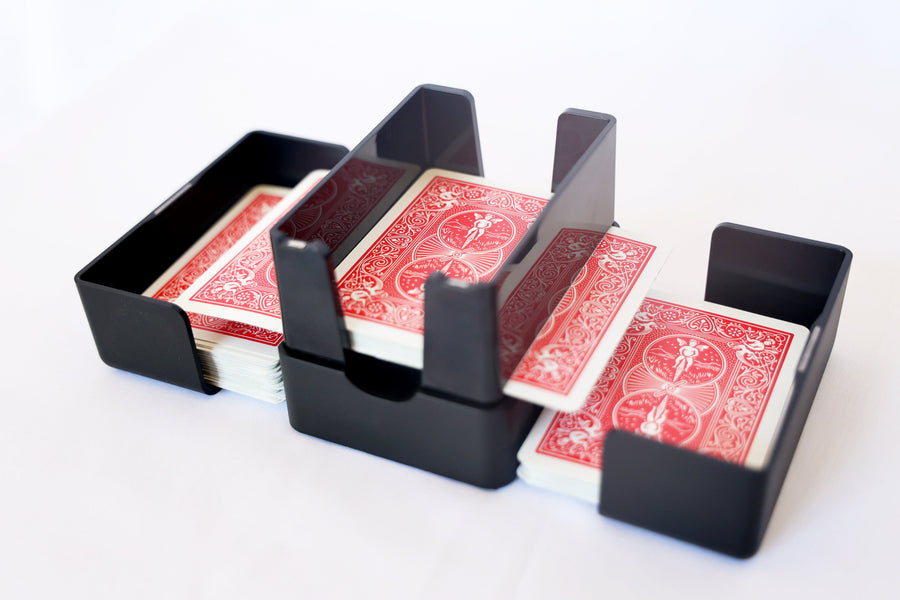
Product photo shows the original Lotus V1.
The one these guides keep pointing to
Lotus Card Shuffler V2
The Tabletop Family rated the Lotus V2 24/25, their Best Overall among the 8 distinct models they bench-tested from 13 shufflers. Lotus supplied its review units.
$89.00 Free US shipping
Order Now