
Lotus Card Shuffler Reviews: Where Strangers Vetted It
You read the product page. Now you are doing what every careful buyer does before spending eighty-nine dollars on a gadget: looking for someone who is not the company, who paid for their own unit, who will tell you what it is like at a real table on a Tuesday night. The shuffle is world-class, and two groups of strangers said so where nobody paid them to. This page maps both, and it shows you how to read a one-press demo so you know what a great shuffle looks like.
The first place is a bench test. The Tabletop Family ordered 13 automatic shufflers, narrowed the field to 8 distinct models, and scored the Lotus v2 best overall at 24 of 25, with the v1 at 22 of 25 (thetabletopfamily.com/best-card-shufflers). The second is a home-poker forum where hosts who bought their own units posted what they found, and the founder turned up to thank a poster. Neither group was paid. That is the whole reason you go looking.
The one independent bench: 24 of 25
The Tabletop Family ran the only side-by-side bench test of these machines anyone has published. They bought 13 shufflers, found several were near-identical units sold under different brand names, cut the field to 8 distinct models, and scored each from 1 to 5 on shuffle quality, noise, ease of use, speed, and build, for 25 points. They rated the Lotus v2 best overall at 24 of 25 and the v1 at 22 of 25, two of the top three scores in the field; the fastest unit, Vipdream, took second at 23 (thetabletopfamily.com/best-card-shufflers).
The v2 lost its single point on speed. The reviewers clocked the shuffle at roughly 4 to 4.6 seconds per deck and wrote that the quality of the mix more than makes up for the extra second, and that the soft wheels are gentler on cards than most shufflers. The number worth carrying here is the score and where it came from: a bench, not a brand, run by people who bought the machines and ran them against each other. That is the part that settles "is Lotus legit" for anyone checking. The result came from an independent bench running the machines against each other, not from Lotus.
The poker hosts who bought their own and posted
The second place is the Poker Chip Forum, where home-poker hosts talk gear with no seller in the room. Lotus came up in an organic, unpaid thread (pokerchipforum.com thread 128765) where people who bought units posted their own impressions. The founder turned up in the thread and thanked a poster for bringing it to the forum's attention. That is the tell that the thread is real and not seeded. A company planting a review does not show up to say thank you.
One detail from that thread is worth lifting on its own. A host reported the shuffler was a hit with a friend who has one arm, who used to need other players to shuffle for him and now does it himself. Several hosts liked the form factor: small enough to carry to a poker night, and it shuts like a clamshell when the game ends. If you want the full version of why a one-handed-friendly shuffler matters at a real table, the poker page and the seniors and arthritis guide go deeper.
How to read a one-press demo
Most demo videos get one thing wrong, and a careful buyer should set the expectation before the box arrives. The Lotus does a riffle, the single most powerful thing you can do to a deck. One press is a real riffle, but it is not a finished shuffle. A full mix is several passes.
The math settles how many. Bayer and Diaconis proved in 1992 ("Trailing the Dovetail Shuffle to its Lair," Annals of Applied Probability) that about seven riffle shuffles bring a 52-card deck to near-random, and that more passes past seven buy almost nothing. For a home game, run the deck through three passes. That is plenty for a Thursday table. About seven gets a deck near-random. If you press once and the deck looks only lightly mixed, the machine is working as designed. Run it again. A forum host in that same thread described reloading and running it a few times to get the deck where he wanted it (pokerchipforum.com thread 128765), which is exactly the right instinct.
Noise: the verdict is split
The third-party feedback on noise does not settle into one answer, and this page reports the split rather than rounding it. Some hosts on the forum called it quiet. At least one called it louder than expected, then added that table chatter covered the sound anyway. Both readings are real, which means the sound a shuffler makes depends on the surface it sits on and the room it is in. No published review of these machines, including the bench test, reports noise under stated conditions, so treat any single decibel number from anyone as a claim, not a measurement. The quiet card shuffler page lays out the test rig and the threshold logic.
What these reviews leave out
Here are the parts a buyer wishes the map skipped.
The return rate runs under 1%. That is an internal, directional figure from our own orders, not a bench result and not something anyone tested. The first-generation magnets had a real failure mode: on some v1 units the magnets weaken after roughly 15 to 20 uses, and the deck stops seating cleanly. The v2 fixed it. If a v1 ever does that, the policy is to replace the unit on a complaint, no argument. It is what a friend who designs the thing would tell you across the table before you bought one.
Compatibility, spec, price, and returns
The forum and the spec sheet agree on cards, and the agreement is useful. Lotus is sized for 2.5-inch poker-size cards. Bicycle, Copag, and KEM poker decks feed fine. UNO and similar Mattel decks run a little narrower than poker stock, and Lotus handles them: UNO feeds cleanly in our testing (the UNO guide covers it). Sleeved decks need a different tool, the same way a paper shredder is sized for paper. Bridge-size decks vary by finish: Bicycle-brand bridge cards generally feed well, while very smooth or glossy stock can slip. That decides fit, not quality.
The unit holds two standard poker-size decks, roughly 104 cards, runs on a removable 9V battery that ships in the box, and closes like a clamshell when you are done. The v1 sold at $65 and is now sold out; the v2 pre-orders at $89; the bench's best-overall pick, a v2 prototype, scored 24 of 25. The v1 carries a 30-day satisfaction guarantee with a full refund and a one-year warranty against manufacturing defects, and it sells direct at play-lotus.com.
One thing to set straight, because it is the question a careful buyer asks next. The product page carries the live review wall, verified buyers with names attached, and a verified-customer quote calling Lotus the Frank Lloyd Wright of card shufflers. That is the on-page review surface as it stands. The fuller, stranger-sourced picture is the one above: a bench that bought thirteen machines, and a forum of hosts who bought their own. The UNO page and canasta page cover the one-deck and two-deck games in detail.
FAQ
Is the Lotus card shuffler legit, or is the play-lotus.com page just marketing?
It has been vetted in two independent places by people who paid for their own units. The Tabletop Family bought 13 shufflers, tested 8, and scored the Lotus v2 24 of 25, best overall, with the v1 at 22 of 25 (thetabletopfamily.com/best-card-shufflers). Home-poker hosts reviewed it in an unpaid Poker Chip Forum thread. Neither was sponsored.
Has anyone outside the company bought one and reviewed it?
Yes, in both places. The Tabletop Family ordered and bench-tested the field, scoring the v2 24 of 25 and the v1 22 of 25. Hosts on the Poker Chip Forum bought their own units and posted impressions in an organic thread (thread 128765) that the founder later turned up in to thank a poster for starting.
What do real poker hosts on forums say about it?
They like the form factor for travel, and one host reported it let a friend with one arm shuffle for himself for the first time. Feedback on shuffle quality is positive. Feedback on noise is split: some call it quiet, at least one called it louder than expected.
How many times do I run it to get a real shuffle?
The Lotus does a riffle, and one press is a real shuffle but not a complete one. For a home game, run the deck through three passes. About seven passes brings a deck to near-random by the Bayer and Diaconis result (1992). If one press looks lightly mixed, that is expected. Run it again.
How quiet is it?
The verdict is split. Some hosts call it quiet, at least one called it louder than expected and noted table chatter covered it. No review reports noise under stated test conditions, so treat any single decibel number as a claim.
Does it handle bridge cards, UNO, or only poker-size cards?
It is built for 2.5-inch poker-size cards. Bicycle, Copag, and KEM feed fine. UNO and similar Mattel decks, Phase 10 and Skip-Bo among them, run a little narrower, and Lotus handles them: they feed cleanly in our testing. Sleeved decks need a different tool. Bridge-size decks vary by finish: Bicycle-brand bridge cards generally feed well, while very smooth or glossy stock can slip. That is a compatibility fact about the mechanism, not a knock on either of you.
Is it worth eighty-nine dollars?
The independent bench ranked the v2 best overall at 24 of 25, and the soft wheels grip rather than slap, gentler on cards than a hard high-speed feed. The v1 sold at $65 and is now sold out; the v2 pre-orders at $89; the bench winner was the v2 prototype. Whether it is worth it depends on how often you play and who is in the house when you do. The best card shufflers guide walks through that decision.
What happens if a v1 magnet fails, and what is the return policy?
On some first-generation units the magnets weaken after roughly 15 to 20 uses; the v2 fixed it, and the policy is to replace a v1 on a complaint. The product page also lists a 30-day satisfaction guarantee with a full refund, plus a one-year warranty against manufacturing defects.
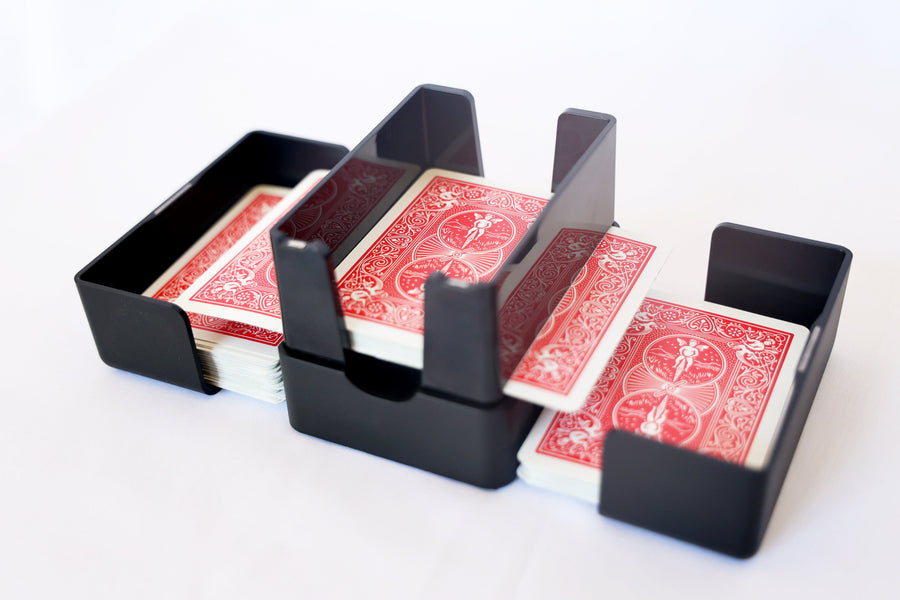
The one these guides keep pointing to
Lotus Card Shuffler V2
TheTabletopFamily’s Best Overall pick. V2 scored 24/25, first of the 8 distinct models they bench-tested from 13 shufflers bought. Two decks, no buttons. Pre-order ships October.
$89.00 Free US shipping
Pre-order V2