
Lotus and Casino-Grade Shufflers: Two Machines, Two Jobs
A casino shuffler and a Lotus run seven times reach the same place: a deck mixed past the point where another pass would matter. The casino paid for speed and for the tamper-proofing a card room needs. You paid for the table. The rest of this page is the evidence for that sentence: what the in-table machines are built to do, what a home game needs from a shuffle, and where the Lotus V2 at $89 fits.
The standard is the same at every price
A shuffle has one job, and the mathematics has already measured it. Dave Bayer and Persi Diaconis showed in 1992 that about seven riffle shuffles bring a 52-card deck to near-random, and that further riffles buy almost nothing (Trailing the Dovetail Shuffle to its Lair, Annals of Applied Probability). Near-random means each of the 52! possible orders, roughly 8 followed by 67 zeros, is about as likely as any other. Uniform is uniform. No machine at any price produces a more random deck than that, because there is no such thing.
The question for any shuffler is not what it cost. It is how many passes it takes to get there, and whether the maker tells you. A Lotus runs one true riffle per pass: the deck drops into one center tray, soft silicone rollers deal it card by card into two piles, and you restack. Three passes suit a game night. About seven reach near-random. We print those numbers because the mathematics does.
The published study of a casino shelf shuffler makes the same point from the other side. In 2013, Persi Diaconis, Jason Fulman and Susan Holmes analyzed a ten-shelf casino shuffler at its manufacturer's request and found that a single pass left the deck short of random. Their advice was to run it through the machine twice (Analysis of casino shelf shuffling machines, Annals of Applied Probability). Passes decide the shuffle. Price decides everything else.
What a casino machine is built for
The shufflers in casino poker rooms live inside the table, run on wall power, and shuffle one deck while the current hand plays out, so the dealer never stops dealing. In a room where the house earns on every hand, that speed is the product. The second product is security. The current version of the in-table shuffler widely used in casino poker rooms reads every card with an internal camera to verify that a complete deck came back. Security researchers at IOActive documented that in 2023, when they showed how the camera could be turned against the game (IOActive's white paper; our rigging guide covers the stories). These machines are regulated equipment, rented to card rooms on service contracts rather than sold at retail (the 2013 paper above describes the arrangement), and a new one is priced at about $10,000 (Bloomberg, October 2025).
None of that is a judgment on the machines. It is a list of what a card room pays for: dealer throughput and game protection, in hardware mounted in a table and running all night for years.
What a home game needs
Strip away the card room's threat model and the list gets short.
- A shuffle nobody argues with. Three riffle passes for a casual game, about seven to reach near-random. That standard settles table disputes, and it is the same standard a casino machine is measured against.
- Quiet enough to talk over. Game night is a conversation with cards in it. The shuffle should not stop it.
- No cords. Kitchen tables, folding tables and coffee tables do not have an outlet in the middle.
- Anyone can run it. A seven-year-old and a grandparent with arthritis should both be able to start it: no crank, no held button, no sequence to learn.
A home game does not need card recognition, deck verification or tamper-resistant hardware. Those protect a business from professional cheating and dealer error at scale. A Tuesday game has no camera to hack and nothing worth hacking.
Where the Lotus sits
The Lotus is built around that shorter list. The V2 is $89 with free US shipping. One touch sensor starts it, and a sensor inside reads whether one deck or two is loaded, so there is nothing to select: no buttons, no app, no pairing. It holds up to two poker-size decks loaded together, 104 bare cards, so 108-card canasta and 112-card UNO decks are inside capacity. It runs on a removable 9V battery that ships in the box, rated for 500+ shuffles, so nothing runs under the table. It is quiet enough to talk over; the quiet guide publishes the test method rather than a bare number. When the night ends it folds shut like a clamshell with the cards still inside.
The build reasoning, why soft rollers, why the cards stay inside the housing, why a touch sensor, is in our build-quality guide. The purchase carries a 30-day full refund and a one-year warranty against manufacturing defects, with free shipping to US addresses.
Side by side
| Casino in-table shuffler | Lotus V2 | |
|---|---|---|
| Price | Rented to card rooms; about $10,000 new | $89, free US shipping |
| Decks | One deck, held inside the table | Up to two poker-size decks (104 cards; 108- and 112-card decks fit) |
| Power | Wall power | Removable 9V battery, rated 500+ shuffles |
| Noise | Not measured by us, so no number | Quiet enough to talk over |
| Built for | Dealer speed and game security in a poker room | Game nights at a home table |
One deliberate gap in that table: no decibel number in either column. We have not put a meter on a casino unit, and we do not print numbers without their test conditions.
What casino money buys
A casino shuffler and a Lotus run seven times reach the same place: a deck mixed past the point where another pass would matter. The casino paid for the speed and the tamper-proofing a card room needs. You paid for the table. Casino-grade at home means paying thousands of dollars for security features no kitchen table needs, so match the machine to the job. A poker room needs throughput and game protection. A home table needs a near-random shuffle, quiet, no cords, and a start a kid or a grandparent can manage. That second list costs $89.
FAQ
What shuffler do casinos use?
Poker rooms most commonly use an in-table machine from the Deckmate line: one deck drops into a unit mounted inside the table, is shuffled while the current hand plays out, and comes back ready to deal. The design priorities are dealer throughput and security; the Deckmate 2 verifies the deck with an internal camera as it works. They are wall-powered, built for continuous duty, and leased to licensed card rooms rather than sold at retail.
Is a home shuffler as random as a casino machine?
Yes, run enough passes. Seven riffles take a deck to near-random (Bayer and Diaconis, 1992), and a more expensive machine cannot improve on uniform. The Lotus runs an inverse riffle, dealing the deck card by card into two piles that you restack; about three passes suit a casual game and about seven reach near-random. The casino unit buys speed and verification for a card room, not a more random deck.
Do I need a casino-grade shuffler at home?
No. A home game needs a near-random shuffle, which is a matter of passes rather than price, and it faces none of the threats a casino machine is built to stop: no professional cheat, no dealer error at scale, no house earning on every hand. A machine built for a card room adds wall power and a camera to a game that needs neither.
What's the best shuffler for a home poker game?
The evidence is not ours. The Tabletop Family bench-tested 8 distinct models from 13 shufflers and scored the Lotus V2 24 out of 25, their Best Overall. Lotus supplied its review units; the field, the method and the scores were theirs. The home-poker specifics, from pass counts to two-deck handling, are in our poker card shuffler guide, and the full ranked field is in the best card shufflers guide.
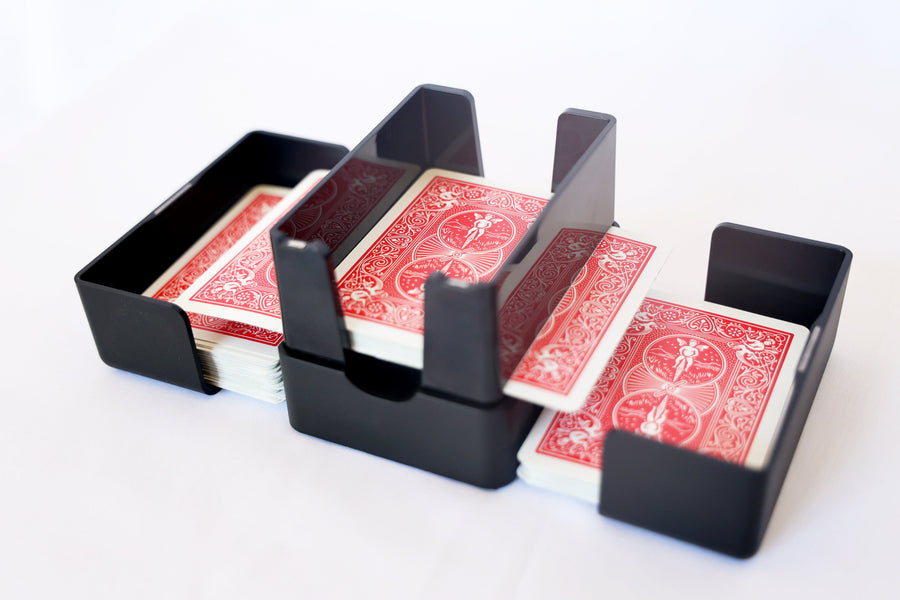
Product photo shows the original Lotus V1.
The one these guides keep pointing to
Lotus Card Shuffler V2
The Tabletop Family rated the Lotus V2 24/25, their Best Overall among the 8 distinct models they bench-tested from 13 shufflers. Lotus supplied its review units.
$89.00 Free US shipping
Order Now